Introduction
On a busy working morning, one announcement can reach a team chat three times. Someone shares a link, someone else posts a screenshot, and a third person adds a short summary from memory. All three describe the same event, yet no two of them say exactly the same thing. Meanwhile, a quieter report that matters more may have gone by without anyone noticing.
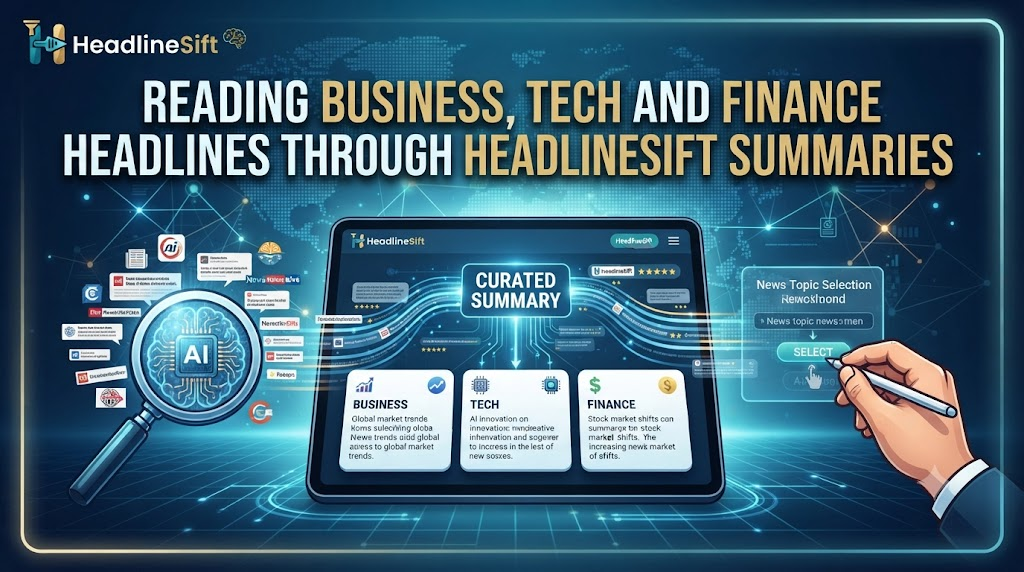
Organized news discovery tries to reduce this kind of confusion. Headlines from many publishers are collected in one place, related stories are grouped, and brief summaries show what each report is about. HeadlineSift is a platform built around that approach. It is an AI-powered service that gathers headlines from hundreds of news sources and arranges them across countries and categories.
This article explains how such a platform works, where AI summaries are useful, where they can fall short, and how readers can keep their own judgment in charge. It pays particular attention to the habits of people who follow technology, business and finance coverage for their work.
The Idea Behind HeadlineSift and the People It Helps
HeadlineSift is a news discovery service. It does not write its own reporting. It collects headlines from many publishers, uses AI to merge duplicate coverage, and orders stories according to how significant they seem. Readers can filter by country and category, and they can view the list as top ranked, latest, most covered or high impact, with options to limit results by time.
The categories include technology, business and economy, finance and stock market, health and wellness, science and space, education and careers, and breaking news.
Several kinds of readers may find this useful:
- Engineers and technical managers who track developments in their field
- Business owners who follow industry, economic and company news
- Researchers and students who keep an eye on current affairs
- Anyone who prefers a structured daily scan to endless browsing
The platform involves three separate stages, and each does a different job. Finding a story tells you that something has been reported. Reading a summary tells you what the report is mainly about. Opening the original article lets you check the evidence and the exact wording for yourself.
Each story on HeadlineSift is presented with its publisher’s name and a link to the original report. The platform also has separate pages on AI summary limits, source attribution and content removal requests. This article describes the platform only within what it states publicly.
Why Following Current Events Often Becomes a Burden
Not everyone finds the news tiring, but certain pressures are widely felt.
- The same item keeps returning. A single announcement can appear in dozens of slightly different articles.
- Headlines compress detail. “Policy update released” tells you nothing about what changed.
- Reports are revised during the day. What was true at breakfast may be corrected by the afternoon.
- Reports are hard to line up. Each publisher stresses different facts, so comparison takes time.
- Nothing signals what is urgent. When every story looks pressing, choosing where to begin is hard.
Consider an engineering manager who hears that a software vendor has changed its terms. A search brings up many pages. Most paste the same first paragraph from the vendor’s notice. Only a few explain which customers are affected and what they need to do. Finding those few is the real work.
A Closer Study of How AI-Assisted News Discovery Functions
Using AI to Collect and Group Headlines From Many Publishers
An AI news aggregator gathers headlines from many publishers and puts them into one organized view. The software can group stories by subject, location, how recent they are, or the event they describe. When several outlets cover the same development, the system can combine them so a reader sees one entry instead of a crowd of near-duplicates. HeadlineSift states that it follows hundreds of sources and uses AI to merge duplicate coverage.
A shared view should not be mistaken for independent confirmation. When a technology vendor makes an announcement, many outlets will republish its main points. Fifteen articles on one vendor statement still rest on one statement. Seeing how many sources stand behind a story is helpful, but readers should still ask whether those sources checked the facts or simply repeated them.
Turning Lengthy Reports Into Concise Points With AI
An AI news summarizer reduces a long article to its most important points. Take a detailed report on a new electronic toll system for a highway. A good summary would keep the essentials: what has changed, which highway is affected, and when the new system begins.
Such summaries let a busy reader scan many stories in a few minutes and open only those that bear on their work.
They also have known limits:
- Conditions and exceptions can be lost when text is compressed.
- Words that signal doubt, such as “proposed” or “under review,” may disappear.
- The reasons behind a decision are often cut first.
- Software can misread complicated or ambiguous wording.
HeadlineSift reflects this openly, since some stories show a note that AI analysis is still pending. A summary should be treated as a first look. When a detail will influence a decision, the original report is the right place to read it.
How Headlines Are Weighed, Ordered and Shown to Readers
Curated news headlines are chosen and arranged with intent instead of being displayed in the order they arrive. A platform may look at relevance, freshness, information about the source and the apparent significance of an event.
Significance and popularity are not the same. A rumor about an unreleased gadget can attract enormous attention in a day, while a vendor’s notice about a security patch may matter far more to those who run the software and be read by far fewer people. Attention measures curiosity. It does not measure value or accuracy.
HeadlineSift says it ranks stories by significance. The exact method is not described here, and no ranking approach can honestly claim to be free of bias. A ranked list is a sound starting filter, followed by the reader’s own decision about what to open.
Keeping Pace With Stories That Evolve During the Day
Some stories change as more is learned. After a software vulnerability is disclosed, the first report may name one product. Later reports may add other affected versions, and still later ones may describe fixes.
A breaking news aggregator lets readers see how several publishers are covering the same developing event. Placing their headlines side by side makes it easier to notice which facts appear everywhere and which appear in only one report. It cannot confirm that any report is correct, and this article makes no claim about alerts or promised update times.
A few habits help more than any feature:
- Check when a story was published and when it was last updated.
- Treat words such as “early reports” and “pending confirmation” as real signals.
- Return to the publisher’s page later and look for corrections.
- Hold off on forwarding details that rest on a single early account.
Understanding How Events Look in Different Countries
Developments in one country often reach others through trade, regulation, technology and prices. A global news aggregator helps readers see this by bringing reports from many regions into one place. HeadlineSift allows browsing by country, including India, Japan, the United Kingdom and the United States, as well as a global view.
Local conditions change how a story should be read. A new charging standard for electric vehicles in one region may look like a local matter, yet it can affect manufacturers and suppliers in other countries. A report written for a domestic audience may also assume background that outside readers lack.
No single report shows an international event in full. When the subject is serious or disputed, reading reliable publishers from more than one country gives a more balanced view.
Following Software, Security and AI News With Context
Technology coverage often places announcements, research and opinion in the same article. A technology news aggregator helps readers follow artificial intelligence, cybersecurity, software, cloud computing and devices without checking many separate sites. On its technology stories, HeadlineSift notes that product and company information may change after publication.
Four kinds of information are worth separating:
- A vendor’s announcement explains what the vendor wants known about its product.
- A research finding reports results under defined test conditions.
- An independent test shows what an outside party measured.
- Expert commentary offers informed judgment, which is still opinion.
Suppose a vendor says its new tool detects nearly all threats. That is a claim until an independent test confirms it under stated conditions. Readers who keep these types apart will weigh technology news more fairly.
Interpreting Company Announcements and Industry Movements
Business coverage includes reorganizations, leadership changes, partnerships, results and shifts across entire industries. A business news aggregator brings such reports together so readers can follow one sector or compare how different publishers describe the same announcement.
A headline rarely gives the full picture. “Company to split into two units” does not say which divisions are affected, when the change takes effect, or what reasons were given. The full article or the company’s own statement is where those answers appear.
Business reporting records what has been announced. It does not forecast what will happen. Facts should be confirmed before a view is formed, and assumptions about a company’s future should be avoided.
Reading Financial and Economic Headlines Without Overreacting
Financial news headlines may cover stock markets, interest rates, inflation, government policy, company results and commodity prices. They are written quickly and are easy to over-read.
Take a monthly inflation figure that comes in higher than before. Food prices, fuel costs, currency movements or a one-time factor could each have contributed. A headline will often point to one cause, while the real picture usually involves several.
A news summary is not personal investment advice. It cannot account for anyone’s goals, finances or comfort with risk. HeadlineSift marks its finance stories as informational only, and readers should treat them that way. No news source can promise returns or predict where a market will go.
Weighing Likely Effects Against Confirmed Facts
News impact analysis helps readers think about why an event matters and who may be affected. It is most useful when it encourages a clear set of questions:
- What has happened?
- What has been confirmed?
- Who may be affected?
- What might happen next?
- What information is still missing?
The key is to keep established facts and possible effects in separate columns. “A new energy-efficiency rating for appliances was announced” is a fact. “Manufacturers may redesign some products, and prices could change” is a possible effect. AI-generated analysis can help frame the second kind of statement, but it is an interpretation and not a certainty. HeadlineSift cannot predict outcomes, and no tool can measure the effect of every event accurately.
Building a News Routine Around Your Own Field and Interests
News is more useful when it matches what a person needs to know. A software engineer may follow security and cloud updates, a researcher may follow science and space, and a frequent traveler may watch country-level developments.
A personalized news digest is a set of stories assembled around the interests of a single reader. HeadlineSift describes this as a future direction, so it should not be treated as a current feature. For now, readers can approximate part of the benefit by choosing a country and category and returning to them regularly.
Personalization has its own risks wherever it appears. A feed built only on past choices can hide views and events a reader would want to see. It may make reading easier, but it does not remove bias and does not replace looking beyond familiar topics.
Why Credit to the Original Publisher Is Essential
Every news item has a history. It begins as a report from a newsroom, which usually carries a byline or publication credit. A summary then shortens that report for quick reading. An opinion piece may react to it, and an AI-generated explanation may offer an interpretation of what it could mean. Each layer is useful, but each one sits further from the original facts.
This is why readers should be able to see who published a story and follow a link to the full report. HeadlineSift shows the publisher’s name and links to the original report with each story, and it has a separate page on how it handles source attribution. That allows a reader to trace a claim back to where it began.
A link does not prove that a claim is true. Publishers can make mistakes, and important statements may need to be compared with other reliable reports. Naming the source makes checking possible, but it does not do the checking.
A Practical Five-Step Method for Reading News Effectively
- Choose a headline from a field you follow. Country and category filters keep the list short and relevant.
- Read the summary for the main point. This shows whether the story needs more of your time.
- Check the date and the publisher. Old stories can appear new, and unfamiliar publishers deserve a closer look.
- Compare reliable reports on important stories. Two or three sources show where reports agree and where they differ.
- Read the full article before you act. Do not decide, publish or forward based on a summary alone.
Typical Errors to Avoid With AI-Summarized News
- Taking the summary as the whole story. Use it to decide what to read, and open the report for details.
- Trusting a headline by itself. Headlines are brief by design, so check the evidence beneath them.
- Blurring analysis and fact. Ask whether a statement was reported by the publisher or produced by interpretation.
- Counting copies as confirmation. Check whether the articles share a single source.
- Overlooking dates. Confirm when a story appeared and whether later reports changed it.
- Reading finance stories as advice. News describes events. Financial decisions should reflect your own situation and, where suitable, qualified guidance.
- Forwarding unfinished reports. Wait until the main facts have been confirmed.
A Hypothetical Scenario Showing the Method in Use
Imagine Mei, an IT manager at a mid-sized company. One morning she sees a headline saying that a software vendor will end support for an older version of its product.
She reads the AI summary. It says support for the older version will end and that customers are expected to upgrade. That gives her the main point, but it does not say when support ends or what the options are.
Mei opens the original report from the publisher. The full article quotes the vendor’s notice, which gives the date on which standard support will stop. It also says the vendor will share details about migration help later. The summary had not mentioned that further details were still to come.
Next, she looks for a second reliable report on the same announcement. It confirms the date and adds that some customers may be able to buy extended support, though the vendor has not published the terms. Mei notes that both reports rely on the vendor’s notice, so the second adds context but not independent confirmation.
She can now separate what is known from what is not. The end-of-support date set by the vendor is confirmed. The terms of any extended support are not. Security risk from running unsupported software, and the cost of upgrading, are possible effects only. Mei decides to plan a review of the systems that use the older version and to watch for the vendor’s formal guidance before committing to a budget. She used the summary to save time and the original sources to stay accurate.
Answers to Common Reader Questions
Why do outlets publish the same story at different times?
Some publish at once, while others wait for confirmation or additional detail. Time zones and newsroom resources also play a part, so the earliest version is not always the best one.
How can a team share news summaries internally without spreading errors?
Include the source link, the date and a note that the text is a summary. Ask team members to confirm the original report before using the information in a decision.
Does a longer article always contain more reliable information?
No. Length shows how much was written, not how well it was checked. Look at the sources cited and whether claims can be traced to documents or named parties.
What is the difference between a correction and an update?
A correction fixes something that was wrong in an earlier version. An update adds new information as events develop. Both matter, so look for notes on the publisher’s page.
Can an AI summary be used for compliance or legal decisions?
No. Such decisions should rest on the official documents and, where appropriate, professional advice. A summary can point you to the right document, but it should not replace reading it.
Should I follow every breaking story?
Not necessarily. Follow the stories that affect your work or decisions, and check them at sensible intervals. Constant checking can add stress without adding understanding.
How can a publisher raise a concern about how its story appears?
HeadlineSift has a separate page for content removal requests and a link for reporting issues. These are the routes the platform provides for such concerns.
What is a sensible way to start with a news discovery platform?
Begin with one country and one category, and set aside a fixed time each day. Open the full reports for the few stories that matter, and widen your range once the routine feels comfortable. A personalized news digest, which HeadlineSift describes as a future direction, may someday help, but good reading habits will still apply.
Conclusion
For anyone responsible for staying current, the aim is not to read more but to read better. A single view of headlines, short summaries and direct links to the publishers can help a reader decide where to start, and a few steady habits turn that start into dependable understanding. HeadlineSift contributes by collecting stories from many outlets, offering brief AI summaries, and leaving the full reporting with the publishers who produced it. Used with care, such a platform saves time on sorting, while the reader keeps the responsibility for checking what matters and deciding what to do with it.