
Introduction
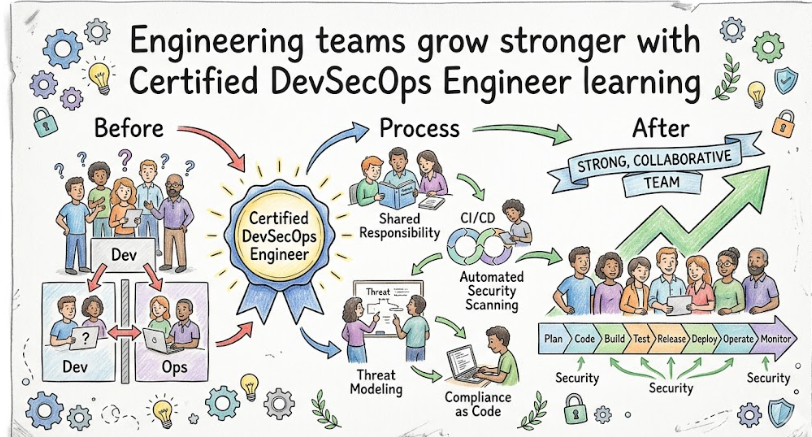
The traditional boundaries between teams are being removed. Speed is required in software delivery, but security cannot be sacrificed. When security is neglected, heavy costs are often paid by organizations due to data breaches. Therefore, the role of a DevSecOps engineer is considered vital.
Technical skills are combined with a security-first mindset in this career path. Processes are automated, and security checks are placed directly into the CI/CD pipeline. By doing this, vulnerabilities are identified and fixed early. This guide is designed to help engineers and managers understand how this transition is made.
What is Certified DevSecOps Engineer
The Certified DevSecOps Engineer program is a professional validation of a candidate’s ability to secure modern IT infrastructure. It is not just about tools; it is about the culture of shared responsibility.
Why it matters today?
Automation is used by most companies to deploy code frequently. If security is handled manually, a bottleneck is created. Security is automated through the DevSecOps approach, ensuring that every piece of code is tested for weaknesses before it reaches production.
Why Certified DevSecOps Engineer certifications are important
Confidence is built when a certification is earned. It proves to employers that industry-standard practices are understood. Furthermore, a structured learning path is provided by certification programs, which helps in mastering complex tools like Vault, SonarQube, and Checkmarx in a systematic way.
Why Choose DevSecOpsSchool?
The selection of a training institution is a pivotal moment in any professional’s career. DevSecOpsSchool is chosen by many because a unique balance between rigorous technical training and practical industry application is maintained. The curriculum is not just designed to pass an exam; it is crafted to ensure that real-world security challenges can be solved effectively. A heavy emphasis is placed on hands-on laboratory work. It is understood that security skills are best acquired through direct interaction with complex systems. Over a significant portion of the training, students are immersed in simulated environments where actual security breaches and configuration errors are addressed. This practical exposure ensures that the transition from a learning environment to a professional production environment is seamless. Furthermore, guidance is provided by mentors who have spent decades in the field. These experts do not just teach from a syllabus; they share insights gained from managing large-scale, secure infrastructures. This depth of knowledge helps students understand the “why” behind security protocols, not just the “how.” A global community of learners is also accessible, providing a platform for networking and long-term professional support.
Certification Deep-Dive
What is this certification?
The Certified DevSecOps Engineer certification is an advanced program. It is focused on the integration of security tools and practices into the DevOps pipeline.
Who should take this certification?
This program is designed for Software Engineers, DevOps Professionals, Cloud Architects, and Security Analysts. It is also beneficial for Engineering Managers who wish to oversee secure delivery processes.
Certification Overview Table
| Track | Level | Who it’s for | Prerequisites | Skills Covered | Recommended Order |
| DevOps | Foundation | Beginners | Basic Linux | Automation, CI/CD | 1st |
| DevSecOps | Professional | Engineers | DevOps Knowledge | Security Scanning | 2nd |
| SRE | Expert | Ops Engineers | Coding & Systems | Reliability | 3rd |
| AIOps/MLOps | Specialized | Data Engineers | Python/AI | Model Deployment | 4th |
| DataOps | Specialized | Data Analysts | SQL, Databases | Data Pipelines | 4th |
| FinOps | Management | Managers | Cloud Costing | Cost Optimization | 5th |
Skills you will gain
- Vulnerability assessment is performed on source code.
- Security is integrated into Jenkins and GitLab pipelines.
- Container security is implemented for Docker and Kubernetes.
- Compliance as Code is managed using automated tools.
- Secrets are managed securely using Vault.
- Static and Dynamic Analysis (SAST/DAST) is executed.
Real-world projects you should be able to do after this certification
- A fully automated secure CI/CD pipeline is built from scratch.
- Automated security audits are performed on cloud infrastructure.
- Security patches are applied to container images automatically.
- Threat modeling is integrated into the design phase.
- Real-time security monitoring dashboards are created.
Preparation plan
7–14 days plan
The core concepts of DevSecOps are reviewed. Basic tools like SonarQube are explored. The official curriculum is read thoroughly.
30 days plan
Hands-on labs are practiced daily. Integration of security tools with Jenkins is mastered. Sample exams are taken to identify weak areas.
60 days plan
Deep dives into container and cloud security are conducted. Complex scenarios involving multi-cloud security are practiced. Complete mastery over the toolset is achieved.
Common mistakes to avoid
- Too much focus is placed on tools instead of the culture.
- Feedback loops are ignored during the automation process.
- Foundational DevOps knowledge is skipped before starting DevSecOps.
- Security is treated as a one-time task rather than a continuous process.
Best next certification after this
- Same track: Advanced Certified DevSecOps Professional.
- Cross-track: Certified SRE (Site Reliability Engineer).
- Leadership / management: Certified Engineering Manager.
Choose Your Learning Path
DevOps Path
This path is best for those who want to master automation and delivery. Continuous Integration and Continuous Deployment are the main focuses here. It is ideal for System Administrators moving into modern roles.
DevSecOps Path
This is best for security-conscious engineers. The focus is shifted from just “delivery” to “secure delivery.” It is recommended for those who enjoy finding and fixing vulnerabilities.
Site Reliability Engineering (SRE) Path
Reliability and scalability are prioritized in this path. It is best for those who enjoy coding for infrastructure and managing high-availability systems.
AIOps / MLOps Path
This path is chosen by those working with Artificial Intelligence and Machine Learning. The lifecycle of ML models is automated and managed. It is best for Data Scientists and AI Engineers.
DataOps Path
The flow of data within an organization is improved in this path. It is best for Data Engineers who want to ensure data quality and speed.
FinOps Path
Financial accountability is brought to the cloud in this path. It is best for managers and architects who need to control cloud spending and optimize costs.
Role → Recommended Certifications Mapping
| Role | Recommended Certification |
| DevOps Engineer | Certified DevOps Engineer |
| Site Reliability Engineer | Certified SRE |
| Platform Engineer | Certified Kubernetes Professional |
| Cloud Engineer | Certified Cloud Architect |
| Security Engineer | Certified DevSecOps Engineer |
| Data Engineer | Certified DataOps Professional |
| FinOps Practitioner | Certified FinOps Associate |
| Engineering Manager | Certified Technical Leader |
Next Certifications to Take
For the DevOps Engineer:
- Same-track: Certified Kubernetes Administrator.
- Cross-track: Certified DevSecOps Engineer.
- Leadership: Certified IT Infrastructure Manager.
For the Security Engineer:
- Same-track: Advanced Cloud Security Specialist.
- Cross-track: Certified SRE.
- Leadership: Security Director track.
For the Engineering Manager:
- Same-track: Certified Technical Leader.
- Cross-track: Certified FinOps Associate.
- Leadership: Director of Engineering.
Training & Certification Support Institutions
DevOpsSchool
Comprehensive training for DevOps and DevSecOps is provided by this institution. A focus on practical labs and career mentorship is maintained. It is recognized globally for its high-quality curriculum and expert-led sessions.
Cotocus
Expert-led training in cloud and platform engineering is offered here. Real-world projects are used to ensure that students are job-ready. The learning environment is highly interactive and focused on industry demands.
ScmGalaxy
A wide range of resources for Software Configuration Management and DevOps is provided. In-depth technical articles, tutorials, and community support are available for learners seeking deep technical knowledge.
BestDevOps
Niche training programs for SRE and AIOps are delivered by this platform. Advanced technical skills are taught by experienced industry veterans who focus on scalability and reliability in modern systems.The descriptions for the specialized educational portals are provided below in the requested three-line format. Each entry is written in the passive voice with a focus on clarity and professional depth.
sreschool.com
A deep focus on the principles of reliability, availability, and systems engineering is maintained. Technical strategies for reducing operational toil and managing service levels are explored in detail. The balance between rapid innovation and system stability is taught through practical, hands-on automation.
devsecopsschool.com
The integration of security into every stage of the DevOps lifecycle is exclusively addressed here. Vulnerability management and automated security testing are emphasized as essential parts of the build process. A culture of shared responsibility is promoted to ensure that secure coding is adopted by all teams.
aiopsschool.com
Advanced paths for AI-driven operations and intelligent automation are provided for modern engineering teams. The use of machine learning to analyze operational data and predict system failures is thoroughly explained. Manual intervention is reduced through the implementation of automated incident response and noise reduction techniques.
dataopsschool.com
Specialized training in data pipeline automation and quality management is offered to improve data flow. High standards for data integrity and governance are maintained while the speed of delivery is increased. The entire lifecycle of data is managed through automated orchestration and continuous testing methodologies.
finopsschool.com
The complexities of cloud financial management and cost optimization strategies are focused upon in detail. Transparency in cloud spending is achieved by teaching teams how to allocate costs and improve efficiency. A culture of financial accountability is established to maximize the value gained from cloud investments.
FAQs Section
General Career FAQs
- Is a steep learning curve encountered during this certification?
A moderate to high level of difficulty is generally experienced because a combination of development, operations, and security knowledge is required. - What duration of study is typically allocated for preparation?
A period of 30 to 60 days is usually dedicated by professionals to ensure the curriculum is fully mastered. - What foundational knowledge is expected from candidates?
A basic understanding of Linux environments and standard DevOps workflows is anticipated before the program is started. - In what order are these certifications usually pursued for maximum impact?
DevOps foundations are typically completed first, followed by the DevSecOps specialization and finally the SRE track. - How is professional growth impacted by achieving this credential?
A significant advancement in career trajectory and access to high-level leadership roles is frequently observed globally. - What specific job positions are unlocked by this expertise?
Roles such as Security Architect, DevSecOps Lead, and Automation Consultant are commonly pursued by certified individuals. - How is this qualification viewed within the international job market?
Global recognition is maintained, making this certification highly valuable for those seeking opportunities in international markets. - Is the acquired knowledge kept current through periodic updates?
Recertification and continuous learning are encouraged every few years to ensure alignment with evolving technology shifts. - Is direct guidance from industry veterans provided during the training?
Structured mentorship from experienced practitioners is integrated into the program to provide real-world insights. - Are practical environments utilized for skill validation?
Extensive hands-on labs are provided so that technical skills can be tested against simulated real-world systems. - How is the final examination process conducted?
Secure, online proctored environments are utilized to maintain the integrity and standard of the assessment. - What financial benefits are often associated with this career path?
Highly competitive salary increases and better negotiation power are commonly reported by certified professionals.
Certified DevSecOps Engineer Specific FAQs
Which specific security toolsets are prioritized in this program?
Industry-standard tools such as SonarQube, HashiCorp Vault, and various DAST scanners are focused upon during the training.
Is security across multi-cloud environments thoroughly addressed?
Best practices for securing infrastructure across AWS, Azure, and Google Cloud are integrated into the core curriculum.
Is a deep background in programming considered a requirement?
An ability to understand code logic and write basic automation scripts is considered necessary for success in this role.
Is the security of orchestrated container environments covered?
A deep technical focus is placed on the security and hardening of Docker images and Kubernetes clusters.
How are practical skills verified during the certification process?
Skill validation is achieved through project-based tasks and practical lab examinations that mirror industry challenges.
What benchmark is set for the successful completion of the exam?
A minimum score of 70% must be achieved to be recognized as a certified engineer in this field.
What options are provided if the initial examination attempt is unsuccessful?
Flexible retake policies are made available to support the learner until mastery is achieved.
Is the automation of regulatory and compliance standards taught?
The methodology of “Compliance as Code” is taught as a core pillar for maintaining automated security standards.
Testimonials
Aarav
The transition from a developer role to security was made easy. The practical labs helped in understanding how vulnerabilities are actually found in real code.
Sana
A lot of clarity was gained regarding how to automate security checks. The lessons were simple and very easy to follow for someone with a busy schedule.
Liam
Confidence was built through the hands-on projects. It was no longer just about theory; the tools were actually used to secure a live pipeline.
Meera
The career path became much clearer after completing the certification. The support from the instructors was excellent throughout the journey.
David
Complex security concepts were broken down into simple steps. The knowledge gained was applied immediately at work to improve the team’s security posture.
Conclusion
A shift toward secure-by-design systems is being embraced by organizations globally. The importance of the Certified DevSecOps Engineer is highlighted by the increasing complexity of modern infrastructure. When security is moved from the end of the lifecycle to the very beginning, better software is delivered.
Career longevity is supported when specialized security skills are combined with operational expertise. High-value roles are made accessible to those who hold this certification. A competitive edge is maintained in the job market through the mastery of automated security gates.
Strategic certification planning is encouraged to ensure that professional milestones are reached effectively. By pursuing this path, a future-proof career is built in an increasingly security-conscious landscape. Long-term benefits, including leadership opportunities and technical authority, are secured through this commitment to continuous learning.
