
Introduction
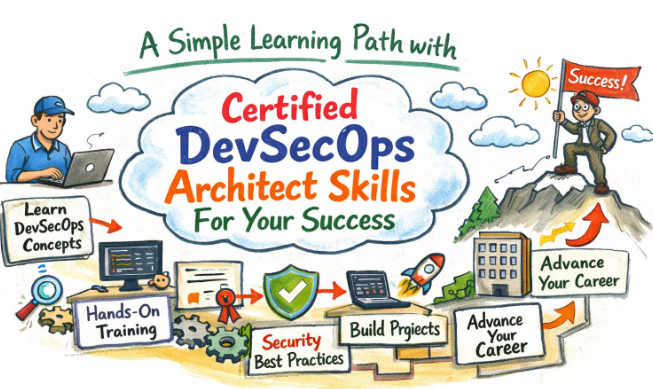
The integration of security into automated workflows is no longer just a technical task; it is a business requirement. As digital systems grow more complex, the risk of vulnerabilities expanding across the supply chain becomes a critical concern. A structured approach to defense is required to ensure that innovation does not lead to instability. The Certified DevSecOps Architect program is designed to create leaders who can build these secure foundations at scale.
Defining the Role of a Certified DevSecOps Architect
A Certified DevSecOps Architect is a specialist who designs the entire security framework for an automated software lifecycle. This role is focused on creating “golden paths” that allow developers to move fast while staying within safe guardrails. Strategic planning, risk management, and the automation of complex compliance requirements are the core focus areas for this professional designation.
Why It Matters Today
In a world where data is a primary asset, the protection of that data is a major competitive advantage. Companies that can prove their systems are secure gain more trust from customers and partners. By building security into the architecture, the cost of fixing errors is reduced significantly. An architect ensures that protection is proactive rather than reactive, preventing major issues before they can even reach a production environment.
Why Certified DevSecOps Architect Certifications are Important ?
A professional certification serves as a verified record of expertise. It demonstrates that an architect has a deep understanding of the methodologies required to protect modern cloud-native systems. For the global market, this validation is a key factor in career advancement and project leadership. It provides a standard for technical excellence that is recognized by major organizations and hiring managers.
Why Choose DevSecOpsSchool?
A focus on deep practical knowledge is maintained by DevSecOpsSchool. Students are provided with the chance to work in real-world lab environments that simulate actual industry threats. Guidance is provided by mentors who have spent their careers solving complex automation problems. Access to a global network of peers is made available, fostering a culture of continuous learning and support. Because the curriculum is built around the latest industry standards, the skills gained are always relevant to the current market. This hands-on approach ensures that an architect is prepared for the actual challenges found in high-stakes environments.
Certification Deep-Dive: Certified DevSecOps Architect
What is this certification?
This is an expert-level program focused on the design and governance of secure CI/CD ecosystems. It covers the strategic side of security automation and organizational risk management.
Who should take this certification?
This track is intended for lead developers, security engineers, and infrastructure architects. It is also highly valuable for technical directors who oversee digital transformation initiatives.
Strategic Certification Overview Table
| Track | Level | Best For | Prerequisites | Core Focus | Path Order |
| DevOps | Advanced | Senior Engineers | CI/CD Basics | Scale & Flow | 1 |
| DevSecOps | Expert | Security Leads | DevOps Foundation | Security Design | 2 |
| SRE | Advanced | Reliability Leads | System Ops | Resilience | 3 |
| AIOps/MLOps | Specialized | Data Scientists | ML/Data Basics | Model Defense | 4 |
| DataOps | Specialized | Data Engineers | Data Pipeline | Data Privacy | 5 |
| FinOps | Management | Finance Leads | Cloud Basics | Cost Governance | 6 |
Skills You Will Gain
- The design of secure-by-default automation blueprints is mastered.
- Knowledge of integrating advanced scanning tools into global pipelines is acquired.
- Compliance as Code frameworks are developed for multi-cloud environments.
- Security strategies for large-scale container clusters are implemented.
- Infrastructure as Code protection through automated policy is achieved.
- Automated vulnerability management at the architectural level is managed.
Real-World Projects You Should Be Able to Do
- A secure automation framework for a global enterprise is designed.
- A centralized system for tracking and fixing security gaps is built.
- Automated governance for cloud-native infrastructure is set up.
- Security guardrails are successfully integrated into a developer’s workflow.
- A secure-by-design software supply chain is implemented for an organization.
Preparation Plan
7–14 Days Plan The foundational concepts of security architecture are reviewed. Time is spent learning how different security tools interact within a pipeline. Small-scale labs are used to practice basic security configurations.
30 Days Plan A deeper exploration of cloud security and container defense is conducted. Each week is used to focus on a different security domain, such as network protection or identity management. Practice scenarios are used to test architectural decision-making.
60 Days Plan A full review of enterprise-grade security design is completed. Complex real-world case studies are analyzed to understand how to handle large-scale failures. Significant time is dedicated to building full-scale secure projects in a lab environment.
Common Mistakes to Avoid
- Over-focusing on specific tools while neglecting the overall security plan.
- Ignoring the human and cultural side of security adoption.
- Failing to secure the automation server and the build environment itself.
- Forgetting to set up automated alerts that reach developers in real-time.
Best Next Certification After This
- Same Track: Master of Security Automation.
- Cross-Track: SRE Master Class.
- Leadership / Management: Engineering Director Program.
Choose Your Learning Path
DevOps Journey This path is for those who want to focus on the speed of software delivery. It ensures that code moves from a developer’s machine to the customer with high quality and zero delays.
DevSecOps Journey This is the choice for security-minded professionals. It focuses on making sure that speed and safety are always balanced through automated protection.
SRE Journey This path is best for those who care about system uptime. It uses software engineering skills to ensure that systems are always available and reliable.
AIOps / MLOps Journey This is suited for data experts who want to use AI to improve how systems are managed. It covers the protection of the pipelines that feed machine learning models.
DataOps Journey This path is for data engineers who want to make their data delivery faster and more secure. It focuses on the automation of data quality and privacy.
FinOps Journey This is for people who manage cloud spending. It teaches how to get the most business value out of the cloud while keeping costs low and secure.
Role → Recommended Certifications Mapping
| Role | Primary Track | Secondary Option |
| DevOps Engineer | DevOps Professional | DevSecOps Architect |
| SRE | SRE Practitioner | Chaos Engineering |
| Platform Engineer | Kubernetes Expert | Cloud Security |
| Cloud Engineer | Cloud Operations | FinOps Professional |
| Security Engineer | DevSecOps Architect | Cloud Defense Specialist |
| Data Engineer | DataOps Certified | MLOps Architect |
| FinOps Practitioner | FinOps Lead | Cloud Cost Architect |
| Engineering Manager | DevOps Leader | FinOps for Managers |
Next Certifications to Take
For the career-focused learner:
- Same-track: Advanced Security for Containers and Kubernetes.
- Cross-track: Site Reliability Engineering Professional.
- Leadership-focused: Strategic Engineering Management.
Training & Certification Support Institutions
DevOpsSchool This institution is known for its wide range of technical programs. A focus is placed on helping engineers master the tools and strategies needed for modern software delivery. Extensive lab access is provided for every student.
Cotocus Training for digital transformation and automated governance is offered here. The programs are designed to help professionals move into senior architectural roles. A mix of technical education and strategic guidance is provided.
ScmGalaxy A large repository of tutorials and resources for automation is maintained by this platform. It serves as a community hub for continuous learning and professional networking in the field of configuration management.
BestDevOps The most important skills for technology leaders are the focus here. High-quality content and simplified learning paths are provided for complex technical subjects.
devsecopsschool.com This school is dedicated entirely to security automation. It provides deep training on every stage of the secure software lifecycle.
sreschool.com A focus is placed on the principles of reliability and system performance. It is the primary choice for those who want to keep systems running smoothly.
aiopsschool.com This school specializes in the intersection of AI and IT operations. It covers how machine learning can be used to predict and fix system issues.
dataopsschool.com Concentration is placed on the automation of data delivery and governance. It is designed for engineers who want to master data pipelines.
finopsschool.com This platform is focused on the technical management of cloud finances. It teaches how to optimize costs while maintaining performance.
FAQs Section
1. Is the exam for the architect level difficult?
The difficulty is considered high because it requires a combination of technical skills and strategic thinking for large-scale systems.
2. How much time is needed to complete the certification?
Most learners find that 4 to 8 weeks is enough time to cover all materials and prepare for the final assessment.
3. What are the prerequisites?
A strong understanding of cloud basics and DevOps pipelines is recommended before starting this advanced track.
4. What is the best sequence for these courses?
It is usually best to complete a professional level certification before attempting the architect level.
5. How does this help a career?
Holding this certification often leads to senior-level roles and much higher salary brackets in the global market.
6. What kind of jobs can be applied for?
Roles such as Security Architect, Lead DevSecOps Engineer, and Infrastructure Manager are common for graduates.
7. Is the certification recognized in India and globally?
Yes, it is highly respected by international technology firms and is valid all over the world.
8. Can technical managers benefit from this?
Yes, it provides the insight needed to build secure engineering cultures and manage high-level digital projects.
9. Is the exam taken online?
The exam is conducted through an online platform, allowing for flexible scheduling from any location.
10. Is support provided for the labs?
Yes, access to expert mentors is provided to help students through the practical project work.
11. Are cloud platforms like AWS and Azure covered?
Yes, security practices for all major cloud providers are included in the curriculum.
12. How often is the content updated?
The materials are reviewed and refreshed frequently to include the latest tools and security threats.
Additional FAQs: Certified DevSecOps Architect
1. Is coding a major part of this program?
Yes, some scripting and code knowledge are needed to automate security tests and build protection frameworks.
2. Does the course cover Kubernetes security?
Yes, the protection and management of container orchestration systems is a core part of the training.
3. What is the focus of “Shift-Left” security?
The focus is on moving security testing to the very beginning of the development cycle to catch risks early.
4. Are the projects based on real-world scenarios?
Yes, the lab projects are designed to mirror the actual problems faced by top-tier technology teams.
5. Is automated compliance part of the training?
Yes, methods for ensuring systems meet rules like GDPR and SOC2 are covered in depth.
6. What are the main tools used in the course?
A wide range of tools for scanning code, managing secrets, and securing containers is explored.
7. How is the certification delivered?
A digital certificate and badge are issued upon the successful completion of the exam and all required projects.
8. Is there a network for graduates?
Yes, access to an exclusive community of certified professionals is provided for career growth and support.
Testimonials
Arnav A whole new way of looking at security architecture was gained. My ability to lead complex projects has grown significantly after completing this program.
Kiara Confidence in building secure automation was found through the detailed labs. The transition to a senior role was made much smoother by this training.
Veer Solving real-world problems in a safe environment was the highlight of the course. The mentor guidance was truly helpful for my career progression.
Sia The simple and clear explanations of complex topics were very impressive. This certification is a great investment for any serious security professional.
Ishaan Higher-level job offers were received shortly after adding this certification to my profile. The practical depth of the course is unmatched.
Conclusion
The journey toward becoming a Certified DevSecOps Architect is a commitment to the future of software engineering. As the digital world becomes more complex, the need for visionary leaders who can design secure systems will only increase. By completing this program, a professional is not just gaining a title, but is becoming a key architect of the modern, secure web. The long-term impact on a career is significant, providing both stability and the opportunity to lead major digital transformations. Strategic growth starts with the right knowledge, and this path offers exactly what is needed for a successful future.
