
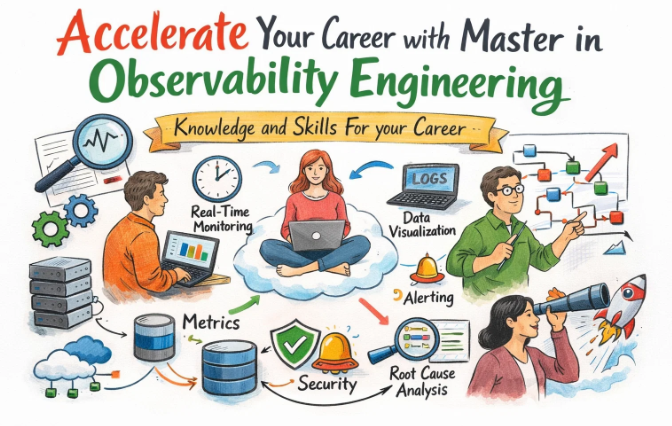
Introduction
The landscape of modern technology is often described as a vast ocean of data, where finding the root cause of a failure is like searching for a needle in a haystack. For many years, IT operations were conducted in a reactive manner—waiting for a dashboard to turn red before a problem was addressed. However, in today’s high-velocity cloud environments, a system can appear “healthy” on the surface while suffering from deep-seated performance bottlenecks that impact the end-user experience.
Observability Engineering is introduced here as the solution to this “digital blindness.” It is the practice of engineering systems that are inherently transparent, allowing every internal state to be understood through its external outputs. In this comprehensive guide, the Master in Observability Engineering (MOE) certification is examined as a transformative milestone for any technical career. The focus is shifted from merely “watching” a system to “questioning” it, ensuring that reliability is built into the very fabric of the architecture.
What is Master in Observability Engineering (MOE)
The Master in Observability Engineering (MOE) is defined as an elite certification program that focuses on the end-to-end science of system telemetry. It is a curriculum where the “three pillars”—metrics, logs, and traces—are not just studied as separate entities but are integrated into a single, cohesive visibility framework.
Within this program, the technical nuances of data collection, high-cardinality analysis, and distributed tracing are explored in great detail. The certification is designed to produce experts who can design observability backends that scale with the growth of the business. It is a journey into the mechanics of modern cloud-native systems, where data is leveraged to provide absolute certainty about system health.
Why it Matters in Today’s Software, Cloud, and Automation Ecosystem
The rise of automation and serverless technologies has made observability a core requirement for any stable environment. Several factors are identified for why this discipline is considered indispensable:
- Complexity Management: As microservices grow into the thousands, the ability to trace a single request across the entire stack is required to maintain sanity.
- Reduced MTTR: The “Mean Time To Resolution” is significantly lowered when engineers are provided with the exact data needed to pinpoint a failure instantly.
- Proactive Reliability: Instead of waiting for a crash, patterns are observed that allow for hardware or software adjustments before a failure occurs.
- Business Alignment: Technical performance is directly linked to business revenue. Observability provides the data needed to prove that a fast system leads to a happy customer.
Why Certifications are Important for Engineers and Managers
A formal validation through a program like the MOE is recognized as a vital step for professional growth in a competitive global market.
- For Engineers: A structured learning environment is provided where gaps in knowledge are filled. It ensures that the engineer is not just a “tool user” but a “system designer.”
- For Managers: A standard for hiring and team evaluation is established. Managers are enabled to build teams that speak a common language of reliability and data.
- Global Credibility: As companies in India and internationally move toward SRE models, holding a recognized certification provides a significant edge during the recruitment process.
Why Choose DevOpsSchool?
DevOpsSchool is frequently selected as the preferred training partner by both individuals and large enterprises. The training is delivered with a focus on real-world scenarios that are encountered in production environments.
- Practical Lab Sessions: Theory is always followed by extensive hands-on labs where real-world systems are instrumented and monitored.
- Expert Mentorship: Instruction is provided by seasoned professionals who have managed large-scale cloud infrastructures for decades.
- Updated Content: The curriculum is regularly updated to include the latest advancements in open-source standards like OpenTelemetry.
- Career Support: Beyond the classroom, a vast network of alumni and community resources is made available to every participant.
Certification Deep-Dive: Master in Observability Engineering (MOE)
What is this certification?
The MOE is a master-level credential that validates an individual’s expertise in designing and implementing full-stack observability frameworks. It is centered on turning raw telemetry data into actionable operational intelligence.
Who should take this certification?
This certification is highly recommended for Software Engineers, SREs, Platform Engineers, Cloud Architects, and Engineering Managers who are responsible for maintaining the health of distributed systems.
Certification Overview Table
| Track | Level | Who it’s for | Prerequisites | Skills Covered | Recommended Order |
| DevOps | Advanced | Automation Leads | Cloud Basics | Pipeline Monitoring | 1 |
| SRE | Expert | Reliability Leads | Linux/Scripting | SLOs & SLIs | 2 |
| DevSecOps | Advanced | Security Leads | Security Basics | Forensic Visibility | 3 |
| AIOps | Expert | Data Science Leads | Python Basics | Anomaly Detection | 4 |
| DataOps | Advanced | Data Architects | SQL/Big Data | Pipeline Health | 5 |
| FinOps | Advanced | Cloud Cost Leads | Billing Basics | Cost Transparency | 6 |
Skills You Will Gain
- The instrumentation of applications using OpenTelemetry is mastered.
- Distributed tracing is implemented to visualize complex request flows.
- High-cardinality metrics are analyzed to identify specific user-impact issues.
- Centralized logging systems that scale to terabytes of data are designed.
- Actionable dashboards that reflect business-critical SLIs are created.
Real-World Projects
- A comprehensive observability suite is deployed for a multi-region microservices app.
- A legacy monolithic application is instrumented to provide modern tracing data.
- A predictive alerting system is built to identify potential outages using AIOps.
- A cost-efficiency audit is performed using observability data to reduce cloud waste.
Preparation Plan
7–14 Days Plan
- Foundational Review: The core concepts of Metrics, Logs, and Traces are reviewed.
- Tooling Setup: Basic configurations for Prometheus and Grafana are practiced in a lab.
- Theory Check: The architectural differences between monitoring and observability are studied.
30 Days Plan
- Deep Instrumentation: Hands-on work is performed to instrument applications in different languages (Java, Go, Python).
- Dashboard Mastery: Advanced visualization techniques are learned to create meaningful operational views.
- Case Study Analysis: Real-world incident reports are analyzed to understand how observability was used for resolution.
60 Days Plan
- Expert Scaling: Strategies for managing observability data at scale are explored.
- Mock Certification: Multiple practice exams are taken to ensure readiness for the final certification.
- Mentor Feedback: Final sessions with mentors are used to clear any advanced technical doubts.
Common Mistakes to Avoid
- Dashboards are overloaded with too many widgets, leading to information paralysis.
- Alerts are configured without clear “next steps,” causing team fatigue.
- The cost of telemetry data is ignored, leading to unexpected cloud bills.
- Standardizing data formats across different engineering teams is neglected.
Best Next Certification After This
- Same Track: SRE Master Practitioner.
- Cross-Track: DevSecOps Professional.
- Leadership: Engineering Management & Digital Transformation.
Choose Your Learning Path
1. DevOps Path
The integration of visibility into the CI/CD pipeline is the focus here. It is ideal for those who want to ensure that every code change is tracked and validated in real-time.
2. SRE Path
The management of large-scale system reliability is the goal. This path is suited for those who are responsible for high-availability production environments.
3. DevSecOps Path
The use of observability data for security forensics is emphasized. It is perfect for professionals who want to detect security breaches through anomalous system behavior.
4. AIOps / MLOps Path
The automation of incident response through machine learning is studied. This is the future of operations for those managing massive, complex datasets.
5. DataOps Path
The health and speed of data delivery are monitored. This track is designed for data engineers who need to ensure data quality and flow.
6. FinOps Path
The financial impact of cloud operations is made visible. It is the best path for those tasked with optimizing cloud spend without sacrificing performance.
Role → Recommended Certifications Mapping
| Current Role | Primary Goal | Recommended Track |
| DevOps Engineer | Automated Visibility | MOE + DevOps |
| SRE | System Reliability | MOE + SRE |
| Platform Engineer | Internal Tooling | MOE + SRE |
| Cloud Engineer | Infrastructure Health | MOE + FinOps |
| Security Engineer | Threat Detection | MOE + DevSecOps |
| Data Engineer | Pipeline Integrity | MOE + DataOps |
| FinOps Practitioner | Cost Optimization | MOE + FinOps |
| Engineering Manager | Operational Excellence | MOE + Leadership |
Next Certifications to Take
Once the Master in Observability Engineering (MOE) certification is achieved, the journey toward technical leadership continues. The following certifications are recommended to build upon the foundation of observability:
1. The SRE Master Track (Same-Track)
The deep understanding of system visibility provided by MOE is perfectly complemented by the SRE Master program. While MOE provides the data, SRE provides the framework for acting on that data.
- Why it’s next: The concepts of Error Budgets and Toil reduction are better managed when full observability is already in place.
- Outcome: A professional becomes a “Full-Stack Reliability Architect.”
2. DevSecOps Professional (Cross-Track)
In a world where security is everyone’s responsibility, moving into DevSecOps is a logical next step. Observability data is the primary tool used for security monitoring and incident response.
- Why it’s next: “Security Observability” is a growing field. Using traces and logs to spot hackers is a high-demand skill.
- Outcome: The ability to build secure, transparent pipelines is gained.
3. FinOps Certified Practitioner (Cross-Track)
As cloud budgets grow, the ability to observe and optimize costs becomes vital. FinOps is the practice of bringing financial accountability to the cloud.
- Why it’s next: Observability tools are used to track resource utilization, which is the foundation of FinOps.
- Outcome: The professional is empowered to save the organization significant amounts of money through data-driven optimization.
4. Engineering Management (Leadership-Track)
For those moving into management, a certification in Engineering Management is recommended. This focuses on the “people” and “process” side of technical excellence.
- Why it’s next: Managing a team of observability experts requires a different set of skills than being one.
- Outcome: The transition from a top-tier individual contributor to a strategic leader is completed.
Training & Certification Support Institutions
DevOpsSchool
A global leader in technical training, DevOpsSchool provides a wide array of programs in DevOps, SRE, and Observability. A strong focus on hands-on learning and industry alignment is maintained.
Cotocus
Niche consulting and high-level technical training are the specialties of Cotocus. They are recognized for helping large enterprises implement complex platform engineering and observability strategies.
ScmGalaxy
A massive community resource for software configuration management and automation. ScmGalaxy is used by thousands of engineers for technical documentation and community support.
BestDevOps
The highest standards of DevOps practices and tools are curated here. It serves as a central hub for professionals looking to find the best training resources available.
devsecopsschool.com
A dedicated platform for all things related to security in the DevOps world. Training on how to shift security left and maintain visibility is provided.
sreschool.com
Specialized training for Site Reliability Engineers is the core mission. The principles of reliability and system stability are taught with a focus on modern cloud platforms.
aiopsschool.com
The intersection of Artificial Intelligence and Operations is explored here. Training is provided on how to build the next generation of intelligent, observable systems.
dataopsschool.com
Resources for data engineers are provided, focusing on the health, speed, and reliability of data pipelines in the enterprise.
finopsschool.com
The financial management of the cloud is the primary subject of study. Professionals are trained on how to balance performance and cost effectively.
FAQs Section
1. Is the MOE certification considered difficult for a software engineer?
The program is designed to be challenging but very accessible for anyone with a basic understanding of cloud systems and coding.
2. How much time should be dedicated each week for the 30-day plan?
It is recommended that approximately 10 to 15 hours per week be set aside for study and lab exercises.
3. Are there any specific coding languages required for this course?
While a specific language is not mandatory, a basic understanding of Python, Go, or Java is helpful for instrumentation labs.
4. How does this certification help an Engineering Manager?
Managers are provided with the data needed to make better decisions regarding technical debt and system reliability.
5. Is the certification exam conducted online or at a center?
The exam is conducted in a flexible online format, allowing professionals from all over the world to participate.
6. What is the main difference between logs and traces in the MOE curriculum?
Logs are identified as discrete events, while traces are seen as the continuous journey of a request through multiple services.
7. Can the skills learned here be applied to on-premise data centers?
Yes, while the focus is on cloud-native tools, the principles of observability are universal across all infrastructures.
8. How often is the MOE certification exam updated?
The exam is reviewed and updated annually to stay aligned with the latest shifts in the technology landscape.
9. Is there a community for students after the certification is finished?
Access to an exclusive alumni network is provided for continued learning and career networking.
10. Are group discounts available for corporate teams?
Special training packages are offered for organizations looking to upskill their entire engineering department.
11. Does the course cover specific tools like Datadog or New Relic?
The primary focus is on open-source standards like OpenTelemetry, but popular commercial platforms are also discussed.
12. Is job placement support provided by the training institutions?
Career guidance and interview preparation sessions are included as part of the overall support package.
Additional FAQs: Master in Observability Engineering (MOE)
1. What is the weightage of practical labs in the MOE program?
Approximately 60% of the program is dedicated to hands-on practical exercises to ensure real-world skill acquisition.
2. How is distributed tracing mastered in this course?
Students are guided through the step-by-step process of instrumenting complex microservices and analyzing the resulting trace data.
3. Is there a focus on the cost-efficiency of observability?
Yes, techniques for managing the volume and cost of telemetry data are a core part of the advanced modules.
4. Can this certification help with a transition into an SRE role?
The MOE is recognized as one of the best foundational steps for anyone looking to become a Site Reliability Engineer.
5. Are the mentors available for one-on-one sessions?
Dedicated mentor support is provided to help students through difficult technical concepts and project work.
6. Is OpenTelemetry the only framework taught?
While it is the primary focus, other industry-standard frameworks and historical methods are also reviewed.
7. How are “unknown unknowns” handled in the MOE curriculum?
The methodology for exploring system data to find unexpected patterns and failures is taught as a key skill.
8. Is there a final project required for the certification?
A comprehensive capstone project where a full observability platform is designed and implemented is required for completion.
Testimonials
Aditi Rao
The level of detail provided in the tracing section was outstanding. I was able to implement a full observability stack in my current project within weeks of finishing the course.
Rahul Kapoor
The practical labs were a revelation. Instead of just reading about tools, I actually built a system that helped our team reduce downtime by 40%.
Siddharth Nair
A very human-centered and expert approach was taken by the mentors. Complex cloud-native concepts were made very easy to understand.
Megha Sharma
The career mapping section was incredibly valuable. I now have a clear plan for my next five certifications and how to reach a leadership position.
Anil Deshmukh
The support from the community has been great. Even after the certification, I am still learning from the experts at DevOpsSchool.
Conclusion
The Master in Observability Engineering (MOE) certification is more than just a title; it is a commitment to technical excellence and system transparency. In a world where digital complexity is only increasing, the ability to see and understand the internal workings of a system is the ultimate competitive advantage. By pursuing this path, a professional ensures a long-term career benefit and a place among the leaders of the modern tech industry. Strategic planning, continuous learning, and a focus on visibility are the pillars upon which a successful engineering career is built.
