
Introduction
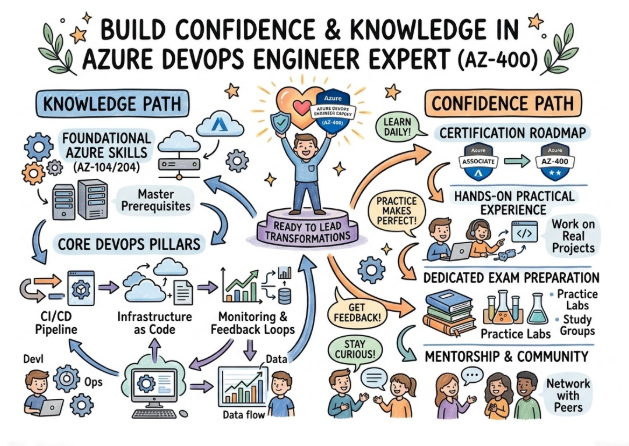
In the current era of rapid digital transformation, the role of an engineer has evolved. It is no longer enough to just write code or manage servers. The Azure DevOps Engineer Expert (AZ-400) certification is recognized as the gold standard for professionals who want to master the art of continuous value delivery.
This certification is valued because it proves that an individual can blend people, processes, and technologies to stay competitive. For software engineers and managers, certifications are seen as a commitment to excellence. They serve as a bridge between basic technical tasks and high-level architectural strategy. In markets like India and across the globe, this credential acts as a major differentiator for those seeking senior leadership or specialized technical roles.
Certification Overview Table
| Track | Level | Who it’s for | Prerequisites | Skills Covered | Recommended Order |
| Cloud Ops | Expert | Senior Tech Leads | AZ-104 / AZ-204 | Strategy, Feedback, Security, SCM | Final Step in DevOps |
Why Choose DevOpsSchool?
When preparing for a high-level exam like the AZ-400, the quality of guidance is paramount. DevOpsSchool is preferred by many because of its focus on the “Engineer’s Mindset.” Instead of just memorizing portal clicks, students are taught the “why” behind every automation strategy. The training environment is built to mimic real enterprise challenges, ensuring that every learner is job-ready from day one.
Certification Deep-Dive: Azure DevOps Engineer Expert (AZ-400)
What is this certification?
The AZ-400 is a specialized validation for experts who design and implement modern DevOps practices. It covers the entire lifecycle, from the initial code commit to final production monitoring.
Who should take this certification?
It is designed for professionals who are already proficient in Azure administration or development. It is the natural next step for those aiming for “Expert” status in the Microsoft ecosystem.
Skills you will gain
- Transformation Planning: Designing a strategy to migrate from legacy systems to DevOps.
- Compliance Automation: Ensuring that every piece of code meets legal and security standards automatically.
- Feedback Loops: Learning how to use data from users to improve the software constantly.
- Infrastructure Agility: Managing cloud resources through automated scripts and templates.
- Disaster Recovery: Building resilient systems that can recover from failures without human intervention.
Real-world projects you should be able to do
- Creation of a global deployment strategy across multiple Azure regions.
- Setup of a “Self-Healing” infrastructure that restarts services based on health signals.
- Development of a “Zero-Trust” security pipeline for sensitive financial applications.
- Automation of database schema changes within the standard application release cycle.
Preparation Plan
- 7–14 Days Plan: High-intensity review. The official exam blueprint is analyzed, and gaps in knowledge are filled using targeted documentation.
- 30 Days Plan: Balanced approach. Concepts are studied during the week, and full-length practice exams are completed during the weekends.
- 60 Days Plan: Deep mastery. Each week is dedicated to a specific domain like “Source Control” or “Instrumentation,” followed by extensive lab work.
Common mistakes to avoid
- Overlooking GitHub: Many candidates forget that GitHub features are now a massive part of this exam.
- Skipping the ‘Soft’ Topics: Questions on team structure and collaboration are often underestimated.
- Ignoring Updates: Microsoft updates this exam frequently; using old study material is a common pitfall.
Best next certification after this
- Same Track: Azure Solutions Architect Expert (AZ-305).
- Cross-Track: Microsoft Cybersecurity Architect Expert (SC-100).
- Leadership / Management: COBIT 5 or Certified Information Systems Manager (CISM).
Choose Your Learning Path
The Automation Specialist (DevOps)
This path is chosen by those who want to eliminate manual work. It focuses heavily on pipelines and release orchestration.
The Security Guardian (DevSecOps)
This route is taken by engineers who believe security is everyone’s responsibility. It centers on automated scanning and policy-as-code.
The Stability Expert (SRE)
This path is for those who value “uptime” above all else. It involves deep dives into telemetry, SLIs, and SLOs.
The Intelligence Architect (AIOps/MLOps)
This is the modern choice for those working with AI. It focuses on the reliable deployment of machine learning models.
The Data Flow Manager (DataOps)
This path is selected by data engineers who want to apply DevOps principles to big data and analytics pipelines.
The Cloud Auditor (FinOps)
This direction is for professionals who want to manage the business side of the cloud, focusing on cost transparency and optimization.
Role → Recommended Certifications Mapping
| Role | Primary Certification | Secondary/Support Certification |
| DevOps Engineer | AZ-400 | Certified Kubernetes Administrator (CKA) |
| Site Reliability Engineer (SRE) | AZ-400 | Prometheus Certified Associate |
| Platform Engineer | AZ-400 | HashiCorp Terraform Associate |
| Cloud Engineer | AZ-104 | AZ-400 |
| Security Engineer | AZ-500 | AZ-400 |
| Data Engineer | DP-203 | AZ-400 |
| FinOps Practitioner | FinOps Certified Practitioner | AZ-400 |
| Engineering Manager | AZ-900 | AZ-400 |
Next Certifications to Take
- Same-track recommendation: AZ-305 (Infrastructure Design).
- Cross-track recommendation: Google Professional Cloud DevOps Engineer (for multi-cloud skills).
- Leadership recommendation: Certified Scrum Product Owner (CSPO).
Training & Certification Support Institutions
DevOpsSchool
Detailed technical mentorship is provided here. The institution is highly regarded for its ability to transform traditional IT workers into modern DevOps experts.
Cotocus
Enterprise-grade training solutions are the hallmark of Cotocus. Their focus is on aligning technical training with actual business goals.
ScmGalaxy
Practical, community-led learning is the focus here. It is an ideal space for engineers who want to stay updated on the latest open-source tools.
BestDevOps
Accelerated learning paths are offered for busy professionals. The curriculum is designed to be concise yet extremely impactful.
devsecopsschool.com
Specialized training for the “Security-First” era is delivered here. It bridges the gap between traditional security and modern automation.
sreschool.com
Advanced training on system reliability and incident response is provided. It is the go-to source for aspiring Site Reliability Engineers.
aiopsschool.com
The future of automated operations is explored here. Students learn how to integrate AI into their existing DevOps workflows.
dataopsschool.com
Focus is placed on the efficient management of data lifecycles. It is designed for engineers who want to bring agility to data environments.
finopsschool.com
The financial impact of cloud computing is taught here. It helps teams gain full control over their cloud expenditure.
FAQs Section
- Is AZ-400 a good choice ?
Yes, the demand for expert DevOps professionals is still growing globally. - How much hands-on experience is needed?
At least two years of working with Azure is generally recommended. - Does the exam cover non-Microsoft tools?
Yes, tools like Jenkins, Ansible, and Terraform are frequently mentioned. - What is the best way to start?
Clearing the AZ-104 or AZ-204 is the mandatory first step for the Expert badge. - Is this certification useful for managers?
Absolutely, it provides the technical context needed to lead engineering teams. - Can I self-study for this exam?
It is possible, but structured training from an institution is often faster. - What is the exam format?
A mix of multiple-choice, drag-and-drop, and case studies is used. - How long does the certification stay valid?
It expires after one year but can be renewed through a simple online assessment. - Are vouchers available?
Many training institutes like DevOpsSchool provide assistance with exam vouchers. - Is Python necessary for AZ-400?
While not a coding exam, knowing basic scripting is a massive advantage. - How does this compare to AWS DevOps Engineer?
It is equivalent in difficulty and value but focused on the Microsoft ecosystem. - What is the average salary hike? Certified professionals often see a 20% to 35% increase in compensation.
AZ-400 Specific FAQs
- Is Azure Boards covered?
Yes, project management and work item tracking are key components. - What is the focus on YAML?
Understanding how to write pipelines in YAML is now a core requirement. - Are there labs in the current exam version?
Labs are occasionally included, so practical knowledge is essential. - How many points is each question worth?
The scoring is scaled, but all questions contribute to the 700-point goal. - Is containerization important?
Yes, knowledge of AKS and Docker is heavily tested. - Does it cover blue-green deployments?
Yes, various deployment strategies are a major part of the syllabus. - Is App Center included?
Mobile app delivery concepts are sometimes touched upon. - What is the best revision strategy?
Going through Microsoft’s official “Learning Paths” is a great way to wrap up study.
Testimonials
Vikram
The clarity I gained regarding CI/CD pipelines was incredible. After finishing the AZ-400 training, I was able to automate our entire release process, saving the team hours of work.
Anjali
Becoming an “Expert” felt like a huge milestone. The depth of the course helped me understand how to secure our cloud environment without slowing down development.
Rohan
This was more than just an exam for me. It was a complete shift in how I view software engineering. The focus on site reliability has made me a better engineer.
Megha
The structured learning path provided by the mentors was the key to my success. I am now much more confident when discussing high-level architecture with my clients.
Karthik
I finally understood the “Ops” in DevOps. The practical labs gave me the skills I needed to land a Senior Platform Engineer role in a global tech firm.
Conclusion
The journey to becoming an Azure DevOps Engineer Expert (AZ-400) is one of the most rewarding paths a tech professional can take. It signifies a transition from being a task-oriented engineer to a strategy-oriented expert. The long-term benefits include not just better pay, but the ability to drive real change within an organization.
By choosing a dedicated learning path and leveraging the support of institutions like DevOpsSchool, you ensure that your career remains on an upward trajectory. The time to plan your certification strategy is now.
