
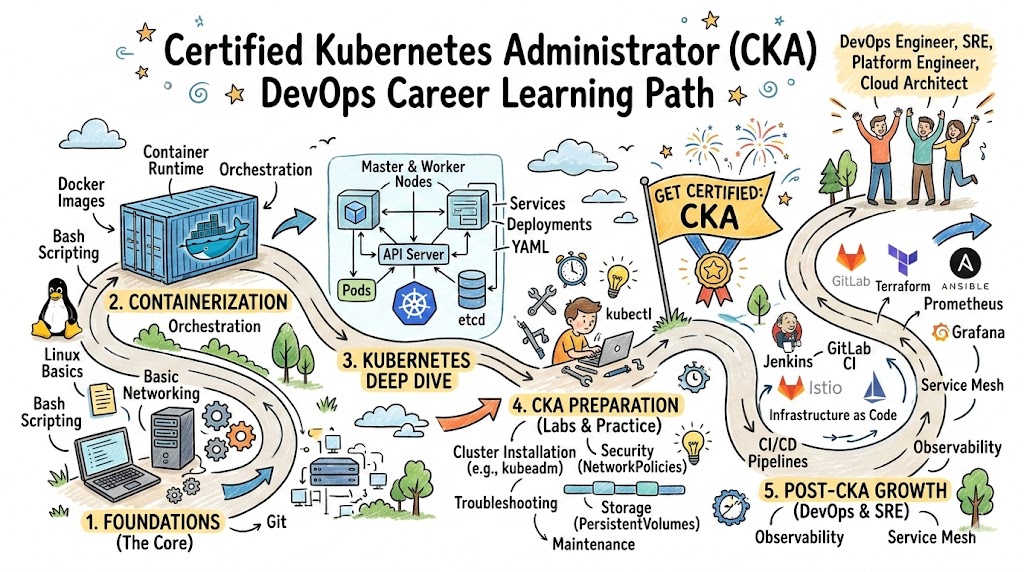
Introduction
The modern computing has been transformed by the need for scalable and resilient systems. Central to this transformation is the ability to manage complex environments efficiently. This guide is prepared to help you understand the path toward becoming a recognized expert in cluster administration through a globally respected standard.
What is Certified Kubernetes Administrator (CKA) ?
The Certified Kubernetes Administrator (CKA) is a practical, performance-based validation of technical skills. It is designed to confirm that a professional is capable of handling the day-to-day operations of a container orchestration platform. Unlike theoretical tests, the ability to solve real-world infrastructure problems is measured here.
Why it matters in today’s software, cloud, and automation ecosystem
As organizations move away from traditional hardware management, the focus is shifted toward automation and cloud-native strategies. Kubernetes has emerged as the standard for running modern applications. Understanding how these clusters are built, secured, and maintained is essential for ensuring that software is delivered reliably and at scale.
Why certifications are important for engineers and managers
By obtaining a certification, a clear signal of competence is sent to the industry. For engineers, a structured learning path is provided, ensuring that no critical knowledge gaps are left behind. For managers, the risk of system failure is reduced when teams are composed of certified individuals who follow standardized operational procedures.
Certification Overview Table
| Track | Level | Who it’s for | Prerequisites | Skills Covered | Recommended Order |
| Infrastructure Management | Professional | Engineers & Architects | Basic Linux & Networking | Setup, Maintenance, Storage, Security | After foundational cloud training |
Why Choose DevOpsSchool?
A unique approach to technical education is offered by DevOpsSchool. The gap between classroom learning and industry requirements is bridged through intensive practical sessions. Mentorship is provided by seasoned professionals who have managed large-scale environments. Comprehensive study materials and lab access are ensured so that every learner feels fully prepared for the challenges of a performance-based exam.
Certification Deep-Dive: Certified Kubernetes Administrator (CKA)
What is this certification? A hands-on assessment is conducted to verify the skills needed for cluster administration. It is focused on the core components that keep a containerized environment running smoothly.
Who should take this certification?
- Professionals managing servers and networks.
- Those responsible for cloud infrastructure.
- Engineers focused on system reliability.
- Technical leads overseeing container adoption.
Skills you will gain
- The ability to build a production-ready cluster is developed.
- Knowledge of how to manage cluster nodes is acquired.
- Deep understanding of internal networking and services is gained.
- Expertise in managing persistent data and storage is built.
- Proficiency in diagnosing and fixing cluster errors is achieved.
Real-world projects you should be able to do after this certification
- A high-availability cluster can be deployed from the ground up.
- Complex application traffic can be managed using specialized controllers.
- System updates and patches can be applied without causing downtime.
- Security policies can be enforced to protect sensitive data.
- Automated backup and recovery workflows can be established.
Preparation plan
- 7–14 days plan: A focused review of the exam domains is conducted. High-priority tasks like troubleshooting and cluster installation are practiced daily in a lab environment.
- 30 days plan: Each technical topic is explored in detail. Time is spent every day working through documentation and practicing command-line efficiency.
- 60 days plan: A comprehensive study of advanced networking and security is performed. Multiple mock exams are completed to ensure that tasks can be finished within the time limit.
Common mistakes to avoid
- Excessive time spent on theory instead of practical terminal practice.
- Forgetting to verify if the correct cluster context is being used.
- Ignoring the importance of learning how to search the official documentation quickly.
- Neglecting to practice resource creation using imperative commands.
Best next certification after this
- Same track: Certified Kubernetes Security Specialist (CKS).
- Cross-track: Infrastructure as Code certifications (e.g., Terraform).
- Leadership / management: Strategic cloud management programs.
Choose Your Learning Path
The DevOps Journey Automation and integration are the focus here. This path is chosen by those who wish to streamline the process of moving code from development to production using robust clusters.
The DevSecOps Journey Security is woven into the infrastructure layer. This path is intended for professionals who prioritize the protection of data and the hardening of containerized environments.
The Site Reliability Engineering (SRE) Journey System uptime and performance are the primary goals. This path is suited for those who use automation to manage large-scale systems and minimize manual intervention.
The AIOps / MLOps Journey Modern intelligence models are hosted on scalable platforms. This path is designed for engineers who manage the infrastructure required for data science and machine learning.
The DataOps Journey Data workflows are managed with agility. This path is selected by those responsible for the reliability and scalability of data pipelines and database clusters.
The FinOps Journey Efficiency and cost-effectiveness are prioritized. This path is for professionals who analyze resource usage to ensure that cloud spending is optimized without sacrificing performance.
Role → Recommended Certifications Mapping
| Current Role | Target Certification 1 | Target Certification 2 |
| DevOps Engineer | CKA | CKAD |
| SRE | CKA | CKS |
| Platform Engineer | CKA | Infrastructure Automation |
| Cloud Engineer | CKA | Cloud Architecture |
| Security Engineer | CKS | CKA |
| Data Engineer | CKA | Data Platform Management |
| FinOps Specialist | CKA | Financial Management for Cloud |
| Engineering Manager | CKA | Technical Strategy |
Next Certifications to Take
After the CKA is achieved, further growth is encouraged through these paths:
- Same-track: The Certified Kubernetes Security Specialist (CKS) is recommended for those wanting to master environment hardening.
- Cross-track: Certifications in multi-cloud management are suggested to broaden technical versatility.
- Leadership-focused: Advanced programs in digital transformation and engineering leadership are advised for career progression into management.
Training & Certification Support Institutions
DevOpsSchool An extensive range of training modules is provided here. Focus is placed on practical labs and real-world scenarios to ensure that technical skills are deeply ingrained. Expert guidance is available to help navigate the certification journey.
Cotocus Professional training and consulting services are delivered by Cotocus. A strong emphasis is placed on corporate readiness and the adoption of modern cloud-native practices. Specialized workshops are held to address complex infrastructure needs.
ScmGalaxy A community-driven platform where a wealth of technical knowledge is shared. Tutorials, blogs, and forums are maintained to help professionals stay updated on the latest trends in software configuration and automation.
BestDevOps Simplified learning paths are created for those entering the world of automation. Core concepts are taught in an accessible manner, making it easier for engineers to build a strong foundation in modern operations.
devsecopsschool.com Specialized education on integrating security into the development lifecycle is offered. The skills needed to protect automated pipelines and containerized applications are taught through hands-on practice.
sreschool.com The principles of system reliability and observability are the core focus. Training is designed to help professionals build resilient systems that can handle large-scale traffic with minimal failure.
aiopsschool.com The intersection of artificial intelligence and operations is explored. Programs are provided that teach how machine learning can be used to improve system monitoring and incident response.
dataopsschool.com The agility of data management is prioritized in these training programs. Best practices for building scalable and reliable data pipelines are taught to ensure high-quality data delivery.
finopsschool.com Financial accountability in the cloud is the primary subject. Training is provided to help organizations understand and optimize their cloud costs while maintaining operational excellence.
FAQs Section
General FAQs
- How is the CKA exam conducted?
The exam is performed in a remote, proctored environment using a web browser. - What happens if the exam is failed?
A free retake is usually provided if the first attempt is not successful. - Is Linux experience required?
Yes, a basic comfort level with the Linux command line is needed. - How long should one study for the CKA?
A period of 2 to 3 months is often suggested for thorough preparation. - Is the CKA better than a general cloud cert?
The CKA is more specialized and proves hands-on skills in container management. - Can the exam be taken in different languages?
Yes, several languages are supported for the exam interface. - What is the value of CKA in India?
It is highly valued by top tech firms and global consulting companies. - Is there a recertification process?
Yes, the certification must be renewed every three years to remain active. - Are there multiple-choice questions?
No, the exam is entirely made of performance-based tasks. - What is the cost of the exam?
The current pricing can be found on the official provider’s website. - Is a webcam required?
Yes, a functioning webcam is necessary for the proctoring process. - Can the documentation be used?
Access to the official Kubernetes documentation is allowed during the test.
CKA Specific FAQs
- Is cluster troubleshooting part of the exam?
Yes, a significant portion of the score is based on fixing broken clusters. - Is the control plane covered?
Yes, managing control plane components is a key requirement. - Are network policies included?
Yes, configuring communication between pods is tested. - Is storage management tested?
Yes, creating and managing persistent volumes is required. - Should Kubeadm be learned?
Yes, it is the primary tool used for cluster lifecycle tasks in the exam. - Is YAML knowledge necessary?
Yes, the ability to read and write YAML files is essential. - Can aliases be used in the terminal?
Yes, setting up aliases is a common way to save time. - Is Etcd maintenance included?
Yes, backing up and restoring the Etcd database is a task often found in the exam.
Testimonials
Kabir “A deeper understanding of how clusters function was gained. The preparation process forced me to learn the small details that make a huge difference in production.”
Meera “The transition to a cloud-native role was made possible. Confidence in managing complex networking tasks was built through the hands-on labs provided.”
Rohan “A structured approach to troubleshooting was developed. The skills acquired are used every day to keep our systems running without interruption.”
Ishani “Career growth was accelerated after the certification was earned. It provided the technical validation needed to take on more senior responsibilities.”
Amit “Reliability was improved across our entire infrastructure. The standardized methods learned during training have helped our whole team work more efficiently.”
Conclusion
The journey to becoming a Certified Kubernetes Administrator (CKA) is one of the most rewarding paths for a modern engineer. By mastering the art of cluster management, a future-proof skill set is developed. Long-term career stability and the ability to lead technical innovations are the natural results of this achievement. Strategic planning and a commitment to hands-on learning are recommended for everyone in the field.
