
Introduction
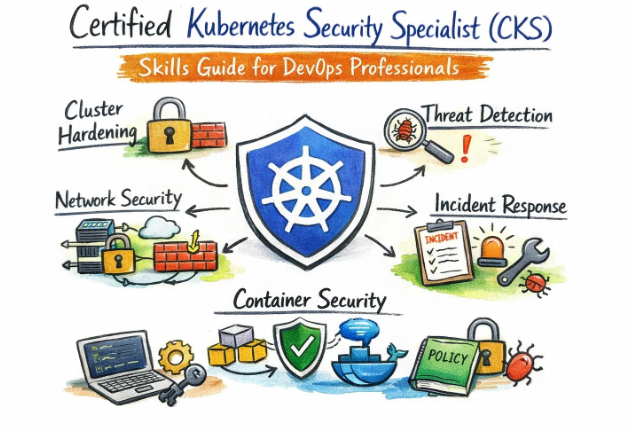
The safety of a Kubernetes cluster is built through careful planning and constant monitoring. It is not something that is achieved by accident. For those who work with containers every day, the CKS certification is seen as a way to prove that these skills are mastered. In this guide, the steps to becoming a certified expert are explained in a straightforward way.
Security is often ignored until a problem occurs. In the world of Kubernetes, the protection of data and applications is now handled as a primary task. The Certified Kubernetes Security Specialist (CKS) is recognized as a top-tier credential for those who manage these systems.
What is Certified Kubernetes Security Specialist (CKS)?
The CKS is a hands-on exam that tests the ability to secure a cluster. It is not a test of memory, but a test of skill. Tasks are performed in a real environment where security flaws must be found and fixed. The focus is placed on the entire lifecycle of an application, from the moment it is built to the moment it is run.
Why it matters in today’s software, cloud, and automation ecosystem
Infrastructure is now defined by code, which means mistakes can be copied very quickly. When a cluster is left open, the entire company is put at risk. The CKS matters because it teaches the methods used to close these gaps. By following these practices, systems are made much harder to attack. Automation is only useful if the underlying platform is kept safe.
Why certifications are important for engineers and managers
Expertise is verified through these programs. For an engineer, a certification is used to show that hard work has been put into learning a complex tool. For a manager, it is used to ensure that the team is capable of handling production-level threats. When a certificate is earned, a clear signal is sent to the market that a high standard of quality is maintained.
Why Choose DevOpsSchool?
DevOpsSchool is chosen by many because the training is rooted in actual work experience. The lessons are not just theoretical; they are based on the challenges faced in real-world clusters. Students are supported by mentors who understand the frustrations of broken pipelines and insecure configurations. The labs are designed to be practical, so that what is learned on Monday can be used at work on Tuesday. High-quality resources and a helpful community are provided to ensure that no one is left behind.
A Closer Look at the CKS
What is this certification?
The CKS is a professional-level credential for those who already know how to manage Kubernetes. It is focused entirely on the security aspects of the platform.
Who should take this certification?
This path is designed for people who have already passed the CKA exam. It is perfect for those who are responsible for the safety of cloud-native applications.
Certification Overview Table
| Track | Level | Who it’s for | Prerequisites | Skills Covered | Recommended Order |
| DevSecOps | Professional | Security Professionals | CKA Certificate | Cluster Protection | After CKA |
| SRE | Professional | Reliability Experts | CKA Certificate | Runtime Safety | After CKA |
| Platform | Professional | Infrastructure Leads | CKA Certificate | Supply Chain Security | After CKA |
Skills you will gain
- Clusters are hardened by disabling unnecessary services.
- Access is limited through the use of Role-Based Access Control (RBAC).
- Traffic is managed and restricted with Network Policies.
- Images are checked for vulnerabilities before they are deployed.
- Suspicious behavior is caught using runtime monitoring tools.
- Secrets are kept safe through encryption and proper management.
- Policies are enforced to prevent insecure containers from starting.
Real-world projects you should be able to do after this certification
- A complete security audit is performed on a live cluster.
- A policy is created to ensure that no container runs as the root user.
- A tool is set up to alert the team if a file is changed unexpectedly.
- A private registry is secured so that only signed images are used.
- Network rules are written to stop database pods from talking to the public internet.
Preparation Plan
14 Days Plan (Quick Review)
- First Half: The basics of cluster hardening and RBAC are practiced.
- Second Half: Image scanning and runtime security tools are tested in a lab.
30 Days Plan (Moderate Pace)
- Weeks 1-2: Each domain of the exam is studied one by one.
- Weeks 3-4: Mock exams are taken to improve speed and accuracy with the CLI.
60 Days Plan (Deep Learning)
- Month 1: The documentation is read thoroughly, and every command is practiced.
- Month 2: Complex scenarios are built and solved to ensure a deep understanding of the toolset.
Common mistakes to avoid
- The CKA knowledge is allowed to get rusty before starting the CKS.
- Too much time is spent on a single difficult question during the exam.
- The host security is forgotten while only focusing on Kubernetes.
- The official documentation is not used effectively as a reference.
- Practice is skipped in favor of just watching videos.
Best next certification after this
- Same Track: Certified Kubernetes Application Developer (CKAD).
- Cross-Track: AWS Security Specialty.
- Leadership: Certified Information Systems Security Professional (CISSP).
Choose Your Learning Path
DevOps
A focus is placed on making security a part of the automation process. Pipelines are built so that security checks are performed every time code is pushed. This path is best for those who want to bridge the gap between development and operations.
DevSecOps
Security is treated as the most important feature of the software. Every layer of the stack is examined for weaknesses. This is the ideal path for specialists who want to become security leaders in a cloud-native world.
Site Reliability Engineering (SRE)
Reliability is protected by ensuring that security incidents do not cause downtime. Monitoring and alerting are used to keep the system healthy and safe. This path is for those who care about both uptime and integrity.
AIOps / MLOps
Artificial intelligence models are protected within the cluster. Secure data pipelines are built to ensure that training data is never exposed. This is a growing field for those interested in the future of technology.
DataOps
The focus is shifted toward the safety of data. Databases and storage systems are secured within Kubernetes to prevent leaks. This path is suited for data engineers who work with sensitive information.
FinOps
Security is balanced with the cost of running the cloud. Tools are chosen that provide the best protection without wasting the company’s budget. This path is for those who manage the financial side of technology.
Role & Recommendation Mapping
| Role | Primary Goal | Recommended Certificate |
| DevOps Engineer | Pipeline Safety | CKS |
| SRE | System Uptime | CKS |
| Platform Engineer | Infrastructure Hardening | CKS |
| Cloud Engineer | Multi-cloud Security | CKS |
| Security Engineer | Threat Mitigation | CKS |
| Data Engineer | Data Protection | CKS |
| FinOps Specialist | Cost-Effective Security | CKS |
| Engineering Manager | Team Standards | CKS |
Next Steps for Learners
- Same-track: The Certified Kubernetes Application Developer (CKAD) is recommended to see the cluster from a developer’s point of view.
- Cross-track: The Terraform Associate is suggested to learn how to secure infrastructure from the very first line of code.
- Leadership: The CISM (Certified Information Security Manager) is recommended for those who want to move into high-level decision-making.
Where to Find Support
DevOpsSchool
A deep dive into Kubernetes security is provided here. The training is structured to help even those who are new to security feel comfortable with the material.
Cotocus
Bootcamps are offered that focus on getting results quickly. The training is designed to be intense and very practical for working professionals.
ScmGalaxy
A large collection of guides and community help is found on this site. It is a great place to find answers to specific technical problems.
BestDevOps
Clear and simple courses are provided for modern tech roles. The content is kept up to date with the latest industry changes.
devsecopsschool.com
Everything related to DevSecOps is taught here. It is a specialized site for those who want to make security their main career focus.
sreschool.com
The relationship between reliability and security is explored at this school. It is built for engineers who manage large systems.
aiopsschool.com
The use of AI in IT operations is the main topic here. Training is provided on how to keep AI workloads safe on Kubernetes.
dataopsschool.com
The focus is placed on the security of data processing. It is an excellent resource for anyone working in the big data space.
finopsschool.com
Cloud costs and security are managed together through the courses offered here. It helps in making smart financial and technical choices.
Questions and Answers
General FAQ
- Is the CKS exam hard?
The exam is considered difficult because it requires practical work rather than just picking an answer. - How long should I study?
At least one to two months is suggested for most people. - Do I need the CKA first?
Yes, the CKA must be active before the CKS can be attempted. - What is the best order for certificates?
CKA followed by CKS is the standard path. - Will this help my career?
A lot of value is added to a resume by having the CKS, as it is a highly respected credential. - What jobs can I get?
Roles like Senior DevOps Engineer or Security Architect are common for CKS holders. - Is the test taken at home?
Yes, it is taken online while being watched by a proctor. - How long does the certificate last?
It is valid for two years from the date it is earned. - What if I fail the first time?
A free retake is usually provided so that the exam can be tried again. - Are there labs in the exam?
Yes, the entire exam consists of technical labs. - Is it recognized in other countries?
It is a global standard and is recognized everywhere in the tech industry. - Is it good for managers?
Yes, it helps managers understand the risks their teams are facing.
CKS Specific FAQ
- Which security tools are used in the exam?
Tools like Falco and Trivy are often included. - Is Linux security important?
Yes, the security of the host machine is a big part of the test. - Are Network Policies tested?
Yes, the ability to write network rules is required. - Do I need to scan images?
Yes, finding vulnerabilities in images is a key skill. - Is logging covered?
Auditing and logging are both tested during the exam. - Is secret management included?
Yes, keeping sensitive data safe is a major domain. - Is the Kubernetes version old?
The exam is updated regularly to stay current with new versions. - Can I use notes?
Only specific online documentation is allowed during the test.
Testimonial
Arjun
The training provided a new way to look at cluster management. Security is now integrated into every task that is performed. It was a very helpful experience.
Meera
A lot of clarity was gained regarding the safety of containers. The hands-on labs made the difficult concepts much easier to understand.
David
The career benefits were seen almost immediately. The knowledge of runtime security has helped in protecting production workloads more effectively.
Sita
Confidence was built through the practice exams. The focus on real-world problems was exactly what was needed for the job.
Vikram
The path to certification was made very clear. The lessons were simple to follow and provided a lot of value for the daily work.
Final Thoughts
The Certified Kubernetes Security Specialist (CKS) is an important step for any professional working in the cloud. It is a way to ensure that the systems being built are not just fast, but also safe. By following a structured plan, this difficult goal can be reached.
In the long term, the skills learned through this process will serve as a strong foundation for any technical role. Security will always be a priority, and those who master it will always be in demand. Taking the time to plan and learn is the best investment that can be made in a career today.
