
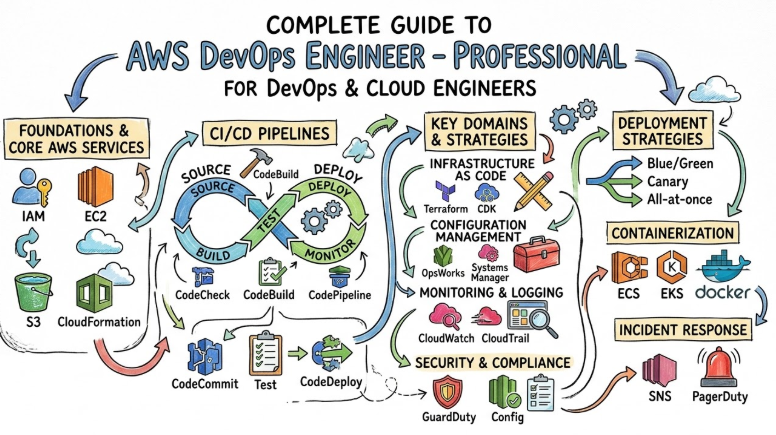
Introduction
Reliable application delivery has become one of the biggest responsibilities for engineering teams. When software is deployed across cloud environments, every deployment must be automated, monitored, and secured. If deployment pipelines fail or infrastructure becomes unstable, entire business operations can be affected.
Because of these challenges, specialized DevOps professionals are often required to design systems that can deploy applications safely and consistently. Automation pipelines must be created, monitoring systems must be configured, and infrastructure must be managed efficiently.
The AWS DevOps Engineer – Professional certification has been designed to validate advanced expertise in cloud operations and automation practices. Engineers who hold this certification are often recognized for their ability to manage complex cloud environments and implement reliable deployment workflows.
In modern cloud environments, systems are expected to remain stable even during large traffic spikes or unexpected failures. Through DevOps practices, infrastructure can be automated, monitored, and recovered quickly when issues occur.
Professional certifications help engineers demonstrate that these skills have been mastered. For organizations, certified professionals provide confidence that systems will be designed with reliability and automation in mind.
Certification Overview
| Track | Level | Who it’s for | Prerequisites | Skills Covered | Recommended Order |
|---|---|---|---|---|---|
| DevOps Engineering | Professional | DevOps engineers, platform engineers, cloud engineers | Cloud infrastructure experience and CI/CD knowledge | Infrastructure as Code, CI/CD automation, monitoring systems, operational reliability | After basic cloud or DevOps certification |
Provider: DevOpsSchool
Why Choose DevOpsSchool?
Learning DevOps concepts through structured training environments can often help professionals understand complex cloud systems more effectively. At DevOpsSchool, practical learning methods are used so that real infrastructure scenarios can be explored.
Instead of focusing only on theoretical explanations, real deployment workflows are demonstrated. Engineers are shown how automated pipelines are built, how monitoring systems are configured, and how infrastructure automation is implemented.
Hands-on exercises are usually included so that learners can practice building automation workflows themselves. This type of practical exposure helps engineers understand the challenges that occur in production environments.
Because DevOps roles require both operational knowledge and automation expertise, structured training programs can help engineers develop confidence in managing real systems.
Certification Deep Dive
What is this certification?
The AWS DevOps Engineer – Professional certification validates advanced expertise in managing and automating cloud environments. Through this certification, the ability to design reliable deployment pipelines and monitor infrastructure performance is assessed.
Operational reliability, infrastructure automation, and system monitoring are major areas covered by the certification.
Who should take this certification?
This certification is often pursued by professionals responsible for maintaining cloud infrastructure and deployment pipelines.
Recommended candidates include:
- DevOps engineers
- Cloud engineers
- Platform engineers
- Site Reliability Engineers
- Infrastructure automation specialists
Engineers working with production deployment pipelines can benefit greatly from the knowledge covered in this certification.
Skills You Will Gain
Through certification preparation, several practical capabilities are strengthened.
Important skills include:
- Infrastructure as Code implementation
- Automated deployment pipeline design
- Monitoring and logging system configuration
- Cloud infrastructure scalability management
- Security automation within DevOps pipelines
- Incident detection and response automation
These capabilities help engineers maintain reliable systems across complex cloud environments.
Real-World Projects You Should Be Able to Do
After preparing for the certification, engineers should be able to implement several real-world DevOps solutions.
Examples include:
- Designing automated CI/CD pipelines for application deployment
- Implementing infrastructure automation templates
- Creating monitoring dashboards for production environments
- Automating application rollback strategies
- Building alerting systems for infrastructure failures
These practical implementations help organizations maintain stable production systems.
Preparation Plan
7–14 Day Plan
During the early preparation stage, foundational DevOps topics should be reviewed.
Recommended activities include:
- Revisiting DevOps principles
- Reviewing CI/CD pipeline architecture
- Understanding infrastructure automation tools
- Studying monitoring and logging systems
30 Day Plan
The second preparation stage should focus on practical implementation.
Suggested preparation activities include:
- Building infrastructure automation environments
- Creating deployment pipelines for sample applications
- Configuring monitoring dashboards
- Practicing troubleshooting scenarios
60 Day Plan
The final stage should emphasize advanced operational scenarios.
Key preparation steps include:
- Designing full CI/CD pipelines for production systems
- Simulating infrastructure failures and recovery
- Implementing scalable architecture solutions
- Practicing automated rollback strategies
Common Mistakes to Avoid
Several preparation mistakes are often observed among candidates.
These mistakes should be avoided:
- Studying theory without practicing deployments
- Ignoring monitoring and logging concepts
- Avoiding real infrastructure simulations
- Underestimating troubleshooting skills
- Focusing only on exam preparation rather than practical understanding
Cross-Track Certifications
Some engineers prefer to expand into related disciplines that work closely with DevOps engineering. These cross-track certifications help professionals gain expertise in specialized areas such as security automation, system reliability, artificial intelligence operations, or data pipeline management.
These certifications are often selected because modern cloud systems require collaboration across multiple engineering domains.
Examples of cross-track learning paths include:
DevSecOps
Security automation is integrated into CI/CD pipelines. Engineers learn how vulnerability scanning, compliance automation, and security policies can be implemented directly within deployment workflows.
Key benefits include:
- Secure software delivery pipelines
- Automated security scanning
- Infrastructure security compliance
- DevOps security monitoring
Site Reliability Engineering (SRE)
Reliability engineering focuses on ensuring that systems remain stable under heavy load and unexpected failures.
Through SRE certifications, engineers gain knowledge about:
- Service reliability metrics
- Error budgets and service level objectives
- Advanced monitoring and observability
- Incident management strategies
- Production system troubleshooting
These skills are extremely valuable for engineers responsible for high-availability systems.
AIOps / MLOps
Artificial intelligence is increasingly used to improve operational monitoring and system management.
Engineers in this path learn how machine learning can be used to:
- Detect anomalies in infrastructure performance
- Predict system failures
- Automate incident detection
- Optimize infrastructure resource usage
This path is often chosen by engineers working in advanced cloud environments where operational intelligence is required.
DataOps
Data-driven organizations rely heavily on reliable data pipelines. DataOps focuses on the automation and reliability of data workflows.
Key learning areas include:
- Data pipeline automation
- Data reliability engineering
- Analytics workflow orchestration
- Data infrastructure monitoring
Engineers working with data platforms often combine DevOps knowledge with DataOps practices.
FinOps
Cloud costs can increase quickly when infrastructure is not optimized. FinOps focuses on financial governance of cloud resources.
Through FinOps certifications, engineers learn how cloud infrastructure can be optimized for cost efficiency while maintaining performance.
Important areas include:
- Cloud cost monitoring
- Resource optimization strategies
- Cloud budgeting and forecasting
- Infrastructure cost governance
FinOps knowledge is highly valued in organizations managing large cloud infrastructure environments.
Leadership and Management Certifications
As engineers gain experience, many professionals move toward leadership roles. In these positions, responsibility shifts from individual system management to team coordination and engineering strategy.
Leadership certifications are useful for engineers who want to become:
- DevOps Team Leads
- Engineering Managers
- Cloud Infrastructure Directors
- Platform Engineering Leaders
These certifications focus on topics such as:
- DevOps team management
- Engineering strategy planning
- Platform governance models
- Cross-team collaboration practices
- DevOps transformation leadership
Instead of focusing only on technical implementation, leadership programs help professionals understand how engineering teams can be organized and managed effectively.
Choosing the Right Next Certification
The best next certification should be selected based on personal career goals.
For example:
- Engineers who enjoy automation and infrastructure design often continue within the DevOps track.
- Professionals interested in system stability and reliability often move toward SRE certifications.
- Engineers focused on security and compliance usually choose DevSecOps programs.
- Professionals working with data platforms often pursue DataOps certifications.
- Engineers responsible for cloud cost optimization often explore FinOps certifications.
By choosing the right certification path, professionals can gradually develop a well-rounded skill set that supports long-term career growth.
Role → Recommended Certifications Mapping
| Role | Recommended Certification |
|---|---|
| DevOps Engineer | AWS DevOps Engineer – Professional |
| Site Reliability Engineer (SRE) | Reliability engineering certification |
| Platform Engineer | Infrastructure automation certification |
| Cloud Engineer | Cloud architecture certification |
| Security Engineer | DevSecOps certification |
| Data Engineer | DataOps certification |
| FinOps Practitioner | FinOps certification |
| Engineering Manager | DevOps leadership certification |
Next Certifications to Take
| Learner | Same Track | Cross Track | Leadership |
|---|---|---|---|
| DevOps Engineer | Advanced DevOps Architecture | DevSecOps Certification | Engineering Leadership |
| Cloud Engineer | Cloud Automation | SRE Certification | Cloud Strategy |
| Platform Engineer | Infrastructure Engineering | FinOps Certification | Platform Leadership |
| Security Engineer | DevSecOps Advanced | DevOps Certification | Security Leadership |
| Data Engineer | DataOps Certification | MLOps Certification | Data Platform Leadership |
Training & Certification Support Institutions
DevOpsSchool
DevOpsSchool provides structured learning environments where cloud automation concepts are demonstrated through real deployment scenarios. Practical exercises are often used to help engineers understand infrastructure automation and monitoring strategies.
Cotocus
Cotocus focuses on DevOps consulting and enterprise infrastructure solutions. Exposure to enterprise DevOps environments helps professionals understand real operational challenges.
ScmGalaxy
ScmGalaxy focuses on software lifecycle management practices and automation workflows. Knowledge resources help engineers understand deployment automation and version control practices.
BestDevOps
BestDevOps focuses on certification preparation and DevOps learning resources that support practical implementation of automation pipelines.
DevSecOpsSchool
DevSecOpsSchool focuses on integrating security into DevOps pipelines. Security checks are automated so that vulnerabilities can be detected early in the development process. Topics such as secure coding practices, automated security scanning, and compliance monitoring are introduced. Engineers are guided to build secure and reliable deployment workflows.
SRESchool
SRESchool focuses on the principles of Site Reliability Engineering. Reliable systems are designed by using monitoring, automation, and incident management practices. Concepts such as service level objectives and system availability are explained. Engineers are helped to maintain stable services even during infrastructure failures.
AIOpsSchool
AIOpsSchool focuses on using artificial intelligence to improve IT operations. Machine learning techniques are applied to logs, metrics, and monitoring data. System anomalies and potential failures can be detected automatically through intelligent analysis. Engineers are guided to manage large infrastructure environments more efficiently using AI-driven insights.
DataOpsSchool
DataOpsSchool focuses on improving the reliability and automation of data pipelines. Large volumes of data are processed in modern organizations, so stable data workflows are required. Practices such as data pipeline automation, data quality monitoring, and workflow orchestration are introduced. Data engineers are helped to maintain reliable and scalable analytics infrastructure.
FinOpsSchool
FinOpsSchool focuses on teaching how cloud costs can be managed and optimized effectively. Cloud spending is monitored so that unnecessary infrastructure expenses can be reduced. Concepts such as cost allocation, budgeting, and financial governance of cloud resources are explained. Engineers and finance teams are guided to make better decisions when managing large cloud environments.
FAQs
General Certification FAQs
- How difficult is the AWS DevOps Engineer – Professional certification?
Advanced operational scenarios are tested, so preparation usually requires strong DevOps knowledge. - How long should preparation take?
Preparation time depends on prior experience with DevOps tools and cloud systems. - Are prerequisites required?
Practical experience with CI/CD pipelines and infrastructure automation is recommended. - Can beginners attempt this certification?
It is usually recommended after gaining foundational DevOps or cloud knowledge. - Does certification improve career opportunities?
Certified professionals are often considered capable of managing production systems. - Is monitoring knowledge required?
Monitoring and logging systems are important topics. - Are automation tools included?
Automation tools are central to DevOps practices. - Is cloud architecture knowledge important?
Understanding cloud infrastructure improves preparation success. - Does this certification help with operational reliability?
Yes, system reliability concepts are emphasized. - Is CI/CD pipeline knowledge required?
Deployment pipeline design is a major topic. - Are troubleshooting skills tested?
Operational troubleshooting scenarios are commonly included. - Does this certification benefit engineering managers?
Managers gain deeper understanding of DevOps practices.
AWS DevOps Engineer – Professional Specific FAQs
- What is the focus of this certification?
Automation pipelines and operational reliability. - Are infrastructure automation practices included?
Infrastructure as Code is heavily emphasized. - Are monitoring tools covered?
Monitoring and observability practices are included. - Does it help with production infrastructure management?
Yes, operational troubleshooting capabilities are strengthened. - Is scalability covered in the certification?
Scalable architecture design is emphasized. - Are deployment strategies included?
Automated deployment strategies are discussed. - Is security integration included?
Security practices are integrated into deployment pipelines. - Does the certification improve cloud automation expertise?
Automation practices are significantly strengthened.
Testimonials
Deployment pipelines were finally understood in a practical way. Automation concepts became much clearer.
— Ravi K.
Monitoring systems and incident response workflows were explained clearly during certification preparation.
— Maria T.
Confidence in managing cloud infrastructure improved greatly after studying the certification topics.
— Ahmed R.
DevOps automation practices were finally connected with real infrastructure scenarios.
— Daniel L.
Production deployment strategies became much easier to understand.
— Neha P.
Conclusion
Cloud infrastructure continues to power modern digital services across industries. As organizations depend more heavily on scalable applications and reliable deployments, DevOps expertise has become increasingly important.
The AWS DevOps Engineer – Professional certification helps engineers strengthen their understanding of automation pipelines, infrastructure reliability, and monitoring systems. Through structured preparation, professionals can develop deeper insight into how modern cloud environments are designed and maintained.
Engineers who build strong DevOps capabilities are often better prepared to manage complex production systems. Strategic certification planning can help professionals strengthen their technical foundation while expanding career opportunities in cloud engineering and DevOps operations.
