
Introduction
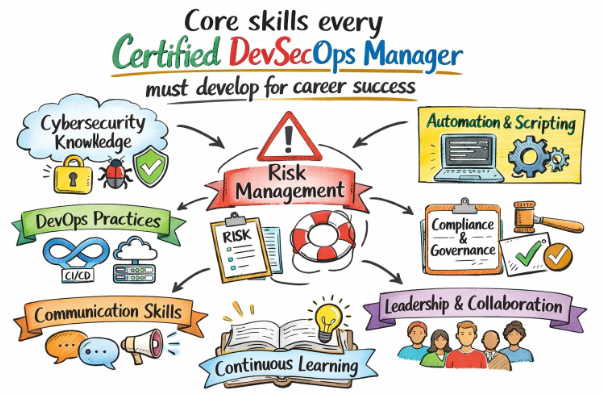
The integration of security into the development and operations cycle is a major priority for modern enterprises. Traditional methods where security was checked at the very end of a project are being replaced. Instead, security is being baked into every stage of the software lifecycle. This transformation is driven by the need for faster releases without compromising on safety.
For those in leadership or aspiring to manage technical teams, understanding how to oversee these automated security processes is vital. The Certified DevSecOps Manager designation is designed to provide the necessary skills to lead these initiatives. Through this guide, a clear understanding of the certification, the learning path, and the career growth it offers will be provided.
What is Certified DevSecOps Manager
The Certified DevSecOps Manager is a professional credential that focuses on the management and governance of security within a DevOps environment. It is not just about technical tools but also about people, processes, and policies. Leadership skills are developed to ensure that security is maintained across the entire organization.
The program is structured to help managers understand how to build a culture of shared responsibility. High-level strategies for vulnerability management, compliance, and automated auditing are taught. It is intended for those who want to lead the transition from traditional DevOps to a more secure and resilient DevSecOps model.
Why it matters today?
Security breaches are becoming more frequent and costly. Organizations are often held accountable for data leaks, which can lead to significant financial and reputational damage. Consequently, professionals who can manage security risks while maintaining the speed of delivery are in high demand.
A manager in this field ensures that security does not become a bottleneck. Instead, security is used as an enabler for better software quality. By holding this certification, a professional is recognized as someone who can align business goals with security requirements effectively.
Why Certified DevSecOps Manager certifications are important
Certifications serve as a benchmark for professional knowledge. In a competitive job market, a certified manager is often preferred over non-certified candidates because their skills have been verified by an independent body.
The importance of this specific certification lies in its focus on leadership. While many certifications focus on how to use a tool, this program focuses on how to manage the people and the strategy behind the tool. It provides a structured way to learn the best practices that are used by top-tier companies globally.
Why choose DevSecOpsSchool?
DevSecOpsSchool is chosen by many professionals due to its deep focus on practical application. The training is delivered by experts who have spent decades in the industry. Complex concepts are broken down into simple, manageable lessons that are easy to follow.
The curriculum is constantly updated to reflect the latest trends in the industry. A strong emphasis is placed on hands-on labs and real-world scenarios. By choosing this institution, learners are given access to a wealth of resources and a community of like-minded professionals who are dedicated to the field of DevSecOps.
Certification Deep-Dive: Certified DevSecOps Manager
What is this certification?
This certification is a leadership-focused program that teaches how to manage security within a DevOps framework. Strategies for team collaboration, risk assessment, and policy enforcement are covered in detail.
Who should take this certification?
Engineering managers, lead developers, and DevOps architects who are responsible for security governance should take this certification. It is also suitable for security professionals who wish to move into a management role within an automated environment.
Certification Overview Table
| Track | Level | Who it’s for | Prerequisites | Skills Covered | Recommended Order |
| DevOps | Advanced | Senior Engineers | Basic DevOps knowledge | Automation, CI/CD, Culture | 1 |
| DevSecOps | Management | Engineering Managers | DevOps experience | Security Governance, Compliance | 2 |
| SRE | Professional | Platform Engineers | System Admin skills | Reliability, Scalability | 3 |
| AIOps/MLOps | Specialist | Data Scientists | Python, ML basics | Model Monitoring, AI Analytics | 4 |
| DataOps | Specialist | Data Engineers | Data Management | Data Pipeline Security, Quality | 5 |
| FinOps | Professional | IT Managers | Finance/Cloud basics | Cost Optimization, Cloud Governance | 6 |
Skills you will gain
- Governance of security policies across automated pipelines.
- Management of risk and compliance in cloud-native environments.
- Leadership in fostering a security-first culture among engineering teams.
- Ability to implement automated security testing strategies.
- Knowledge of threat modeling and vulnerability management at scale.
- Strategic planning for DevSecOps adoption in large organizations.
Real-world projects you should be able to do after this certification
- Design a security governance framework for a multi-cloud organization.
- Implement an automated compliance monitoring system for CI/CD pipelines.
- Lead a team in the migration from manual security checks to automated DevSecOps.
- Conduct a full risk assessment and threat model for a new microservices-based application.
- Create a company-wide security training and awareness program for developers.
Preparation plan
7–14 days plan
A focus is placed on understanding the core definitions and the DevSecOps manifesto. The official curriculum is reviewed, and the basic principles of security automation are studied.
30 days plan
Deeper study is conducted into specific tools and governance frameworks. Practice tests are taken to identify weak areas. Real-world case studies are analyzed to understand how managers handle security incidents.
60 days plan
A complete review of all management strategies is performed. Hands-on labs are completed to ensure that the practical application of security tools is understood. Mock exams are used to build confidence before the final certification test.
Common mistakes to avoid
- Focusing only on tools while ignoring the cultural aspect of DevSecOps.
- Neglecting the importance of compliance and legal requirements.
- Trying to implement all security measures at once instead of using an incremental approach.
- Failing to involve the development team in security decisions.
Best next certification after this
- Same track: Advanced DevSecOps Architect.
- Cross-track: Site Reliability Engineering (SRE) Professional.
- Leadership / management: Certified DevOps Manager.
Choose Your Learning Path
DevOps Path
This path is best for those who want to master the art of continuous delivery and automation. It focuses on the foundational culture and the tools needed to speed up the software development life cycle.
DevSecOps Path
This is ideal for professionals who want to specialize in the intersection of security and operations. It is best for those who aim to protect the software supply chain through automation.
Site Reliability Engineering (SRE) Path
This path is designed for engineers who are focused on the stability and uptime of systems. It is best for those who enjoy solving complex infrastructure problems and ensuring system resilience.
AIOps / MLOps Path
This is perfect for individuals working with large data sets and machine learning models. It focuses on using artificial intelligence to improve IT operations and manage the lifecycle of ML models.
DataOps Path
This path is best for data engineers and architects. It focuses on improving the quality and speed of data delivery through automated pipelines and collaborative management.
FinOps Path
This path is suitable for those who want to manage cloud spending. It is best for professionals who need to balance technical performance with financial accountability.
Role → Recommended Certifications Mapping
| Role | Recommended Certification | Key Focus Area |
| DevOps Engineer | Certified DevOps Professional | CI/CD and Automation |
| Site Reliability Engineer | Certified SRE Professional | Reliability and Scalability |
| Platform Engineer | Kubernetes Certified Professional | Infrastructure as Code |
| Cloud Engineer | AWS/Azure Solutions Architect | Cloud Infrastructure |
| Security Engineer | DevSecOps Certified Professional | Vulnerability Scanning |
| Data Engineer | DataOps Certified Professional | Data Pipeline Automation |
| FinOps Practitioner | Certified FinOps Associate | Cloud Cost Management |
| Engineering Manager | Certified DevSecOps Manager | Security Governance |
Next Certifications to Take
For the DevOps Learner
- Same-track: Master in DevOps Engineering.
- Cross-track: SRE Certified Professional.
- Leadership: Certified DevOps Manager.
For the Security Focused Learner
- Same-track: DevSecOps Expert.
- Cross-track: DataOps Certified Professional.
- Leadership: Certified DevSecOps Manager.
For the Infrastructure Focused Learner
- Same-track: Advanced Cloud Architect.
- Cross-track: FinOps Certified Professional.
- Leadership: Certified Engineering Manager.
Training & Certification Support Institutions
DevOpsSchool
Comprehensive training is provided for all major DevOps and DevSecOps certifications. A strong focus on hands-on labs and real-world projects is maintained to ensure student success.
Cotocus
Specialized consulting and training services are offered to organizations and individuals. Expertise in cloud migration and automated security is shared through structured learning programs.
ScmGalaxy
A wide range of community-driven resources and training programs is available here. Support is provided for learners who want to master configuration management and continuous integration.
BestDevOps
A platform dedicated to providing the best resources for DevOps learning. Curated courses and certification paths are designed to help professionals stay ahead in their careers.
devsecopsschool.com
The primary destination for security-focused training. A variety of programs are hosted here that cover everything from basic security automation to advanced management.
sreschool.com
Education is focused entirely on reliability and system uptime. The principles of site reliability engineering are taught through practical examples and detailed theory.
aiopsschool.com
Advanced training in the field of artificial intelligence for IT operations is provided. Learners are taught how to use AI to predict and prevent system failures.
dataopsschool.com
The focus is placed on the automation of data workflows. Training is provided to help data professionals deliver high-quality data at speed.
finopsschool.com
Resources and training are provided for the management of cloud costs. Professionals are taught how to optimize their cloud spend while maintaining high performance.
FAQs Section
Q: What is the difficulty level of the Certified DevSecOps Manager exam?
A: The exam is considered to be of intermediate to advanced difficulty. A deep understanding of both management principles and security tools is required for success.
Q: How much time is required to prepare for this certification?
A: For most professionals, a period of 30 to 60 days is recommended. This allows enough time to study the theory and complete the necessary hands-on practice.
Q: Are there any prerequisites for this program?
A: While there are no strict mandates, having experience in a DevOps environment and a basic understanding of security concepts is highly beneficial.
Q: What is the ideal certification sequence for a manager?
A: It is often recommended to start with a basic DevOps certification before moving on to the Certified DevSecOps Manager program.
Q: How does this certification add value to a career?
A: Credibility is added to a professional profile. It demonstrates that the individual possesses the skills to lead modern security initiatives in a complex technical environment.
Q: What specific job roles can be pursued after getting certified?
A: Roles such as DevSecOps Manager, Security Lead, Engineering Manager, and Cloud Security Architect can be pursued.
Q: Is the certification recognized globally?
A: Yes, the program is designed to meet international standards and is respected by companies all over the world.
Q: How long is the certification valid?
A: Typically, the certification is valid for a period of several years, after which renewal or continuing education may be required.
Q: Does the training include hands-on labs?
A: Yes, practical experience is a major part of the training provided by authorized institutions.
Q: Is knowledge of coding required?
A: While deep coding skills are not the primary focus, the ability to read and understand scripts and automation files is very helpful.
Q: Can this certification help with salary growth?
A: Certified professionals often report a significant increase in their earning potential due to the specialized nature of their skills.
Q: How are the exams conducted?
A: Exams are usually conducted online through a proctored environment, making it convenient for professionals worldwide.
Certified DevSecOps Manager Specific FAQs
Q1: What is the primary focus of the Certified DevSecOps Manager program?
A1: The primary focus is on the governance, management, and cultural transformation required to integrate security into DevOps.
Q2: Does this certification cover specific security tools?
A2: Yes, a variety of open-source and commercial security tools are discussed in the context of automation and management.
Q3: How does this differ from a DevSecOps Engineer certification?
A3: The engineer certification focuses on the “how-to” of tool implementation, while the manager certification focuses on strategy, people, and policy.
Q4: Is threat modeling included in the curriculum?
A4: Yes, threat modeling is a key component of the risk management section of the course.
Q5: Are compliance frameworks like GDPR or HIPAA covered?
A5: General principles of compliance and how to automate their monitoring are covered within the governance modules.
Q6: Is there a focus on cloud security?
A6: Yes, the program is heavily weighted towards cloud-native security practices and management.
Q7: Can a non-technical manager take this course?
A7: While a technical background is helpful, the course is designed to be accessible to managers who have a basic understanding of the software lifecycle.
Q8: What kind of support is available during the training?
A8: Students are typically given access to instructors, community forums, and comprehensive study materials.
Testimonials
Aarav
The practical labs provided a lot of clarity on how to manage security pipelines. My confidence in leading security discussions with stakeholders has grown immensely since I completed the program.
Mei
A very clear structure was followed during the training. The complex ideas of security governance were explained in a way that was very easy to understand and apply to my daily work.
Arjun
The focus on the cultural side of DevSecOps was the most valuable part for me. I was able to implement a new security-first mindset in my team immediately after the course.
Priya
New skills were gained in the area of automated compliance. The real-world projects helped me understand how to handle security at a much larger scale than I was used to.
John
Career clarity was achieved through this certification. It helped me move from a purely technical role into a management position where I now oversee security for our entire platform.
Conclusion
The role of a Certified DevSecOps Manager is essential for any organization that wants to build secure, reliable, and fast software. By focusing on both the leadership and the technical aspects of security, this certification prepares professionals for the challenges of the modern industry. Long-term career benefits include higher salary potential, better job stability, and the ability to lead high-impact projects. Strategic learning and certification planning are encouraged for anyone looking to make a significant mark in the field of engineering management.
