
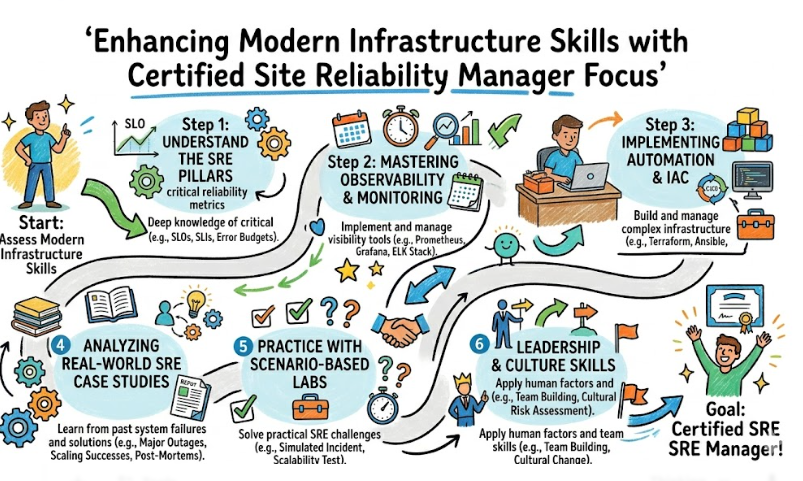
Introduction
The way software is managed has changed. In the past, developers built code, and operations teams fixed it when it broke. Now, a more integrated approach is required. Reliability is seen as a shared responsibility. A bridge is built between fast delivery and system stability.
A Certified Site Reliability Manager is expected to lead these efforts. It is not just about technical skills. It is about culture, metrics, and managing people who manage systems. High-performing teams are led by those who understand the balance between risk and speed. This guide is written to help professionals understand how this balance is maintained.
What is Certified Site Reliability Manager?
The Certified Site Reliability Manager (CSRM) is a professional designation. It is granted to individuals who demonstrate mastery in SRE principles from a leadership perspective. The focus is shifted from just writing scripts to designing reliable ecosystems.
Strategic planning is emphasized in this program. Service Level Objectives (SLOs) are defined, and error budgets are managed by these professionals. It is ensured that the customer experience is never sacrificed for the sake of a quick release. The certification is recognized as a standard for those moving into reliability leadership.
Why it matters today?
Systems are more complex than ever before. Cloud-native architectures and microservices are used by almost every major company. When these systems fail, the cost is measured in millions. A steady hand is needed to navigate these outages.
Efficiency is increased when a dedicated manager oversees reliability. Burnout among engineers is reduced when proper SRE practices are implemented. Today, the market demands leaders who can speak the language of both business and deep engineering. The Certified Site Reliability Manager fills this gap perfectly.
Why Certified Site Reliability Manager certifications are important?
Credibility is built through formal certification. In a crowded job market, a clear signal of expertise is provided by the CSRM title. Standardized knowledge is gained, ensuring that the same high-quality practices are applied across different industries.
Career growth is often tied to these credentials. Organizations look for proof that an individual can handle the pressure of managing critical infrastructure. By earning this certification, a commitment to professional excellence is shown. It also provides a structured way to learn complex topics that might be missed during daily work.
Why Choose SRESchool?
Success in the SRE field is closely linked to the quality of training received. SRESchool is chosen by many because of its deep focus on real-world reliability. A curriculum is provided that goes beyond theory.
The most modern tools and techniques are taught by experts who have handled massive traffic. A supportive community is offered to every student. Learning is made simple and accessible. When SRESchool is chosen, a roadmap to career mastery is followed. It is not just about passing an exam; it is about gaining the confidence to lead.
Certification Deep-Dive: Certified Site Reliability Manager
What is this certification?
The Certified Site Reliability Manager certification is a specialized program for leaders. It is designed to validate skills in managing SRE teams and reliability frameworks.
Who should take this certification?
This program is intended for Engineering Managers, Senior DevOps Engineers, and aspiring SRE Leads. It is also highly beneficial for Platform Engineers who want to move into management roles.
Certification Overview Table
| Track | Level | Who it’s for | Prerequisites | Skills Covered | Recommended Order |
| SRE | Professional | Aspiring Managers | Basic DevOps Knowledge | SLOs, Error Budgets, Incident Management | 1st in SRE Track |
| DevOps | Advanced | Senior Engineers | CI/CD Experience | Automation Strategy, Culture | 2nd after Foundation |
| DevSecOps | Specialist | Security Leads | Security Basics | Threat Modeling, Compliance | 3rd for Security Focus |
| AIOps | Advanced | Data Scientists | Python / ML Basics | Predictive Maintenance, Anomaly Detection | 4th for AI Focus |
| DataOps | Specialist | Data Engineers | SQL / Big Data | Pipeline Reliability, Data Quality | 5th for Data Focus |
| FinOps | Professional | Cloud Architects | Cloud Cost Basics | Unit Economics, Cloud Efficiency | 6th for Cost Focus |
Skills you will gain
- Deep knowledge of Service Level Indicators (SLIs) and Objectives (SLOs).
- Mastery over Incident Response and Post-Mortem cultures.
- The ability to manage error budgets to balance innovation and stability.
- Skills in building and scaling SRE teams within an organization.
- Expertise in choosing the right automation tools for reliability.
- Understanding of how to reduce “Toil” in engineering workflows.
Real-world projects you should be able to do after this certification
- A complete reliability roadmap for a production application can be designed.
- An incident management framework for a distributed team can be established.
- Error budget policies that guide developer behavior can be implemented.
- Multi-cloud monitoring and alerting systems can be architected.
- Cultural shifts toward “blameless” environments can be led.
Preparation plan
7–14 days plan
Focus is placed on the core definitions. SLOs, SLIs, and SLAs are reviewed. The official study guide provided by SRESchool is read daily. Practice questions are used to identify weak areas.
30 days plan
A deeper dive into case studies is taken. Incident management scenarios are simulated. Hands-on labs are completed to understand monitoring tools. Peer discussions are held to broaden perspectives.
60 days plan
Comprehensive mastery is aimed for. All modules are revisited. A mock project is created to apply all SRE principles. Final review sessions are attended to ensure every concept is clear.
Common mistakes to avoid
- Too much focus on tools instead of the underlying SRE culture.
- Ignoring the human aspect of managing stressed engineering teams.
- Skipping the practical labs and focusing only on reading theory.
- Not understanding the specific business context of reliability.
Best next certification after this
- Same track: Certified SRE Architect.
- Cross-track: Certified DevSecOps Professional.
- Leadership / management: Certified Engineering Leadership Professional.
Choose Your Learning Path
DevOps
This path is chosen by those who want to master the entire software lifecycle. It starts with automation and ends with continuous delivery. It is best for engineers who love building pipelines.
DevSecOps
Security is integrated into every step of the process here. This path is ideal for those who want to ensure that speed does not come at the cost of safety.
Site Reliability Engineering (SRE)
Operations is treated as a software problem in this track. It is the perfect choice for engineers who are passionate about uptime and scalability.
AIOps / MLOps
Artificial intelligence is used to manage IT operations. This is best for data-driven professionals who want to automate complex decision-making.
DataOps
Reliability is applied to data pipelines. It is suited for data engineers who need to ensure that information is always accurate and available.
FinOps
Cloud costs are managed with the same rigor as performance. This path is great for those who want to optimize the financial health of their cloud infrastructure.
Role → Recommended Certifications Mapping
| Role | Recommended Certifications |
| DevOps Engineer | Certified DevOps Professional |
| Site Reliability Engineer (SRE) | Certified Site Reliability Manager |
| Platform Engineer | Certified SRE Architect |
| Cloud Engineer | Certified Cloud Reliability Specialist |
| Security Engineer | Certified DevSecOps Expert |
| Data Engineer | Certified DataOps Professional |
| FinOps Practitioner | Certified FinOps Specialist |
| Engineering Manager | Certified Site Reliability Manager |
Next Certifications to Take
One same-track certification
A deep focus on the technical design of reliable systems is provided. It is considered the next logical step for those who want to stay close to the technical architecture after becoming a manager.
One cross-track certification
Security principles are merged with the speed of DevOps. This cross-track certification is recommended for managers who need to oversee secure delivery pipelines.
One leadership-focused certification
Soft skills and organizational strategy are prioritized. This is the best choice for those who want to move from managing a single team to leading entire departments.
Training & Certification Support Institutions
DevOpsSchool
A wide range of courses in automation and cloud management is offered. It is known for its practical approach and community-driven learning models. Career guidance is provided to every student.
Cotocus
Comprehensive training in modern technology stacks is delivered. Specialized programs for corporate teams and individuals are available. It is recognized for its high-quality lab environments and expert mentors.
ScmGalaxy
A wealth of knowledge regarding software configuration management is shared. Tutorials, blogs, and certification paths are provided for engineers at all levels. It is a go-to resource for those looking to master CI/CD.
BestDevOps
The best practices in the DevOps industry are taught here. A focus on job-ready skills is maintained. Students are prepared for the real challenges faced in high-pressure production environments.
devsecopsschool.com
Education on the intersection of security and operations is provided. The curriculum is designed to make security a standard part of the development process. It is a leader in DevSecOps training.
sreschool.com
Deep expertise in site reliability is shared. This is the primary provider for the Certified Site Reliability Manager program. It is trusted by professionals worldwide for its niche focus.
aiopsschool.com
The future of IT operations through AI is explored here. Training on how to use machine learning for monitoring and automation is provided. It is ideal for forward-thinking tech leaders.
dataopsschool.com
The focus is placed on the reliability of data systems. Data engineers are taught how to build robust and scalable data architectures. It is a essential resource for the modern data era.
finopsschool.com
Cloud financial management is made easy. Courses are offered on how to balance performance with cost efficiency. It is the leading school for cloud cost optimization.
FAQs Section
- What is the difficulty level of this program?
The difficulty is considered moderate to high. A strong understanding of both technical systems and management principles is required.
- How much time is needed to complete the certification?
Between 30 to 60 days are usually required. This depends on the prior experience of the candidate and the time dedicated to study.
- Are there any prerequisites?
A basic knowledge of DevOps or SRE is recommended. Experience in a leadership or senior engineering role is also helpful.
- What is the recommended certification sequence?
A foundation in DevOps is usually gained first. Then, the Certified Site Reliability Manager path is followed to specialize in leadership.
- How is career value added by this certification?
Salary potential is often increased. Higher-level management roles are made accessible to those who hold this credential.
- Which job roles are suitable after this?
Roles like SRE Manager, Engineering Manager, and Operations Lead are perfectly suited for certified professionals.
- Is the certification recognized globally?
Yes, the standards set by SRESchool are recognized by major tech companies in India and international markets.
- Can the exam be taken online?
Yes, the convenience of taking the exam from any location is provided through the official portal.
- What kind of growth can be expected?
Growth into senior leadership roles, such as Director of Reliability or VP of Engineering, is supported by this path.
- Are study materials provided?
Detailed guides and access to labs are provided by the training institution upon enrollment.
- Is there a community for support?
A large network of alumni and experts is available to help students during and after their certification.
- How often is the content updated?
The curriculum is reviewed annually to ensure it reflects the latest industry trends and tools.
FAQs specifically focused on Certified Site Reliability Manager
- What is the main focus of CSRM?
The primary focus is placed on the strategic management of reliability rather than just day-to-day coding tasks.
- Does it cover incident management?
Yes, a major portion of the syllabus is dedicated to building robust incident response and post-mortem processes.
- Is coding required for this certification?
While deep coding is not the main focus, the ability to understand and review automation scripts is necessary.
- How are SLOs handled in the course?
The math and logic behind setting realistic SLOs and managing error budgets are taught in detail.
- Is “Toil” reduction covered?
Yes, strategies for identifying and automating repetitive manual tasks are a core part of the learning.
- How does it differ from a standard SRE course?
A standard course focuses on tools. The CSRM focuses on the leadership and organizational structure needed for SRE success.
- Can I move from DevOps to SRE Management?
Yes, this certification is designed specifically to help with that career transition.
- What is the official URL?
The official details are found at certified-site-reliability-manager.
Testimonials
Aarav
The way I view system failures was changed by this program. Instead of panic, a structured approach is now taken. My confidence in leading a team of senior engineers has grown immensely.
Sanjay
The balance between shipping features and maintaining uptime is now understood clearly. The concepts of error budgets were applied immediately at my workplace. It has made our releases much smoother.
Priya
Career clarity was gained after finishing the CSRM course. The path from a senior engineer to a manager was laid out perfectly. I feel ready to handle large-scale production issues now.
Elena
Real-world application is the best part of this training. The labs were very helpful in understanding how monitoring should be structured. My professional value has definitely increased.
John
A human-centric approach to reliability was learned. It is not just about the servers; it is about the people. This certification provided the skills needed to build a healthy engineering culture.
Conclusion
The importance of the Certified Site Reliability Manager certification cannot be overstated. In a world where uptime is everything, the leaders who can guarantee reliability are the ones who will succeed. Long-term career benefits are gained by those who take the time to master these principles.
A strategic approach to learning is encouraged for everyone. By following a clear path and obtaining recognized certifications, a secure future in the tech industry is built. Reliability is a journey, and the right certification is the best way to start it.
