
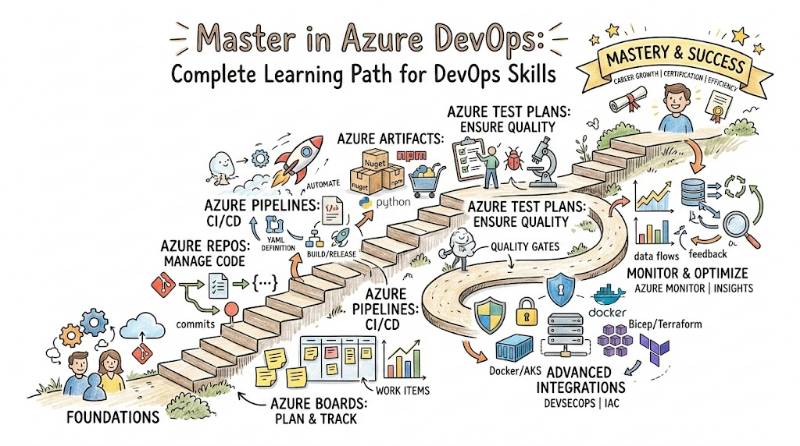
Introduction
In the long journey of software engineering, many tools have been seen to come and go. However, the shift toward unified platforms has remained a constant goal for the industry. A Master in Azure DevOps is now regarded as the pinnacle of this shift. It is not merely seen as a collection of tools, but as a complete methodology where development and operations are finally brought together.
This specific path is valued because the chaos of manual deployments is replaced by the discipline of automation. In the current ecosystem of cloud and high-speed delivery, the stability provided by such a master-level understanding is essential. For engineers and managers, certifications are not just pieces of paper; they are recognized as proof that a standard of excellence is maintained. A structured learning path is required to ensure that no gaps are left in one’s professional knowledge.
Comparison of Certification Paths
| Track | Level | Who it’s for | Prerequisites | Skills Covered | Recommended Order |
| Azure DevOps Mastery | Professional | Systems Engineers | Foundational Tech | CI/CD, Pipelines, Governance | Primary |
Why is DevOpsSchool Chosen?
A unique approach to technical education is offered by DevOpsSchool. It is observed that many platforms focus only on the theoretical aspects, but here, the focus is placed heavily on the practical application of Azure tools. The curriculum is built by those who have spent decades in the field, ensuring that only relevant, industry-standard information is shared.
Support is provided at every step, meaning a learner is never left to struggle with complex configurations alone. Because the training is aligned with real-world enterprise needs, it is trusted by thousands of professionals globally. The transition from a traditional role to a cloud-focused role is made much smoother through their structured guidance.
Master in Azure DevOps
What is this certification?
The complete lifecycle of application delivery within the Microsoft cloud environment is mastered through this program. It is recognized as a top-tier validation for those who manage complex software ecosystems.
Who should take this certification?
This path is intended for those who are responsible for the reliability and speed of software releases. It is also highly suitable for architects who must design scalable automation frameworks.
Skills you will gain
- Continuous integration flows are designed and implemented.
- Complex release strategies are automated across multiple environments.
- Source code security is managed through advanced repository policies.
- Infrastructure is treated as code to ensure environment consistency.
- Application performance is monitored to maintain high availability.
- Collaboration between teams is facilitated using integrated boards.
Real-world projects you should be able to do
- A zero-downtime deployment strategy is created for a global application.
- Automated security gates are integrated into the build pipeline.
- Legacy infrastructure is migrated into a modern, containerized Azure environment.
- A centralized package management system is established for the entire organization.
Preparation plan
- 7–14 days plan: The basic interface is explored. The connection between Azure Boards and Repos is established, and simple work items are tracked.
- 30 days plan: The creation of YAML-based pipelines is practiced. Small projects are moved through the automated build process to understand the flow.
- 60 days plan: Advanced governance and security features are implemented. Complex deployments involving multiple cloud services are mastered.
Common mistakes to avoid
- The importance of documentation within the pipeline is often underestimated.
- Automated tests are sometimes skipped, leading to unstable production environments.
- Branching strategies are not planned properly, which causes confusion during code merges.
Best next certification after this
- Same track: Azure DevOps Expert Refinement.
- Cross-track: AWS Certified DevOps Engineer.
- Leadership / management: Strategic Engineering Leadership.
Selected Learning Pathways
1. The DevOps Route
The bridge between creation and maintenance is built here. Efficiency is maximized by ensuring that every manual task is replaced by an automated process. This is selected by those who wish to oversee the entire delivery pipeline.
2. The DevSecOps Route
Safety is woven into the very fabric of the development process. Security is not added at the end but is integrated into every build. This is chosen by professionals who prioritize the protection of data.
3. The Site Reliability Engineering (SRE) Route
The focus is placed on the resilience of the system. Software principles are applied to operations to ensure that the application remains reachable and performant under heavy load.
4. The AIOps / MLOps Route
Intelligence is added to the operational workflow. Machine learning models are managed and deployed with the same rigor as traditional software, ensuring that data-driven insights are delivered reliably.
5. The DataOps Route
The flow of data is optimized. This path is followed by those who want to ensure that data pipelines are as robust and automated as code pipelines, reducing the time from data collection to analysis.
6. The FinOps Route
Financial transparency is brought to the cloud. The cost of every resource is monitored and optimized, ensuring that the business receives the highest return on its infrastructure investment.
Professional Role to Certification Mapping
- DevOps Engineer: Master in Azure DevOps and Container Orchestration.
- Site Reliability Engineer (SRE): Reliability Fundamentals and Azure Monitoring.
- Platform Engineer: Internal Developer Platform Design and Azure DevOps.
- Cloud Engineer: Cloud Infrastructure Master and Resource Governance.
- Security Engineer: Pipeline Security Specialist and Azure Defender.
- Data Engineer: Data Pipeline Automation and Azure Data Lake Management.
- FinOps Practitioner: Cloud Financial Management and Cost Governance.
- Engineering Manager: Modern Delivery Leadership and DevOps Strategy.
Recommendations for Future Learning
For the Technical Learner:
- A same-track certification in Advanced Scripting is suggested.
- A cross-track certification in Multi-Cloud Architecture is recommended.
- A leadership certification in Technical Team Management is advised.
For the Strategy Learner:
- A same-track certification in Portfolio Management is offered.
- A cross-track certification in Cyber Security Governance is available.
- A leadership certification in Executive Technology Direction is pursued.
Support Institutions for Professional Growth
DevOpsSchool
Industry-leading mentorship is provided to all students. The focus is kept on ensuring that the Master in Azure DevOps certification leads to tangible career results. Extensive lab environments are offered for practice.
Cotocus
A deep dive into specific technical problems is facilitated here. The training is known for its clarity and its ability to simplify the most difficult cloud concepts for working professionals.
ScmGalaxy
Knowledge sharing is prioritized through a vast collection of technical articles and community forums. It is seen as a primary resource for those who need to solve configuration management challenges.
BestDevOps
Practical skills are honed through rigorous training programs. The curriculum is updated constantly to reflect the latest changes in the Azure ecosystem.
devsecopsschool.com
A specialized environment for learning about secure pipelines is provided. Every lesson is designed to make security an integral part of the DevOps journey.
sreschool.com
The principles of system uptime and reliability are taught with great detail. It is a place where the art of maintaining large-scale systems is mastered.
aiopsschool.com
The future of operations is explored through the lens of artificial intelligence. Automation is taken to the next level using data-driven models.
dataopsschool.com
Data professionals are given the tools to automate their entire workflow. The gap between data engineering and operations is effectively closed.
finopsschool.com
The management of cloud budgets is taught as a technical discipline. It is where engineers learn to speak the language of business and finance.
Comprehensive FAQ Section
1. Is the Master in Azure DevOps considered a difficult path?
It is viewed as a comprehensive journey that requires dedication, but it is structured to be manageable for those with a technical background.
2. What duration is expected for the completion of this study?
A period of approximately eight to twelve weeks is usually required for a thorough understanding.
3. Are there specific requirements before starting?
A basic familiarity with how software is built and a general understanding of cloud services are recommended.
4. In what order should these skills be learned?
It is advised that version control is mastered first, followed by build automation and then release management.
5. How is career value impacted by this certification?
A significant increase in professional authority and job opportunities is typically experienced.
6. Is this knowledge applicable in different countries?
The principles of Azure DevOps are standardized and recognized across the global tech industry.
7. Can someone from a non-tech background succeed here?
Additional time will be needed to learn the foundational elements, but the path is designed to be inclusive.
8. What specific titles are gained after this?
Titles such as Senior DevOps Architect or Cloud Release Manager are often achieved.
9. Are hands-on exercises included in the training?
Practical application through labs is a mandatory part of the learning process.
10. How is the material kept current?
The content is revised as often as new updates are released by the cloud providers.
11. Is mentorship provided during the course?
Access to experienced professionals is maintained to help guide the learning experience.
12. Is the investment in this certification justified?
The long-term career stability and salary growth are seen as a high return on investment.
Azure DevOps Specific Questions
13. Why is the “Master” designation important?
It signifies that a complete, end-to-end understanding of the platform has been reached.
14. Where is the official registration found?
Registration is completed at master-in-azure-devops
15. Is work management covered in this guide?
Yes, the use of Azure Boards for tracking project progress is a central theme.
16. How are dependencies managed in this program?
The use of Azure Artifacts for package hosting is taught in detail.
17. Are modern pipeline languages used?
The definition of pipelines using YAML is emphasized as the industry standard.
18. Does this help with multi-cloud strategies?
The logic learned here is easily adapted to other platforms like AWS or Google Cloud.
19. Are containers integrated into the lessons?
The deployment of containerized applications is a core component of the mastery program.
20. Who is recognized as the primary provider of this training?
DevOpsSchool is identified as the lead organization for this certification support.
Professional Testimonials
Kabir, Infrastructure Lead
A total shift in perspective was experienced during this program. The way environments are managed is now much more systematic, and errors have been reduced significantly.
Meera, Release Manager
The complexity of multi-stage deployments was simplified. The confidence to lead large-scale migrations was gained through the practical labs provided.
Arjun, Platform Engineer
Skills were improved in areas that were previously confusing. The clear structure of the Master in Azure DevOps course allowed for a very logical progression of knowledge.
Sanya, Security Architect
A new way of looking at pipeline security was discovered. It is now understood how to protect the code without slowing down the development team.
Vihaan, Engineering Director
Career clarity was the most significant outcome. The strategic benefits of automation are now communicated more effectively to the stakeholders.
Final Summary
The pursuit of a Master in Azure DevOps is seen as a vital step for the modern professional. The gap between outdated manual processes and high-efficiency automation is bridged through this certification. Long-term benefits are found in the form of career stability, leadership roles, and a deep technical foundation. A strategic approach to this learning path is recommended for all who wish to remain competitive in the evolving world of cloud technology.
