
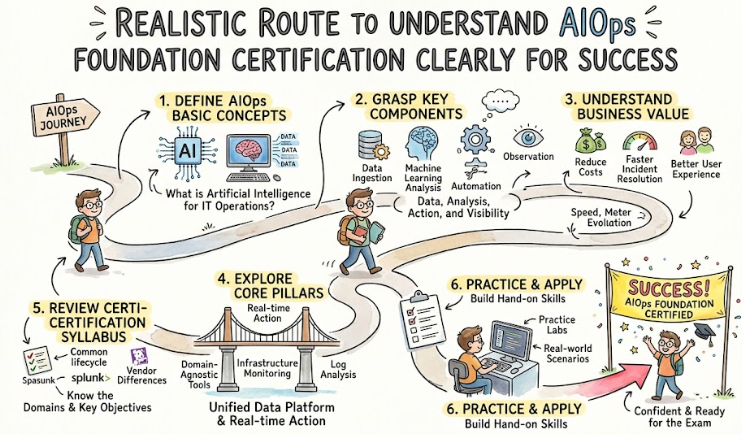
Introduction
The management of modern software environments is no longer a task that can be handled solely by human effort. Massive amounts of data are generated every second by servers, applications, and network devices. To make sense of this noise, Artificial Intelligence for IT Operations (AIOps) is being adopted across the globe. It is the practice where machine learning and data science are applied to IT operational problems.
A clear understanding of how these technologies work together is required for any engineer looking to stay relevant. Instead of manual monitoring, systems are now expected to predict failures before they happen. This shift is not just a trend; it is a fundamental change in how digital services are maintained and scaled.
What is AIOps Foundation Certification?
The AIOps Foundation Certification is an entry-level professional credential designed to validate a candidate’s understanding of AI-driven operations. It is focused on the core concepts, terminologies, and workflows that define the AIOps space. This is not just a theoretical exam; it is a benchmark that shows an individual can contribute to an environment where data-driven decision-making is the norm.
The basics of big data, machine learning, and automation are covered within the curriculum. It is intended to bridge the gap between traditional DevOps practices and the future of intelligent automation.
Why It Matters in Today’s Environment
The complexity of cloud-native applications has reached a point where manual intervention is often too slow. When a service goes down, minutes of downtime can result in massive financial losses. AIOps is utilized to reduce the “Mean Time to Repair” (MTTR) by identifying the root cause of issues automatically.
The importance of this certification is seen in how it prepares engineers to handle high-pressure environments. By understanding how to implement AIOps tools, a professional becomes a vital asset to any team that values uptime and efficiency. It is about moving from a reactive state to a proactive one.
Why AIOps Foundation Certifications are Important
Career growth is often tied to the ability to master new technologies. For many engineers in India and across the global market, a certification serves as proof of competence. It provides a structured learning path that might otherwise be missed through self-study alone.
- Standardization: A common language for AI in operations is established.
- Trust: Employers are given confidence that the engineer understands the risks and rewards of automated operations.
- Efficiency: Learning is streamlined, focusing only on what is necessary for real-world application.
Why Choose AIOps School?
When a learning platform is selected, quality and practical relevance are the most important factors. AIOps School is chosen by many because the curriculum is designed by individuals who have spent decades in the trenches of IT operations.
The focus is placed on real-world scenarios rather than just passing an exam. The labs are built to simulate actual production environments, ensuring that the knowledge gained can be applied on the job immediately. Additionally, the support provided to students is tailored to help them overcome technical hurdles quickly. It is a community where learning is prioritized above all else.
AIOps Foundation Certification Deep-Dive
What is this certification?
This certification is a foundational program that introduces the intersection of AI and IT operations. It is designed to explain how machine learning models can be used to improve system reliability and performance.
Who should take this certification?
Software engineers, DevOps practitioners, and SREs who want to integrate AI into their workflows should consider this. It is also highly recommended for managers who need to oversee AIOps transitions.
Certification Overview Table
| Track | Level | Who it’s for | Prerequisites | Skills Covered | Recommended Order |
| DevOps | Foundation | Engineers | Basic Linux | Automation, CI/CD | 1 |
| DevSecOps | Foundation | Security Pros | DevOps Basics | Security Automation | 2 |
| SRE | Foundation | Ops Engineers | Admin Skills | Reliability, SLIs | 1 |
| AIOps/MLOps | Foundation | Data/Ops Engineers | Cloud Basics | ML Models, Analytics | 1 |
| DataOps | Foundation | Data Engineers | SQL/Data | Pipeline Automation | 2 |
| FinOps | Foundation | Managers/Ops | Cloud Billing | Cost Optimization | 3 |
Skills You Will Gain
- An understanding of how data is ingested from multiple sources.
- Knowledge of anomaly detection through machine learning.
- The ability to automate incident response workflows.
- Proficiency in identifying noise reduction techniques in monitoring tools.
- A grasp of predictive analytics for capacity planning.
Real-World Projects Post-Certification
- A system that automatically categorizes and suppresses redundant alerts is built.
- A dashboard that predicts potential server outages based on historical logs is created.
- An automated remediation script that triggers based on specific AI-detected patterns is developed.
Preparation Plans
7–14 Days Plan (The Intensive Path)
- Day 1-3: Focus is placed on the core definitions and the AIOps lifecycle.
- Day 4-7: Machine learning basics for operations are studied.
- Day 8-14: Practice exams are completed and official documentation is reviewed.
30 Days Plan (The Balanced Path)
- Week 1: Theoretical foundations of big data and AI are covered.
- Week 2: Hands-on labs focusing on data ingestion are performed.
- Week 3: Deep dive into specific AIOps tools and vendor-neutral concepts.
- Week 4: Final revision and mock tests are conducted.
60 Days Plan (The Deep-Dive Path)
- Month 1: Comprehensive study of SRE and DevOps overlaps with AI.
- Month 2: Extensive lab work and community discussions are engaged in to solidify practical skills.
Common Mistakes to Avoid
- Skipping the fundamental concepts of data science.
- Focusing only on tools rather than the underlying logic.
- Ignoring the cultural shifts required for AIOps success.
- Underestimating the importance of high-quality data.
Best Next Certification After This
- Same Track: AIOps Professional Certification.
- Cross-Track: SRE Foundation or MLOps Professional.
- Leadership: FinOps Certified Practitioner or Engineering Management.
Choose Your Learning Path
1. DevOps Path
This path is best for those who want to enhance their CI/CD pipelines with intelligent testing and automated deployments.
2. DevSecOps Path
This is suited for security-focused engineers who wish to use AI to detect threats and vulnerabilities in real-time.
3. Site Reliability Engineering (SRE) Path
Reliability is the goal here. AI is used to manage service level objectives and automate error budget tracking.
4. AIOps / MLOps Path
This path is for the specialists who want to build and maintain the machine learning models used in operations.
5. DataOps Path
Best for data engineers who need to ensure the quality and speed of data flowing through the organization.
6. FinOps Path
Designed for those focused on the financial side of the cloud, using AI to predict and reduce waste.
Role → Recommended Certifications Mapping
| Role | Recommended Certification | Key Benefit |
| DevOps Engineer | AIOps Foundation | Faster release cycles |
| Site Reliability Engineer | SRE Foundation | Improved system uptime |
| Platform Engineer | AIOps Foundation | Better infrastructure scaling |
| Cloud Engineer | FinOps Practitioner | Cloud cost control |
| Security Engineer | DevSecOps Professional | Automated threat hunting |
| Data Engineer | DataOps Foundation | Reliable data pipelines |
| FinOps Practitioner | FinOps Certified | Financial transparency |
| Engineering Manager | AIOps Foundation | Better team resource allocation |
Next Certifications to Take
Same-Track: AIOps Professional
Deep technical knowledge of specific AI models used in production is gained. Advanced automation strategies are mastered.
Cross-Track: SRE Professional
The focus is shifted toward extreme reliability and large-scale system architecture. It complements AIOps by providing the operational context.
Leadership: Certified Engineering Manager
The skills needed to lead technical teams through digital transformations are developed. Strategic planning and people management are emphasized.
Training & Certification Support Institutions
DevOpsSchool
Extensive training programs are provided by this institution. A strong focus is placed on the practical aspects of DevOps and its integration with modern AI tools.
Cotocus
This organization is known for its consultative approach to learning. Professional development is supported through hands-on workshops and real-world project simulations.
ScmGalaxy
A vast repository of resources is maintained here for engineers. Certification support is offered through a combination of expert-led sessions and community forums.
BestDevOps
The curriculum is designed to be accessible yet thorough. Career guidance and technical training are bundled together to help professionals reach their goals.
devsecopsschool.com
Specialized training in the security domain is offered. The intersection of security and automation is explored in detail to prepare engineers for modern threats.
sreschool.com
Everything related to reliability is covered here. Detailed courses on SRE principles and practices are provided to help stabilize complex systems.
aiopsschool.com
This is the primary destination for AI-driven operations training. Comprehensive paths are offered for those looking to master AIOps and MLOps.
dataopsschool.com
The lifecycle of data is the main focus. Training is provided to ensure that data remains a competitive advantage through speed and accuracy.
finopsschool.com
Cloud financial management is taught with a focus on accountability and optimization. It is a vital resource for anyone managing cloud budgets.
FAQs Section
1. What is the difficulty level of the AIOps Foundation exam?
The exam is considered to be of a moderate level, focusing on fundamental concepts rather than deep coding.
2. How much time is required to prepare?
Usually, 2 to 4 weeks are sufficient if a consistent study schedule is followed.
3. Are there any strict prerequisites?
No formal prerequisites are required, though a basic understanding of IT operations is helpful.
4. Can the certification be taken in a specific sequence?
Starting with the Foundation level is recommended before moving to Professional tracks.
5. What is the career value of this certification?
A significant increase in marketability is often seen, as AIOps is a high-demand skill.
6. Which job roles benefit the most?
SREs, DevOps engineers, and Cloud architects see the most immediate benefits.
7. Is the exam available online?
Yes, the certification can be attempted from anywhere through the official portal.
8. How long is the certification valid?
Typically, the certification remains valid for two to three years, reflecting the fast-changing nature of the field.
9. Are there practice tests available?
Yes, mock exams are provided by AIOps School to help students prepare.
10. Does this help with salary growth?
Many professionals report higher salary brackets after adding AIOps skills to their portfolios.
11. Is coding required for this foundation level?
Extensive coding is not required, but understanding how scripts work is beneficial.
12. Is the global market recognizing this?
Yes, the certification is recognized by major tech firms in India, the US, and Europe.
AIOps Foundation Certification Specific FAQs
1. Is machine learning experience needed before starting?
Deep knowledge is not required as the basics are covered within the course material.
2. How is the exam structured?
Multiple-choice questions are used to test the candidate’s knowledge of core AIOps principles.
3. Can this certification be used for MLOps roles?
Yes, it provides a very strong base for anyone looking to transition into MLOps.
4. What tools are covered?
The course is mostly vendor-neutral, but popular frameworks and architectural patterns are discussed.
5. Is there a focus on big data?
Data ingestion and processing are key components of the curriculum.
6. Are real-world case studies included?
Yes, several examples of how companies have implemented AIOps are studied.
7. How does this differ from a standard DevOps cert?
The focus is placed specifically on using AI to enhance operations, rather than just manual automation.
8. Is support provided after the exam?
AIOps School offers community access to all certified professionals for ongoing learning.
Testimonials
Aarav
The clarity provided by this course was exceptional. Complex AI concepts were broken down into simple steps that could be used at work immediately.
Meera
Confidence in handling large-scale monitoring data was gained. The practical approach made the learning experience very rewarding.
John
A new perspective on incident management was discovered. The focus on predictive analytics has changed how system health is viewed.
Priya
Career path clarity was achieved after completing the certification. The shift from manual tasks to intelligent automation is now much easier.
David
Skill improvement was noticed by the entire team. The ability to explain the “why” behind AI in operations has been a huge boost.
Conclusion
The evolution of IT management has reached a point where manual oversight is being replaced by intelligent, data-driven systems. A vital foundation for this transition is provided by the AIOps Foundation Certification. The gap between traditional operations and the future of automated reliability is bridged when these core principles are mastered.
Greater professional growth is unlocked when the focus is placed on understanding how machine learning can transform system maintenance. A long-term advantage in the global market is secured by those who choose to prioritize strategic skill development. By following this structured path, a career is positioned at the very center of the next wave of technical innovation. A future where operational excellence is driven by intelligence is being embraced through this certification.
