Introduction
It is very tempting to jump straight into action. When people get an idea for a new app, a company website, or an online store, they want to start designing buttons, writing code, or posting on social media immediately. Moving fast feels productive.
However, rushing forward without a clear direction usually creates costly problems later. Features get built and then thrown away. Marketing budgets vanish with zero sales to show for it. Team members get confused about what they are supposed to be building.
A digital strategy stops this chaos. It forces you to pause, ask the hard questions, and map out the journey before you spend a single dollar on development.
What Is a Digital Strategy?
At its core, a digital strategy is a detailed action plan that guides how a business or individual uses digital tools and technology to achieve specific goals.
- Simple meaning: It is a roadmap that tells you where you are going online, how you will get there, and how you will measure your progress.
- Why it matters: It keeps everyone on the same page. Instead of guessing what to do next, every decision ties back to a clear business objective.
- Example: Imagine you want to open an online clothing store. Simply buying a domain name and uploading pictures of shirts is not a strategy. A digital strategy defines who buys your clothes, why they will buy from you instead of giant competitors, how they will find your website, and what computer systems you need to process payments safely.
How Digital Strategy Works
A digital strategy does not live in a vacuum; it connects your business goals with real-world technology and user behavior.
- Discovery: You look at the current market, your competitors, and your own capabilities.
- Goal Setting: You define what success looks like—such as getting 500 newsletter sign-ups or selling 1,000 software subscriptions in six months.
- Audience Mapping: You figure out who will use your digital product and what problems they face.
- Resource Planning: You calculate the time, money, and tools required to build and maintain the project.
- Execution and Measurement: You build the project in stages, testing it along the way and checking data to see if it performs as expected.
Why Strategy Matters Before Starting Any Digital Project
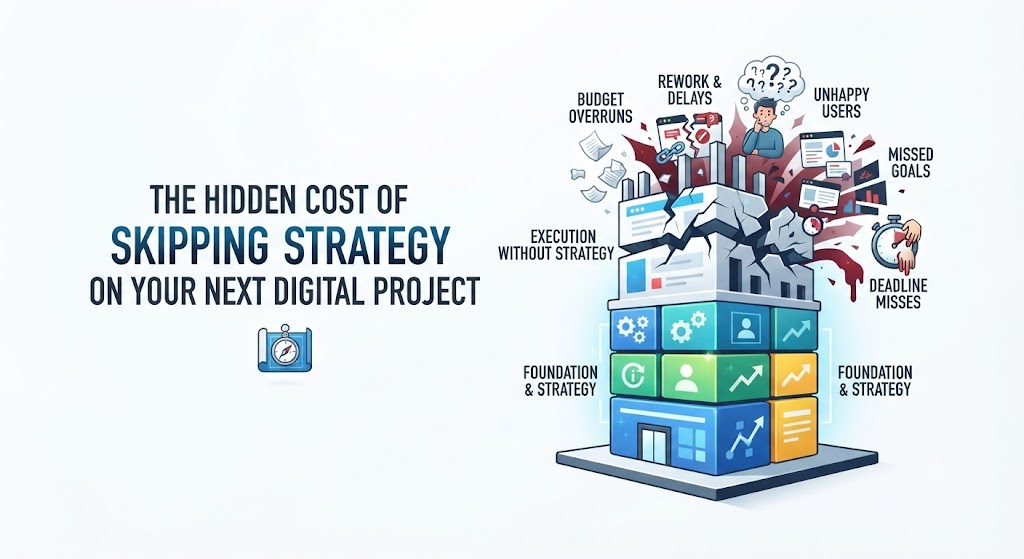
Skipping the strategy phase is the number one reason digital projects fail. Here is why taking time to plan matters so much.
1. It Protects Your Budget
Building software, designing websites, or running digital ad campaigns is expensive. When you have a strategy, you know exactly where your money goes. You avoid paying developers to build features that users do not care about.
2. It Keeps the Team Aligned
Developers want clean code, designers want beautiful visuals, and business owners want high sales. Without a strategy, these team members pull in different directions. A strategy acts as a shared agreement that unites everyone under common goals.
3. It Focuses on the Real User
It is easy to fall in love with your own ideas and assume everyone else will love them too. A digital strategy forces you to step back and focus on the user’s actual needs. If the user cannot figure out how to use your digital product within seconds, the project fails—no matter how cool the technology looks.
Real-World Considerations
When you move from theory to reality, a digital project faces everyday hurdles.
- Scope Creep: This happens when new ideas keep getting added to the project mid-way through development. Without a strict strategy document, a project that was supposed to take three months can stretch into a year.
- Technical Debt: Choosing the cheapest or fastest tools at the beginning often leads to broken code and security holes later. A strategy helps you choose sustainable technology that grows with you.
- Maintenance Costs: Many beginners forget that digital projects require ongoing care. Software updates, server costs, security patches, and content updates require continuous time and money.
Common Mistakes
Here are some traps that beginners and even experienced teams fall into when starting a digital project:
- What people do: Jumping straight into writing code or designing graphics because it feels like real work.
- Why they do it: Planning feels slow and boring compared to creating tangible designs.
- Why it causes problems: You end up building the wrong thing entirely, wasting weeks of work.
- What they should do instead: Spend the first week writing down project goals, user requirements, and core features before opening any design or coding software.
- What people do: Copying a competitor’s exact feature set.
- Why they do it: It seems safe to follow a company that is already successful.
- Why it causes problems: Your audience, budget, and brand are different. What works for a tech giant will often bankrupt a small startup.
- What they should do instead: Focus on your unique value proposition—what you do better or differently for your specific audience.
Risks and Limitations
Even the best strategy cannot guarantee 100% success, because digital markets change fast.
- Changing Technology: New tools, programming frameworks, or AI capabilities can make your planned approach outdated while you are still building it.
- Unpredictable User Behavior: People often say they want one thing in surveys, but behave completely differently when they actually use a digital product.
- How to reduce these risks: Build your digital project in small, testable chunks (often called iterations) rather than waiting until everything is completely finished to show it to the public. Get real user feedback early and often.
Decision-Making Framework
Use this simple step-by-step framework before giving the green light to any digital project:
- Define the Problem: What specific real-world problem does this digital project solve?
- Identify the Audience: Who will use this, and why would they choose it over existing alternatives?
- Set Clear Metrics: How will you measure success? (e.g., user sign-ups, page views, completed purchases)
- Audit Resources: Do you have the time, money, and skill set to build and maintain this project?
- Evaluate Alternatives: Is building a custom solution truly necessary, or can you use existing tools and platforms?
- Plan for Failure: What is your backup plan if user adoption is low after launch?
Checklist
Run through this checklist before starting your next digital project:
- Have I written down the primary business goal of this project?
- Do I clearly understand the target user’s main pain point?
- Have I researched existing competitors or solutions?
- Is there a realistic budget assigned for both creation and ongoing maintenance?
- Do I know which tools, software, or platforms will be used?
- Have I defined what success looks like in measurable numbers?
Key Terms
- Digital Transformation: The integration of digital technology into all areas of a business, changing how it operates and delivers value to customers.
- Scope: The boundaries of a project, including what features, tasks, and deliverables are included (and excluded).
- Target Audience: The specific group of people most likely to want or need your digital product or service.
- User Experience (UX): How a person feels when interacting with a digital product, such as a website or mobile app.
- Value Proposition: A clear statement that explains how your product solves customers’ problems, delivers specific benefits, and tells them why they should choose you over the competition.
- Iteration: The process of repeating a set of steps—such as designing, testing, and refining—to improve a product gradually.
- Minimum Viable Product (MVP): A version of a new product with just enough features to satisfy early customers and provide feedback for future product development.
- ROI (Return on Investment): A metric used to evaluate the efficiency or profitability of an investment compared to its cost.
FAQs
What is the biggest mistake people make in digital projects?
The biggest mistake is starting development without a clear understanding of the target user or the business goal. This leads to building products that look nice but fail to solve a real problem.
Do small websites or projects need a strategy?
Yes. Even a small website needs a strategy to determine its purpose, structure, and how visitors will find it. Without a plan, even a simple site can become disorganized and ineffective.
How long should the strategy phase take?
It depends on the project size, but for most standard digital projects, spending a few days to a couple of weeks on research, planning, and goal-setting saves months of wasted development time later.
What if my strategy changes midway through the project?
Minor adjustments are normal as you learn new things during development. However, major changes to core goals should be carefully evaluated to avoid breaking the project timeline and budget.
How do I know if my digital strategy is working?
You measure it against the goals you set at the beginning. If your goal was to increase online sales, look at your sales data. If your goal was user engagement, track how long users spend on your digital platform.
Conclusion
Starting a digital project without a strategy is an expensive gamble. Taking the time upfront to define your goals, understand your audience, and map out your technical requirements transforms random effort into a focused plan. Strategy gives your project direction, protects your budget, and gives you the best possible chance of building something that truly succeeds.