
Introduction
In the world of modern software, things move fast. Systems are more complex than ever before. We no longer just “run” code; we manage massive distributed systems that must stay up 24/7. This is where Site Reliability Engineering (SRE) comes into play. It is the bridge between software engineering and operations.
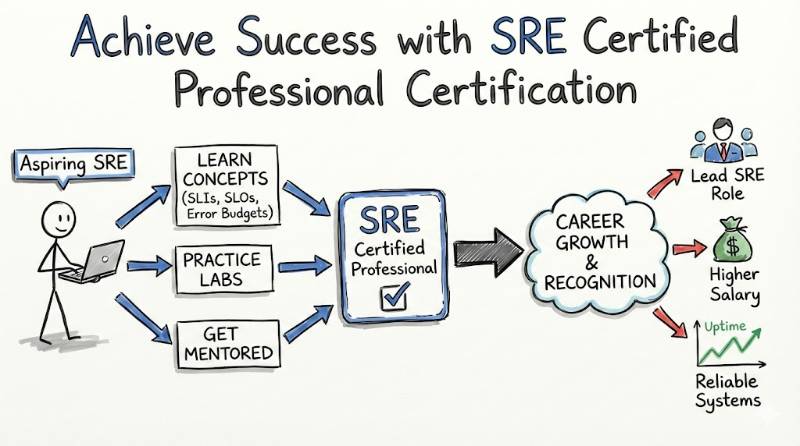
The SRE Certified Professional (SRECP) is a program designed to turn engineers into reliability experts. It is not just about keeping a website running. It is about using code to manage systems, automate manual tasks, and ensure that every user has a seamless experience. For any engineer or manager looking to stay relevant in the cloud-native era, this certification is a vital milestone.
Certifications are more than just a piece of paper. They are a roadmap. They provide a structured way to learn deep technical skills that are often missed in daily tasks. For a manager, seeing an SRECP certification means the candidate understands how to balance new features with system stability. For an engineer, it means having the confidence to handle large-scale production environments without fear.
Certification Overview Table
| Track | Level | Who it’s for | Prerequisites | Skills Covered | Recommended Order |
| SRE | Professional | Software Engineers, DevOps, SREs | Basic Linux & Cloud | Error Budgets, SLIs/SLOs, Automation | Foundation -> SRECP |
Why Choose DevOpsSchool?
When looking for a place to learn, depth of knowledge is the most important factor. DevOpsSchool is chosen by many because it provides a curriculum that is grounded in real-world scenarios. The instructors bring years of production-level experience, ensuring that students do not just learn the “what,” but also the “how” and “why.”
The lab environments provided are robust, allowing for hands-on practice that mirrors actual industry challenges. Moreover, the support community helps in navigating complex technical hurdles long after the training is over. It is a place where professional growth is prioritized through practical, high-quality education.
Certification Deep-Dive: SRE Certified Professional (SRECP)
What is this certification?
The SRE Certified Professional (SRECP) is a comprehensive program that focuses on the principles and practices of Site Reliability Engineering. It covers how to apply software engineering mindsets to IT operations tasks.
Who should take this certification?
This is ideal for DevOps engineers, system administrators, and software developers who want to move into high-level reliability roles. It is also beneficial for technical leads who manage production environments.
Skills you will gain
- Defining and managing Service Level Indicators (SLIs) and Service Level Objectives (SLOs).
- Calculating and managing Error Budgets to balance speed and reliability.
- Automating toil (repetitive manual tasks) using scripting and tools.
- Implementing effective monitoring and observability frameworks.
- Conducting blameless post-mortems after system incidents.
- Managing incident responses and on-call rotations efficiently.
Real-world projects you should be able to do
- Build a monitoring dashboard that tracks real-time user experience metrics.
- Design an automated failover system for a multi-region cloud application.
- Create a CI/CD pipeline that automatically stops deployments if the error budget is exceeded.
- Write a post-mortem report that identifies root causes without blaming individuals.
Preparation plan
- 7–14 days plan: Focus on the core SRE definitions. Learn the difference between SLI, SLO, and SLA. Read the basic SRE handbooks.
- 30 days plan: Start hands-on labs with monitoring tools like Prometheus or Grafana. Practice writing automation scripts for server health checks.
- 60 days plan: Dive deep into incident management simulations. Study distributed tracing and log aggregation. Take mock exams to test your knowledge.
Common mistakes to avoid
- Focusing only on tools and ignoring the cultural aspect of SRE.
- Setting SLOs that are too high and impossible to achieve.
- Neglecting the importance of “blameless” culture during incidents.
- Trying to automate everything at once without understanding the manual process first.
Best next certification after this
- Same track: SRE Expert or Advanced Observability Specialist.
- Cross-track: DevSecOps Professional or Cloud Architect Certification.
- Leadership / management: Engineering Manager Program or SRE Lead Certification.
Choose Your Learning Path
1. DevOps Path
This path is best for those who want to master the entire software delivery lifecycle. It focuses on breaking down silos between developers and operations.
2. DevSecOps Path
Designed for security-minded engineers. Security is integrated into the very beginning of the pipeline rather than being an afterthought.
3. Site Reliability Engineering (SRE) Path
Best for those who love high-scale systems. The focus is on uptime, performance, and using software to manage infrastructure.
4. AIOps / MLOps Path
This is for engineers working with Artificial Intelligence and Machine Learning models. It ensures that ML models are deployed and maintained reliably.
5. DataOps Path
Best for data engineers and architects. It focuses on the automated, policy-driven approach to managing data flow and quality.
6. FinOps Path
Designed for those who want to manage cloud costs. It bridges the gap between finance, engineering, and business teams to optimize cloud spend.
Role → Recommended Certifications Mapping
- DevOps Engineer: DevOps Professional, SRE Certified Professional.
- Site Reliability Engineer (SRE): SRECP, Observability Expert, Chaos Engineering Professional.
- Platform Engineer: Kubernetes Certified Specialist, SRECP, Infrastructure as Code Professional.
- Cloud Engineer: Cloud Architect, SRECP, FinOps Practitioner.
- Security Engineer: DevSecOps Professional, Cloud Security Expert.
- Data Engineer: DataOps Professional, Big Data Certified Architect.
- FinOps Practitioner: FinOps Certified Professional, Cloud Cost Management Specialist.
- Engineering Manager: SRECP (for oversight), DevOps Leader, Strategic Management for Tech.
Next Certifications to Take
For the SRE Learner:
- Same-track: Advanced Chaos Engineering Certification.
- Cross-track: DevSecOps Professional.
- Leadership-focused: Certified Site Reliability Manager.
For the DevOps Learner:
- Same-track: Continuous Delivery Architect.
- Cross-track: SRE Certified Professional.
- Leadership-focused: DevOps Leader (DOL).
For the Security Learner:
- Same-track: Certified DevSecOps Expert.
- Cross-track: SRE Certified Professional.
- Leadership-focused: Security Governance and Leadership.
Training & Certification Support Institutions
DevOpsSchool
Comprehensive training is provided by DevOpsSchool for various tech tracks. A wide range of certifications in DevOps, SRE, and Cloud is offered here. It is well-known for its practical, instructor-led sessions.
Cotocus
A focus on digital transformation and high-end technical training is maintained by Cotocus. Specialized courses in SRE and Platform Engineering are delivered to global clients. It is a key partner for corporate upskilling.
ScmGalaxy
A massive community and knowledge base are hosted by ScmGalaxy. Detailed tutorials and certification guides are shared for free. It serves as a primary resource for engineers seeking self-paced learning.
BestDevOps
The latest trends in the DevOps ecosystem are tracked by BestDevOps. High-quality training programs are curated to meet current industry demands. It is recognized for its simplified approach to complex topics.
devsecopsschool.com
Education regarding the integration of security into DevOps is provided here. Specialized certifications in DevSecOps are offered. It is a go-to platform for security professionals.
sreschool.com
Detailed training specifically for Site Reliability Engineering is found here. The SRECP certification preparation is a core focus. It is dedicated to building the next generation of SREs.
aiopsschool.com
The intersection of AI and Operations is explored at this institution. Courses on how to use AI for better system reliability are provided. It is essential for engineers moving into the AIOps space.
dataopsschool.com
The focus is placed on the lifecycle of data management. Training on how to automate data pipelines is delivered. It is highly recommended for data-driven organizations.
finopsschool.com
Financial accountability in the cloud is taught here. Professionals are trained to optimize cloud costs without losing performance. It is the leading school for FinOps certifications.
FAQs Section
General FAQs
- What is the difficulty level of SRECP?
It is considered an intermediate to advanced level certification. - How much time is required for preparation?
Approximately 30 to 60 days are needed for a thorough understanding. - Are there any prerequisites?
A basic understanding of Linux and Cloud computing is recommended. - In what sequence should I take SRE certifications?
A foundation course should be completed before the Professional level (SRECP). - What is the career value of this certification?
High demand for SREs results in better salary packages and job stability. - Which job roles can I apply for?
Roles like SRE, DevOps Engineer, and Systems Engineer are easily accessible. - Is this certification recognized globally?
Yes, it is respected by tech companies across India and international markets. - Does it cover automation tools?
Yes, various automation and monitoring tools are discussed in the curriculum. - Can a manual tester take this course?
Transitioning is possible if basic coding and Linux skills are acquired first. - How long is the certification valid?
Usually, the certification is valid for two to three years before renewal is suggested. - Is there a community for support?
Yes, access to a large community of experts is provided. - Are lab sessions included?
Hands-on labs are a primary part of the training program.
SRE Certified Professional (SRECP) Specific FAQs
- Is SRECP different from standard DevOps?
Yes, it focuses more on reliability and using software engineering for ops. - Does SRECP teach coding?
It teaches the application of coding to infrastructure tasks. - Are SLIs and SLOs covered in depth?
Yes, these are core components of the SRECP certification. - Is incident management included?
Effective incident response and post-mortems are key topics. - Can I take the exam online?
Yes, the exam can be scheduled and taken online. - What is the passing score?
Usually, a score of 70% or higher is required to pass. - Are study materials provided?
Comprehensive guides and videos are shared with candidates. - Does this help in Cloud Architect roles?
Yes, understanding reliability is a major part of cloud architecture.
Testimonials
Aarav, DevOps Engineer
“A huge improvement in my technical skills was noticed after this course. The concept of Error Budgets is now used daily in my projects.”
Elena, Site Reliability Engineer
“Real-world application was the best part of the training. The confidence to manage large production incidents was truly gained.”
Karthik, Cloud Engineer
“Career clarity was finally achieved. The path from a general engineer to a specialized SRE was clearly mapped out.”
Sara, Security Engineer
“Even as a security professional, the reliability concepts were found to be very helpful. Automation skills were significantly enhanced.”
David, Engineering Manager
“The team’s performance has improved since we adopted these SRE principles. A much better balance between features and stability is maintained.”
Conclusion
The SRE Certified Professional (SRECP) certification is a powerful tool for any tech professional. The importance of reliability cannot be overstated in a world where downtime equals lost revenue. Long-term career benefits include higher salaries, roles in top-tier tech companies, and the ability to solve complex system problems. Strategic learning and certification planning are highly encouraged to ensure a successful future in the evolving cloud ecosystem.
