
Introduction
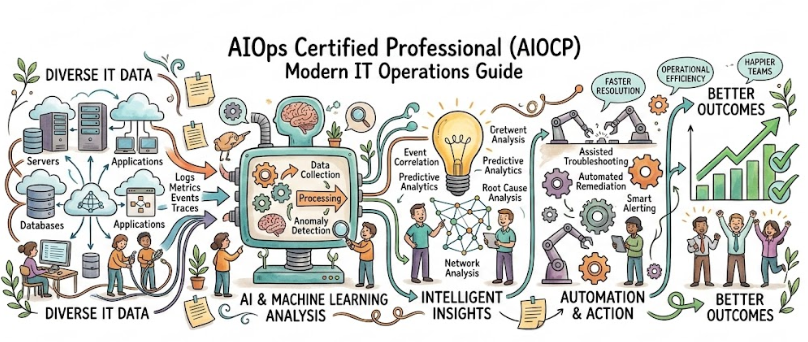
The way technology systems are managed is undergoing a massive transformation. In earlier times, IT teams relied on manual checks and simple alerts to keep servers running. As applications moved to the cloud, the sheer volume of data grew too large for any human team to track effectively. Thousands of logs, metrics, and traces are generated every single minute. Because of this, a more intelligent approach is required to maintain system health. This is where Artificial Intelligence for IT Operations (AIOps) steps in.
The AIOps Certified Professional (AIOCP) program is designed to bridge the gap between traditional operations and modern artificial intelligence. It is not just another technical course; it is a comprehensive framework that teaches how machine learning can be applied to solve real-world infrastructure problems. By obtaining this certification, a clear path is created toward becoming a specialist who can handle the complexities of modern, automated environments.
Why AIOCP Matters in Today’s Ecosystem
The software and cloud ecosystem is now driven by speed and scale. When a system goes down, every second of downtime results in a loss of revenue and trust. Traditional monitoring tools often create too much “noise,” sending hundreds of alerts that may not be important. AIOps is used to filter this noise and identify the root cause of an issue automatically.
For engineers, this shift means that manual troubleshooting is being replaced by predictive analytics. Instead of reacting to a crash, systems are now being built to predict failures before they happen. For managers, the focus has shifted toward efficiency and cost-reduction. By utilizing AIOps, teams are enabled to do more with less, focusing on innovation rather than fire-fighting.
Why Certifications are Important for Engineers and Managers
A professional certification serves as a formal validation of a person’s expertise. In a crowded job market, it provides a standard that employers can trust. For an engineer, it is a way to prove that the latest technologies are understood and can be applied to business problems. It provides a structured learning path that ensures no critical gaps in knowledge are left behind.
For engineering managers, certifications are a tool for team building. When a team is certified, a common language is spoken, and a unified set of best practices is followed. This leads to better collaboration and more predictable outcomes for technical projects. It also demonstrates to clients and stakeholders that the organization is committed to maintaining the highest industry standards.
Certification Overview Table
| Track | Level | Who it’s for | Prerequisites | Skills Covered | Recommended Order |
| AIOps | Professional | SREs, DevOps Engineers | Basic Ops Knowledge | ML, Big Data Analytics | 1st |
| MLOps | Advanced | Data Engineers | AI/ML Foundations | Model Lifecycle, Deployment | 2nd |
| SRE | Specialist | Systems Engineers | Linux & Cloud | Reliability, Uptime | 1st |
| DevSecOps | Specialist | Security Pros | DevOps Basics | Automated Security | 2nd |
| DataOps | Professional | Data Architects | Database Knowledge | Pipeline Automation | 2nd |
| FinOps | Management | Finance/Eng Leads | Cloud Billing | Cost Optimization | 3rd |
Why Choose DevOpsSchool?
DevOpsSchool is frequently chosen by professionals because the emphasis is placed on practical, hands-on learning rather than just theory. The curriculum is developed by experts who have dealt with large-scale production environments for decades. Every lesson is designed to be simple and easy to digest, making it accessible for those who may not have a background in data science or artificial intelligence.
Beyond the high-quality course material, a strong support system is provided to every learner. Instructors are available to help with technical doubts, and a community of like-minded professionals is offered for networking and growth. The training is focused on real-world tools that are currently used in the industry, ensuring that the skills gained are immediately applicable to one’s current job or future career moves.
Certification Deep-Dive: AIOps Certified Professional (AIOCP)
What is this certification?
The AIOps Certified Professional (AIOCP) is a globally recognized credential that focuses on the integration of AI and machine learning into the IT operations lifecycle. It teaches how to use big data and automated algorithms to enhance monitoring, troubleshooting, and system management.
Who should take this certification?
This certification is intended for anyone who is involved in the maintenance and scaling of software systems. This includes DevOps Engineers, Site Reliability Engineers (SREs), Platform Engineers, and Engineering Managers. It is also highly beneficial for Data Engineers who wish to understand the operational side of AI.
Skills you will gain
- Advanced Data Collection: The ability to gather and normalize data from various sources like logs, metrics, and traces is developed.
- Anomaly Detection: Machine learning techniques are learned to identify unusual patterns that indicate potential system failures.
- Event Correlation: Skills are gained to link related events together, helping to find the true cause of an incident quickly.
- Predictive Maintenance: The use of historical data to forecast future resource needs and potential outages is mastered.
- Automation of Root Cause Analysis (RCA): Methods to automatically identify why a problem occurred are practiced, reducing the time spent on manual investigation.
Real-world projects you should be able to do
- Self-Healing Infrastructure: A system is built that can automatically restart services or reallocate resources when an issue is detected by AI.
- Smart Alerting System: An alerting framework is created that suppresses repetitive notifications and only alerts the team to high-priority problems.
- Capacity Planning Dashboard: A tool is developed that uses predictive models to tell a business exactly when more server space will be needed in the future.
Preparation Plan
- 7–14 days plan: The focus is kept on the core concepts of AIOps and the different types of telemetry data. The fundamental differences between traditional monitoring and AI-driven operations are studied.
- 30 days plan: Time is spent working with basic machine learning models used for time-series data. Practical labs are performed to see how data is ingested into AIOps platforms.
- 60 days plan: A full-scale project is implemented. The integration of AI tools with existing DevOps pipelines is completed, and mock exams are taken to ensure readiness for the certification.
Common mistakes to avoid
- Ignoring Data Quality: It is often forgotten that AI is only as good as the data it receives. If the logs are messy, the AI will provide incorrect insights.
- Over-Automation: There is a tendency to try and automate everything on day one. A step-by-step approach is always recommended.
- Neglecting the Human Element: AI is meant to assist humans, not replace them entirely. The focus should remain on how the team can work better alongside intelligent tools.
Best next certification after this
- Same track: Master in AIOps for specialized engineering roles.
- Cross-track: MLOps Certified Professional to understand how to deploy and manage AI models at scale.
- Leadership / management: Digital Transformation Lead for those moving into executive positions.
Choose Your Learning Path
- DevOps Path: This is the most common starting point. It is best for those who want to automate the software delivery process from code to production.
- DevSecOps Path: This path is best for individuals who want to ensure that security is not an afterthought but is built into every automated process.
- Site Reliability Engineering (SRE) Path: This is best for engineers who are passionate about system stability, uptime, and building highly reliable cloud services.
- AIOps / MLOps Path: This is best for those who want to be at the cutting edge of technology. It focuses on making systems smarter through the use of artificial intelligence.
- DataOps Path: This path is best for data-focused professionals who want to ensure that data flows smoothly and reliably across the organization.
- FinOps Path: This is best for managers and engineers who want to specialize in cloud cost management and financial accountability in tech.
Role → Recommended Certifications Mapping
- DevOps Engineer: The path starts with Certified DevOps Professional and is enhanced by the AIOCP to handle modern, data-heavy environments.
- Site Reliability Engineer (SRE): A combination of SRE Certification and AIOCP is recommended to achieve the goal of “NoOps” or zero-touch operations.
- Platform Engineer: Kubernetes certifications are paired with AIOCP to manage complex, containerized platforms more intelligently.
- Cloud Engineer: Certifications from major cloud providers are supplemented by AIOCP to optimize cloud resource usage.
- Security Engineer: The DevSecOps track is followed, with AIOCP used to detect security threats through anomaly detection.
- Data Engineer: The focus is kept on DataOps and MLOps to manage the lifecycle of data and models.
- FinOps Practitioner: The FinOps Certified Professional credential is taken to help organizations save on cloud expenditures.
- Engineering Manager: A broad overview is gained through AIOCP to lead teams toward more efficient, modern workflows.
Next Certifications to Take
Once the AIOCP is obtained, the journey of learning continues. The following recommendations are provided:
- One same-track certification: An advanced course in Predictive Analytics is suggested to deepen technical expertise.
- One cross-track certification: A certification in FinOps is recommended so that the cost-saving benefits of AI can be calculated and presented to the business.
- One leadership-focused certification: A course in Strategic Technical Leadership is suggested for those looking to manage larger departments.
Training & Certification Support Institutions
- DevOpsSchool: This institution is known for its wide variety of technical courses. Extensive support is provided to students, ensuring that both theoretical knowledge and practical skills are acquired for the AIOCP exam.
- Cotocus: Specializing in high-level consultancy and training, this platform is chosen by many for its hands-on approach. Complex tools are simplified so that learners can master them quickly and effectively.
- ScmGalaxy: This is a community-centric platform that offers a wealth of resources. It is used by professionals to stay updated on the latest trends in configuration management and automation.
- BestDevOps: The focus here is on delivering top-tier educational content and tutorials. It is an excellent resource for those who prefer a structured and clear learning environment.
- devsecopsschool.com: This specialized school is dedicated entirely to the security aspect of the development cycle. It is the go-to place for anyone looking to master DevSecOps.
- sreschool.com: Education regarding system reliability and uptime is provided here. The courses are designed to help engineers build systems that are both stable and scalable.
- aiopsschool.com: This is the primary destination for all things related to AIOps. The curriculum is specifically tailored to the AIOCP certification and modern operations.
- dataopsschool.com: Training is provided for the management of data pipelines. It focuses on how data can be automated and treated with the same rigor as software code.
- finopsschool.com: This institution focuses on the financial side of the cloud. It teaches how to manage budgets and optimize costs in a cloud-first world.
FAQs Section
What is the difficulty level of the AIOCP exam?
The exam is considered to be of an intermediate level. While it does not require a PhD in mathematics, a solid understanding of IT operations and basic data concepts is expected.
How much time should be dedicated to study?
It is generally found that most working professionals can prepare successfully in about 6 to 8 weeks if they dedicate a few hours each weekend.
Are there any specific prerequisites?
No formal degree is required, but some experience with Linux, cloud platforms, and basic automation tools is highly recommended.
What is the best sequence for these certifications?
It is often suggested that a person should start with a general DevOps or SRE certification before moving into the specialized AIOps track.
What is the long-term career value of this certification?
As more companies adopt AI, the demand for specialists who can manage these systems is growing rapidly. This certification is a key to higher-level engineering roles.
Will this certification help in finding a job in India?
Yes, the Indian tech market is heavily focused on cloud and automation. Having an AI-focused operations credential is a major advantage.
Is there a lot of programming involved in the course?
Some basic scripting in languages like Python is taught, as it is needed to interact with AI tools, but deep software development is not the main focus.
Does this certification help in salary negotiations?
Specialized skills in emerging fields like AIOps are often associated with higher salary brackets compared to general IT roles.
Is the exam available online?
Yes, the certification exam can be taken online from any location, making it very convenient for busy professionals.
How long does the certification remain valid?
The certificate is typically valid for two years, after which a renewal or an advanced level course is recommended to stay current.
Are there practical lab sessions provided during training?
Yes, most authorized training providers include extensive lab sessions where real AIOps tools are configured and tested.
What is the minimum score required to pass?
A passing score of 70% is usually required to be awarded the AIOCP credential.
How does AIOps differ from standard monitoring?
While monitoring tells you what is happening, AIOps uses AI to tell you why it is happening and what might happen next.
Is Python knowledge mandatory to start?
It is not mandatory to start, but learning some basic Python will make the practical parts of the course much easier to understand.
Can a project manager benefit from AIOCP?
Yes, it helps managers understand the capabilities of their team and the tools they are using, leading to better project planning.
What kind of tools are studied in this program?
Tools for log management, machine learning based alerting, and automated incident response are typically covered.
Is MLOps included in this certification?
The focus is on operations (AIOps), but the foundational concepts of MLOps are often introduced as they are closely related.
Are practice exams provided?
Yes, mock tests are usually part of the training package to help students get familiar with the exam format.
What happens if the exam is not passed on the first try?
A retake policy is usually in place, allowing students to try again after a short period of additional study.
How is the certificate delivered?
A digital certificate is provided upon successful completion of the exam, which can be easily shared on professional profiles like LinkedIn.
Testimonials
“The AIOCP program provided me with the tools to handle the massive amounts of data our systems generate. I now feel much more equipped to handle complex outages.”
— Anil
“The practical labs were the highlight for me. Being able to see how AI detects anomalies in real-time was a huge eye-opener for my daily work.”
— Sunita
“I gained a lot of career clarity through this course. It showed me exactly where the industry is heading and how I can stay relevant as an engineer.”
— Rajesh
“The confidence I gained has allowed me to lead more advanced projects at my company. It was a very worthwhile investment in my professional growth.”
— Meera
“A very simple and clear structure was followed throughout the training. Complex topics were made easy to understand even for someone with a busy schedule.”
— Vikram
Conclusion
The AIOps Certified Professional (AIOCP) certification is more than just a credential; it is a gateway to the future of IT operations. By learning how to apply artificial intelligence to infrastructure management, long-term career benefits are firmly established. The ability to manage systems with intelligence and foresight is what will separate top-tier engineers from the rest in the coming years. Strategic planning and a commitment to learning these new skills are highly encouraged for everyone in the tech industry.
