
Introduction
In the early days of software, we used to have very clear walls. Developers wrote the code, and operations teams made sure it stayed running. Today, those walls have mostly come down. But as we moved toward a faster way of working, a new challenge appeared. Systems became very complex. It is no longer enough to just know how to use a tool. You need to know how all the tools fit together. This is why the role of a DevOps Architect has become one of the most respected positions in our industry.
I have watched this field change and grow for a long time. I have seen teams struggle with messy setups and others succeed because they had a clear plan. If you want to move from just “doing” tasks to “designing” systems, the Certified DevOps Architect (CDA) program is a path worth looking at. It provides the technical depth and the strategic mindset needed for high-level engineering.
What is Certified DevOps Architect (CDA)?
The Certified DevOps Architect (CDA) is an advanced professional program. It is designed for those who want to master the art of designing automated, scalable, and secure software delivery systems. It moves beyond basic scripting. Instead, it focuses on the design patterns that make a system reliable. As a CDA, you are the person who creates the blueprint that the rest of the engineering team follows. You are responsible for ensuring that the various tools used for coding, testing, and deployment work together as a single, efficient machine.
Why it matters in today’s software, cloud, and automation ecosystem
We are living in an era where everything is managed through code. Whether it is servers, networks, or security, everything is managed through automation. In such a fast-moving world, a small design flaw can lead to huge costs or security leaks. Companies today do not just need people who can run a command. They need experts who can design a system that works across multiple clouds, stays secure under pressure, and scales automatically. The Certified DevOps Architect (CDA) provides the skills to handle this modern complexity and ensures that a company’s technology can grow as fast as its business.
Why certifications are important for engineers and managers
Many people ask if certifications still matter. In my experience, they serve as a vital common ground. For an engineer, a certification like the CDA provides a structured way to fill in the gaps in their knowledge. It ensures you haven’t missed a critical piece of the puzzle just because you didn’t use it in your last job. For a manager, it acts as a badge of trust. It proves that the person has been tested against industry standards and is ready for the responsibility of making big technical decisions. It creates a level of confidence that is hard to get through experience alone, especially when hiring or promoting.
2. Certification Overview Table
| Track | Level | Who it’s for | Prerequisites | Skills Covered | Recommended Order | Course |
| DevOps Architecture | Advanced | Senior Engineers, Lead Developers, Architects | Experience with Linux, Cloud, and CI/CD | System Design, Automation, Scaling, Security | After Professional Level Certs | Certified DevOps Architect |
Provider: DevOpsSchool
Why Choose DevOpsSchool?
When looking for a place to learn, you want more than just a video library. DevOpsSchool stands out because they focus on real-world application rather than just theory. Their programs are built around hands-on labs that mimic the actual challenges you face in a high-pressure job environment. They provide access to mentors who have spent a long time in the industry, and their curriculum is constantly updated to match the shifting landscape of the tech world. It is about learning by doing, which is the only way to truly master the art of architecture.
3. Certification Deep-Dive: Certified DevOps Architect (CDA)
What is this certification?
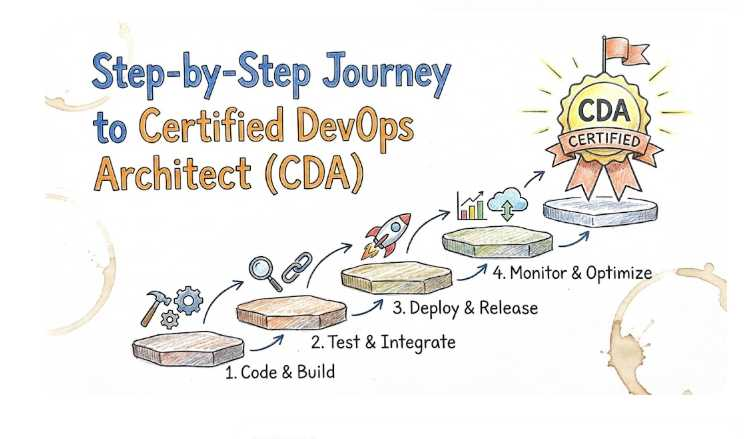
The Certified DevOps Architect (CDA) is a high-level program that teaches you how to design end-to-end automation strategies. It covers the entire lifecycle of software, from the moment a developer commits code to the moment it reaches a user’s screen. It teaches you how to evaluate different technologies and select the ones that best fit your organization’s specific needs.
Who should take this certification?
This certification is intended for those who have moved past basic implementation and are looking to lead. Senior Software Engineers find it valuable because it helps them understand how their code lives and breathes in a production environment. DevOps, Cloud, and Platform Engineers should take it when they feel they are ready to step into leadership or design roles where they set the technical direction for others. Engineering Managers benefit by gaining a deep understanding of the technical roadmap for their departments, allowing them to support their teams better. System Architects also find it useful to modernize their approach to cloud-native designs and automation.
Skills you will gain
One of the most important skills you will develop is Architectural Thinking. This means learning how to design systems that are both flexible enough to change and stable enough to never go down. You will also master Advanced CI/CD, which involves designing pipelines that can handle complex deployments like “Blue-Green” or “Canary” releases without manual work. Infrastructure as Code (IaC) is another major focus, teaching you to build and manage entire data centers using code, making your work repeatable and error-free. You will also learn Security-by-Design, ensuring that security is a core part of the system’s architecture. Finally, you will gain skills in Cloud Strategy and High Availability, allowing you to build systems that survive major failures without the user ever noticing.
Real-world projects you should be able to do
After completing this certification, you should be able to lead a Global Pipeline Design project. This involves creating a delivery system that can deploy an application to multiple countries simultaneously while maintaining speed. You will be capable of setting up an Automated Security Audit system that automatically checks every server for security holes and fixes them before they can be exploited. You will also be able to design Cost-Efficient Scaling models that grow your infrastructure when users arrive and shrink it when they leave, saving your company a significant amount of money. Another key project is a Microservices Migration, where you plan and lead the move of an old “monolith” app into a modern, fast, and scalable setup.
Preparation Plan
- 7–14 Days Plan (The “Quick Review”): This plan is designed for the expert who already does this work daily and just needs to align their knowledge with the exam. Spend the first few days focusing on the latest updates in container orchestration. Follow this by reviewing specific architectural patterns covered in the CDA syllabus. Dedicate the middle section to hands-on labs for any tools you haven’t used recently. Use the final days for taking mock exams and refining your weak areas.
- 30 Days Plan (The “Deep Focus”): This is the most common path for working engineers who need a balanced approach. During the first week, master the concepts of Version Control and advanced build automation. In the second week, deep dive into Infrastructure as Code and Cloud-native designs. The third week should be dedicated to Security, Compliance, and Monitoring strategies. Use the final week for architectural design case studies and comprehensive final reviews of all materials.
- 60 Days Plan (The “Knowledge Builder”): This is the best path if you are moving from a different area of IT or want a very deep understanding. Use the first month to focus on building a strong foundation in Linux, Cloud networking, and basic automation scripts. In the second month, spend several hours every weekend on hands-on labs, focusing on the “why” behind every design choice you make. The last two weeks should be entirely dedicated to exam preparation and reviewing complex topics.
Common mistakes to avoid
A very common mistake is Ignoring the “Culture” part of DevOps. Remember that DevOps is not just about tools; it is about how teams work together. If the culture is broken, the best tools in the world won’t help. Another error is Over-Engineering. Don’t make a system more complex than it needs to be just to use a new technology. A simple, understandable design is almost always a better design. Finally, many people make the mistake of Skipping Documentation. An architect’s job is to communicate a vision. If you can’t explain or document your design, the team will not be able to use it correctly or maintain it.
Best next certification after this
Once you have mastered architecture, you should look at specialized tracks. In the Same Track, a Master in Site Reliability Engineering (SRE) is a logical next step to focus on extreme uptime. For a Cross-Track move, consider an MLOps Certified Professional or FinOps Practitioner certification to expand into AI or cost management. If you want to move into Leadership, a Certified DevOps Manager certification will help you manage the people and processes behind the technology.
4. Choose Your Learning Path
DevOps Path
The DevOps path is for those who love speed and automation. It focuses on the continuous flow of software and removing the “bottlenecks” that slow down development teams. It is best for engineers who enjoy seeing their work go from an idea to a live product in just a few minutes. This path teaches you how to create a culture of constant delivery and improvement.
DevSecOps Path
The DevSecOps path is for the security-minded engineer. In this path, you learn how to “shift-left,” which means bringing security into the very beginning of the development process. You build automated tools that check every piece of code for danger before it is ever allowed to go live. This ensures that the speed of DevOps does not come at the cost of safety.
Site Reliability Engineering (SRE) Path
The SRE path is best for those who value stability above all else. You learn how to use software engineering principles to solve operational problems. This path is perfect if you are interested in making sure systems stay up 99.99% of the time. It involves a lot of data analysis and building automated “operators” to handle complex server tasks.
AIOps / MLOps Path
The AIOps and MLOps path represents the future of our industry. It is designed for those who want to use Artificial Intelligence to manage large-scale systems or learn how to deliver AI models to users. It is a great mix of data science and traditional engineering, focusing on how machines can help us manage other machines more efficiently.
DataOps Path
Managing data is a unique challenge that requires its own set of rules. The DataOps path applies the logic of DevOps to the world of big data. It is best for people who want to ensure that data flows through an organization cleanly, securely, and quickly. You learn how to automate data pipelines so that analysts always have the right information at the right time.
FinOps Path
The FinOps path is for the “Business Engineer.” As companies move more of their work to the cloud, their bills often skyrocket. In this path, you learn how to manage and optimize these costs. It is becoming very important as companies look for architects who can design systems that are not just fast, but also financially sustainable.
5. Role → Recommended Certifications Mapping
- DevOps Engineer: You should focus on the Certified DevOps Professional and then move into becoming a Docker & Kubernetes Specialist. These certifications provide the core technical skills needed to manage modern containers and deployment pipelines effectively.
- Site Reliability Engineer (SRE): A Master in SRE combined with becoming a Prometheus and Grafana Expert is the ideal path. These help you master the art of monitoring and maintaining the health of complex, high-traffic systems.
- Platform Engineer: The Certified DevOps Architect (CDA) is the perfect fit for this role. You should also become a Terraform Associate to master the tools used for building the underlying platforms that other developers use.
- Cloud Engineer: Focus on becoming a Cloud Solutions Architect and a Networking Specialist. This ensures you understand the deep plumbing of the cloud and how to connect different services securely and efficiently.
- Security Engineer: A Certified DevSecOps Professional certification is essential. It proves you know how to integrate security tools directly into the automated pipelines that developers use every day.
- Data Engineer: You should pursue a Certified DataOps Professional certification. This helps you apply automation and quality control to the complex flow of data within a modern organization.
- FinOps Practitioner: Start with a Certified FinOps Associate certification. This gives you the tools to bridge the gap between the engineering team and the finance department, ensuring cloud costs stay under control.
- Engineering Manager: A Certified DevOps Manager certification is highly recommended. It helps you understand the technical needs of your team while giving you the skills to lead them through complex digital transformations.
6. Next Certifications to Take
To stay ahead in this industry, you must always be looking at what is coming next. After you finish the CDA, I recommend three different directions based on your goals. For a Same-Track move, go even deeper into container orchestration by mastering Kubernetes at an expert level. For a Cross-Track move, I highly suggest looking into FinOps. Every company is now looking for architects who can design systems that are cheap to run without losing performance. If you want a Leadership-Focused path, consider a DevOps Manager certification. It will help you move from managing technical systems to managing the talented people who build them.
7. Training & Certification Support Institutions
DevOpsSchool
DevOpsSchool is a top choice for those who want a practical and hands-on learning journey. They provide a massive library of resources and access to trainers who are still very active in the tech industry. Their Certified DevOps Architect (CDA) program is highly regarded because it focuses on the technical depth needed for real-world projects. They offer a community-driven environment where you can learn from the experiences of others while building your own skills.
Cotocus
Cotocus specializes in high-end IT training and personalized support. If you are looking for a learning experience where you have a lot of guidance, Cotocus is a strong option. They focus on making sure you understand the “inner workings” of a technology rather than just memorizing facts. Their approach is very detailed and is designed to help you solve complex problems that you might find in a senior engineering role.
ScmGalaxy
ScmGalaxy is one of the oldest and most respected communities for software configuration and management. They offer a wealth of free tutorials, active forum discussions, and structured training programs. It is an excellent place to stay updated with new trends and find support from a global network of engineers. It is a great resource for anyone who wants to keep learning long after their certification is finished.
BestDevOps
BestDevOps is a platform dedicated to making DevOps simple for everyone. They focus on taking very complex architectural topics and breaking them down into easy-to-understand steps. This makes it a great starting point for those who are just beginning their move into a design or leadership role. Their goal is to remove the “fear” of complex technology and make it accessible to any dedicated learner.
devsecopsschool.com
If security is your primary interest, this specialized school is the place to be. They offer programs that focus entirely on the “Security” part of the DevOps cycle. You will learn how to integrate various security tools and practices into modern automation frameworks. Their training is essential for anyone who wants to protect their company from the growing number of cyber threats.
sreschool.com
This institution follows the reliability principles made famous by the biggest tech firms in the world. They teach you how to think about uptime and performance in a data-driven way. By attending sreschool, you learn how to build systems that can handle massive amounts of traffic while remaining stable and fast. It is perfect for those who enjoy the “science” of system operations.
aiopsschool.com
Aiopsschool is a forward-thinking institution that focuses on the intersection of AI and IT operations. They help you prepare for the next generation of management, where machines use data to help manage other machines. You will learn how to use machine learning to predict failures before they happen and how to automate the response to common IT issues.
dataopsschool.com
Dataopsschool bridges the gap between the world of Data Science and the world of DevOps. If you want to learn how to manage complex data pipelines using the same speed and quality controls used in software development, this is the school for you. They focus on the specific tools and processes needed to make data delivery fast and reliable.
finopsschool.com
Finopsschool focuses entirely on the financial side of the cloud. They teach you the skills needed to help companies lower their cloud costs while still maintaining high performance. You will learn how to read complex cloud bills, find waste, and create a culture where engineers take responsibility for the money they spend on servers.
8. FAQs Section
General Career FAQs
- Is the Certified DevOps Architect (CDA) exam difficult? It is a professional-level exam that requires a deep understanding of design principles. It is fair, but you must study the curriculum thoroughly.
- How long does it take to get certified? Most people find that 30 to 60 days of consistent study, alongside their regular job, is the right amount of time to prepare.
- What are the prerequisites for the CDA? You should have a good understanding of Linux, at least one Cloud platform, and basic CI/CD concepts before you start.
- Will this certification help me get a promotion? Yes, it is often a key requirement for moving from a standard engineer role to a Senior or Architect role.
- Does the CDA cover multiple clouds?
Yes, the principles you learn apply to AWS, Azure, and Google Cloud, making you a versatile architect. - How much does a DevOps Architect earn?
Architects are among the highest-paid professionals in tech, often earning much more than engineers who focus only on using tools. - Is it a multiple-choice exam?
Yes, but the questions are based on real-world scenarios, so you have to apply your knowledge to solve a specific problem. - Can I take the exam online?
Yes, most providers offer online proctored exams so you can take them from your home or office. - How do I renew the certification?
Most certifications require a small refresher or evidence of continued work in the field every few years to stay active. - Is there a community for CDA students?
Yes, platforms like ScmGalaxy and DevOpsSchool have large communities where you can ask questions and share tips. - Do I need to be a developer to be a DevOps Architect?
You don’t need to be a full-time coder, but you must be comfortable reading code and writing automation scripts. - Is this certification recognized globally?
Yes, it is highly recognized in India and in major global markets like the US and Europe.
Certified DevOps Architect (CDA) Focused FAQs
- What is the main difference between a DevOps Engineer and an Architect?
An engineer builds and maintains; an architect designs the strategy and the blueprint for the entire system. - Does CDA teach Kubernetes?
Yes, container orchestration is a core part of modern architecture and is covered in depth. - Will I learn about security in the CDA?
Yes, the program includes a significant focus on DevSecOps and building secure automation pipelines. - Is the CDA training hands-on?
Yes, the best training providers focus heavily on real-world labs where you build actual systems. - Can a manager benefit from the CDA?
Absolutely. It helps them understand the technical challenges their team faces and allows them to make better strategic decisions. - Does the CDA focus on specific tools?
It teaches you how to use popular tools, but more importantly, it teaches you how to choose the right tool for any given situation. - Is there a mock test available?
Yes, most training programs provide mock exams to help you get used to the format and the types of questions asked. - What is the passing score?
Typically, the passing score is around 70%, although this can change slightly depending on the specific version of the exam.
9. Testimonials
Arjun Mehta:
“The Certified DevOps Architect (CDA) program gave me a new way to look at my daily work. I stopped just fixing things and started designing systems that don’t break. My confidence and my salary have both grown since I finished.”
Sarah Jenkins:
“I loved how practical the training was. The hands-on labs helped me understand how to manage a multi-cloud setup without getting overwhelmed. It was exactly what I needed to move into a lead role.”
Rajesh Kumar:
“After doing the CDA, I was able to lead a major cloud migration at my company. The architectural patterns I learned saved us from making several expensive mistakes during the transition.”
Aisha Khan:
“As a security-focused engineer, the CDA helped me see how to integrate my work into the development cycle. It made me a much more effective team member and a better architect.”
Vikram Singh:
“The CDA is a must for anyone who wants to stay relevant in this fast-moving field. It moves you past the ‘tool-of-the-month’ phase and gives you a foundation that lasts for your whole career.”
Conclusion
I have seen many people get caught up in the “tool of the day.” They learn a specific tool and think they are set for life. But tools change every year. What stays the same are the principles of good architecture. The Certified DevOps Architect (CDA) is about mastering those lasting principles so that you can lead any project, regardless of the tools being used.
When you become an architect, your value to a company changes completely. You are no longer just a person who closes tickets or fixes bugs; you are the person who builds the future. You become the one who ensures the company can grow without its technology falling apart. This is a journey toward professional maturity. It is about moving from the “engine room” where things are built to the “captain’s bridge” where the direction is set.
If you want a career that is not just about keeping up, but about leading the way, you must focus on architecture. It is the best way to ensure your skills are always in high demand. The long-term benefits—better pay, more respect from your peers, and more interesting work—are well worth the effort you put in today. A career is a long journey, and having the right map
