
Introduction
In the current technological era, data is no longer just a byproduct of business; it is the engine that drives decision-making. However, the gap between data collection and actionable insight is often widened by inefficient processes. This is where the Certified DataOps Engineer (CDOE) role becomes essential.
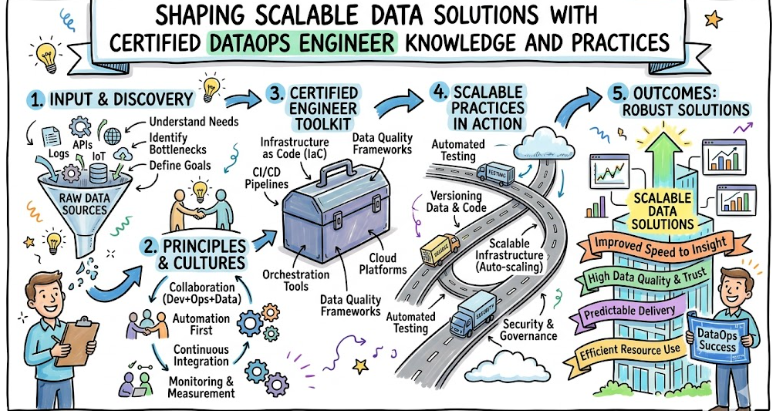
The principles of DevOps are applied to data workflows to ensure that data delivery is automated, high-quality, and scalable. By pursuing this certification, a foundation for managing complex data lifecycles is built. The friction between data engineers, scientists, and analysts is reduced through the implementation of standardized practices.
What is CDOE – Certified DataOps Engineer?
The CDOE is a professional designation that validates an individual’s ability to implement DataOps methodologies within an organization. It is not merely about learning tools; it is about mastering the synchronization of people, processes, and technology.
A focus is placed on the automation of data pipelines, the assurance of data quality through continuous testing, and the orchestration of data environments. When this certification is earned, a signal is sent to the industry that the practitioner is capable of delivering data with the same speed and reliability expected in modern software development.
Why It Matters Today?
Business agility is often hindered by “data silos” and slow processing times. When data takes weeks to move from a source to a dashboard, its value is significantly diminished.
DataOps matters today because it introduces the concept of a “Data Factory.” In this model, data is treated as a product that must move through a reliable assembly line. The CDOE certification ensures that the engineers building these assembly lines are using the most efficient and robust techniques available.
Why CDOE – Certified DataOps Engineer Certifications are Important?
Reliability in data delivery is the primary outcome of this certification. Organizations are increasingly looking for professionals who can prove their expertise through standardized testing.
- Standardization: A common language for data operations is established across the team.
- Quality Assurance: Automated testing protocols are integrated into every stage of the data pipeline.
- Career Growth: Higher-level roles in data architecture and engineering management are made accessible.
- Operational Efficiency: Waste in data processing is identified and eliminated through lean principles.
Why Choose DataOpsSchool?
When selecting a partner for professional growth, the quality of the curriculum is paramount. DataOpsSchool is chosen by thousands of professionals for several key reasons:
- Industry-Aligned Curriculum: The training modules are developed by experts who are actively solving data challenges in global enterprises.
- Practical Lab Access: Theoretical knowledge is supported by hands-on labs where real-world data scenarios are simulated.
- Global Recognition: The certifications issued are respected by major tech hubs from India to Silicon Valley.
- Continuous Support: A community of practitioners is provided, ensuring that learning does not end once the certificate is received.
Certification Deep-Dive: CDOE – Certified DataOps Engineer
What is this certification?
The CDOE is a comprehensive program designed to bridge the gap between traditional data engineering and modern operational excellence. It focuses on the end-to-end automation of data delivery pipelines.
Who should take this certification?
This program is ideal for Data Engineers, Database Administrators, DevOps Engineers looking to specialize, and Engineering Managers who oversee data-driven teams.
Certification Overview Table
| Track | Level | Who it’s for | Prerequisites | Skills Covered | Recommended Order |
| DataOps Essentials | Associate | Beginners in Data | Basic SQL knowledge | Pipeline basics, DataOps culture | 1 |
| Pipeline Automation | Professional | Data Engineers | 1 year IT experience | CI/CD for Data, Version Control | 2 |
| Data Quality & Governance | Specialist | QA & Compliance | Understanding of Data | Testing frameworks, Compliance | 3 |
| Cloud Data Platforms | Expert | Architects | Advanced Cloud knowledge | Snowflake, Databricks, Redshift | 4 |
| DataOps Leadership | Management | Directors / Leads | 5+ years experience | Strategy, ROI, Team Building | 5 |
Skills You Will Gain
- Orchestration: The ability to manage complex workflows across multiple data platforms is developed.
- Automation: Manual interventions in data ingestion and transformation are removed.
- Monitoring: Observability stacks are built to track data health in real-time.
- Collaboration: Communication barriers between data producers and consumers are broken down.
- Version Control: Code-based management of data infrastructure (Data Infrastructure as Code) is mastered.
Real-World Projects Post-Certification
- Automated ETL Pipelines: A system is built where data is ingested, cleaned, and moved to a warehouse without manual triggers.
- Data Quality Dashboards: A real-time monitoring tool is created to alert teams when data drift or schema changes occur.
- Self-Service Data Portals: An environment is provisioned where analysts can access fresh data sets on demand.
- Migration Frameworks: Legacy on-premise data systems are migrated to the cloud using automated scripts.
Preparation Plan
7–14 Days Plan (The Sprint)
- The core principles of the DataOps Manifesto are reviewed.
- The official study guide provided by DataOpsSchool is read thoroughly.
- Practice quizzes are completed to identify weak areas.
30 Days Plan (The Deep Dive)
- One hour is dedicated each day to hands-on lab exercises.
- Case studies on successful DataOps implementations are analyzed.
- Advanced SQL and Python scripts for data automation are practiced.
60 Days Plan (The Mastery)
- A complete end-to-end data pipeline project is built from scratch.
- Peer review sessions are attended to gain different perspectives on problem-solving.
- The final exam is scheduled only after 90% is consistently scored in mock tests.
Common Mistakes to Avoid
- Ignoring Culture: Many focus only on tools, but the cultural shift in communication is equally important.
- Skipping Basics: The fundamentals of version control (Git) are often overlooked, leading to pipeline failures.
- Tool Obsession: The strategy should always drive the tool selection, not the other way around.
Best Next Certification After This
- Same Track: Advanced DataOps Architect.
- Cross-Track: Certified MLOps Engineer (to bridge data with machine learning).
- Leadership / Management: Engineering Director Certification.
Choose Your Learning Path
The DevOps Path
This path is best for those coming from a software background. The focus is shifted from application code to data code, ensuring that deployment strategies are applied to databases.
The DevSecOps Path
This is designed for security-conscious professionals. Data privacy and encryption are integrated directly into the automated data pipelines.
The Site Reliability Engineering (SRE) Path
The focus here is on the “availability” and “reliability” of data. Service Level Objectives (SLOs) for data freshness and accuracy are established.
The AIOps / MLOps Path
This path is best for those working with Artificial Intelligence. It ensures that the data fed into models is clean, versioned, and reproducible.
The DataOps Path (Core)
The standard route for data engineers. It covers the full lifecycle from raw data ingestion to final business intelligence reporting.
The FinOps Path
This path is for those focused on cloud costs. Data storage and processing costs are monitored and optimized to ensure the data strategy is profitable.
Role → Recommended Certifications Mapping
| Role | Recommended Certification |
| DevOps Engineer | Certified DataOps Engineer (CDOE) |
| Site Reliability Engineer (SRE) | Data Reliability Specialist |
| Platform Engineer | Cloud Data Infrastructure Engineer |
| Cloud Engineer | Multi-Cloud Data Architect |
| Security Engineer | Data Security & Compliance Professional |
| Data Engineer | Advanced CDOE Practitioner |
| FinOps Practitioner | Data Cost Optimization Specialist |
| Engineering Manager | Strategic DataOps Leader |
Next Certifications to Take
One Same-Track Certification
The Advanced DataOps Architect program is recommended for those who wish to master complex, multi-region data environments. Technical leadership in data strategy is the primary focus.
One Cross-Track Certification
The Certified MLOps Professional (CMP) is suggested to understand how data pipelines interact with machine learning models. This ensures that the entire AI lifecycle is supported by robust data practices.
One Leadership-Focused Certification
The IT Strategy & Governance Certification is highly beneficial. It provides the necessary framework to manage budgets, human resources, and high-level organizational change.
Training & Certification Support Institutions
DevOpsSchool
Comprehensive training programs are offered here, focusing on the practical application of DevOps and DataOps. A strong emphasis is placed on lab-based learning and industry readiness.
Cotocus
This institution is recognized for its specialized consulting and training approach. High-level technical workshops are provided to help professionals master niche cloud and data technologies.
ScmGalaxy
A vast repository of community knowledge and technical resources is maintained by this organization. It serves as a hub for professionals seeking to stay updated on the latest automation tools.
BestDevOps
Curated learning paths are provided for individuals looking to transition into modern IT roles. The focus is kept on simplicity and career-oriented skill development.
devsecopsschool.com
A dedicated platform where security is integrated into the DevOps lifecycle. The intersection of data protection and automated delivery is thoroughly explored here.
sreschool.com
The principles of reliability and system stability are taught at this institution. It is the go-to place for engineers aiming to master infrastructure at scale.
aiopsschool.com
The application of Artificial Intelligence to IT operations is the core focus. Lessons on how to use data to predict and prevent system failures are provided.
dataopsschool.com
As the primary provider for CDOE, this school offers the most focused curriculum for data professionals. Every aspect of the data lifecycle is covered with operational precision.
finopsschool.com
Education on the financial management of cloud resources is delivered. It is essential for professionals who need to balance technical performance with budgetary constraints.
FAQs Section
- What is the estimated difficulty level of the CDOE examination?
The examination is considered moderately challenging, testing both theoretical concepts and practical troubleshooting skills related to data pipelines. - How much time is typically required to prepare for this certification?
For a working professional, 30 to 45 days of preparation is usually sufficient, assuming 5–7 hours of study per week. - Are there any mandatory prerequisites before attempting the CDOE?
While not strictly required, a foundational understanding of SQL and basic knowledge of cloud infrastructure is highly recommended. - In what sequence should the certifications be taken?
Suggested order: DataOps Essentials → CDOE → Advanced Architect or MLOps tracks. - What is the long-term career value of becoming a Certified DataOps Engineer?
It offers significant career growth, as the demand for data professionals skilled in operational efficiency currently outpaces supply. - Which specific job roles are most impacted by this certification?
Roles like Data Engineers, Cloud Architects, and DevOps Specialists see immediate benefits in workflows and salary potential. - Is the certification recognized in international markets outside of India?
Yes, the CDOE is a globally recognized standard, valued by multinational corporations across North America, Europe, and Asia. - Does the program cover specific tools like Jenkins or Airflow?
The focus is on underlying orchestration and CI/CD principles, though tools like Jenkins and Airflow are often used in labs for demonstration. - How is the strategic perspective of an organization improved by DataOps?
Technical debt is reduced and time-to-insight is accelerated, enabling leadership to make data-backed decisions faster than competitors. - What impact does this have on data security and compliance?
Security is treated as “code” within the pipeline, with automated checks, data masking, and enforced encryption protocols. - Can an Engineering Manager benefit from a technical certification like CDOE?
Absolutely. It provides the technical vocabulary and strategic framework needed to lead high-performing data teams and justify infrastructure investments. - How often is the certification curriculum updated?
The material is reviewed periodically to reflect the latest shifts in cloud technology and data management practices.
Additional FAQs for CDOE – Certified DataOps Engineer
- How does CDOE differ from a traditional Data Engineering certificate?
A traditional certificate focuses on moving data, whereas CDOE emphasizes the process of moving data — highlighting speed, quality, and repeatability. - Can the CDOE certification help in reducing cloud operational costs?
Yes, by implementing efficient pipeline automation and resource monitoring, unnecessary cloud consumption is identified and minimized. - Is hands-on coding required for the CDOE exam?
While extensive coding is not the main focus, the ability to read and understand automation scripts and SQL queries is essential. - What is the pass mark for the CDOE certification exam?
A minimum score of 70% is generally required, ensuring a solid grasp of both theory and practical application. - How does DataOpsSchool support students after they pass the exam?
Students gain access to an alumni network and updated learning materials, keeping knowledge fresh as technology evolves. - Are there mock exams available for the CDOE program?
Yes, comprehensive mock tests are provided to help candidates familiarize themselves with the exam format and timing. - Does this certification cover Big Data environments?
The principles are applicable to any data environment, including Big Data clusters, cloud warehouses, and relational databases. - How is the ROI of a CDOE certification measured by a company?
ROI is observed through reduced data downtime, fewer reporting errors, and increased productivity of data science teams.
Testimonials
Aarav
The clarity provided by this program regarding data lifecycles was exceptional. The implementation of automated testing in our pipelines has since led to a 40% reduction in production errors.
Meera
A deep understanding of data orchestration was gained through this course. The confidence to lead a cross-functional team of engineers and analysts was built during the hands-on labs.
John
The shift from manual data processing to a fully automated “Data Factory” model was made possible. The practical insights shared are applicable to any enterprise-scale cloud environment.
Sana
Career paths that previously seemed stagnant were opened up. The focus on the cultural aspects of DataOps helped in resolving long-standing friction between our dev and data teams.
Vikram
A strategic viewpoint on infrastructure investment was developed. The ability to demonstrate the business value of data reliability has changed the way project proposals are presented to leadership.
Conclusion
The CDOE – Certified DataOps Engineer certification is more than just a credential; it is a commitment to operational excellence. In a world where data is the most valuable asset, the ability to manage it with speed and precision is a rare and sought-after skill.
career benefits include not only increased earning potential but also the opportunity to work on the most innovative projects in the industry. Strategic learning and careful certification planning are encouraged for anyone looking to remain relevant in the evolving IT landscape. By choosing a path with DataOpsSchool, a future as a leader in the data revolution is secured.
