
Introduction
Many business owners view websites and artificial intelligence as two separate tools. A website serves as a digital brochure or an online store, while AI is often seen as a futuristic technology used mainly by tech giants.
Treating these tools as separate entities limits a company’s potential. A static website only displays information, requiring manual updates for every new product or customer question. Integrating artificial intelligence transforms a website from a passive page into an active partner that thinks, learns, and adapts in real-time.
This article explores how combining modern web solutions with artificial intelligence drives real business growth. It breaks down the underlying mechanics, highlights real-world uses, and outlines potential pitfalls to avoid.
What Is the Intersection of Web Solutions and AI?
The term web solutions refers to digital tools and platforms built for the internet—including websites, web applications, customer portals, e-commerce stores, and cloud databases.
Artificial intelligence (AI) describes computer systems designed to perform tasks that typically require human intelligence, such as recognizing patterns, making decisions, translating languages, and solving problems.
The intersection of these two fields occurs when AI is embedded directly into web infrastructure. Instead of just displaying text or accepting a form submission, an AI-powered website analyzes user behavior on the fly, predicts what a customer needs, and automates behind-the-scenes tasks.
- Simple Meaning: Connecting a smart digital brain (AI) to your online storefront or web application (web solutions).
- Why It Matters: It shifts your web presence from a static billboard to an interactive assistant that works for your business 24/7.
- Example: An online bookstore that not only lists novels but uses AI to recommend books based on how long a visitor lingers on specific genres.
How Web Solutions and AI Work Together
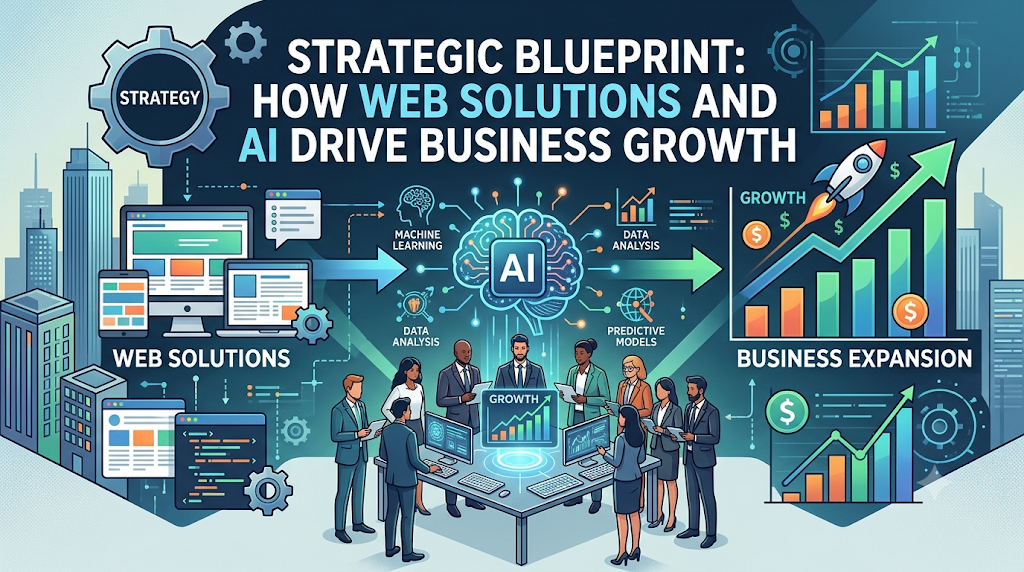
To understand how this combination drives growth, it helps to look at the division of labor between web architecture and artificial intelligence.
1. The Foundation: Web Solutions as the Data Pipeline
Web solutions provide the interface where users interact with a business. Every click, scroll, purchase, and form fill is captured by the web application. Without a stable, fast web solution, gathering clean data is impossible.
2. The Engine: AI as the Processor
Once the web solution collects data, AI algorithms process it instantly. Machine learning models—computer programs that improve automatically through experience—look at past user behavior to predict future actions.
3. The Output: Automated Actions
The system acts on those insights. It might adjust website pricing, display a targeted popup, route a support query to the right department, or update inventory forecasts in the backend database.
Why This Combination Matters for Business Growth
Combining web solutions with AI drives growth through three main levers: personalization, operational efficiency, and data-driven decision-making.
Hyper-Personalization at Scale
Old websites treated every visitor the same. AI-driven web solutions customize the user experience for every single visitor. If a returning customer visits an e-commerce site, the web layout, featured products, and special offers change instantly to match their past buying habits. This level of personalization dramatically increases sales conversion rates.
24/7 Intelligent Automation
Routine customer service requests often overwhelm small support teams. Integrating conversational AI chatbots into web portals allows businesses to resolve common questions instantly, day or night. The web solution handles the traffic, while the AI handles the conversation, freeing human staff to focus on complex tasks.
Smarter Resource Allocation
AI models integrated into business web applications can analyze sales trends and website traffic spikes. This helps inventory management systems predict stock shortages before they happen, reducing wasted spending and preventing lost sales.
Practical Examples Across Industries
| Industry | Traditional Web Approach | AI-Integrated Web Solution | Business Impact |
| E-Commerce | Static product catalogs with basic keyword search. | AI-powered visual search and personalized product recommendations. | Higher average order value and fewer abandoned carts. |
| SaaS / Tech | Standard static FAQ pages and contact forms. | Intelligent chatbots integrated into user dashboards for instant onboarding. | Lower customer churn and reduced support ticket volume. |
| Real Estate | Static listing pages with manual inquiry forms. | AI property matchmakers that suggest homes based on user browsing behavior and budget. | Higher-quality leads sent directly to sales agents. |
Real-World Considerations and Trade-Offs
While the benefits are clear, integrating AI into web solutions introduces new challenges that business leaders must manage.
Complexity and Cost
Building a standard website requires web designers and developers. Adding AI capabilities requires specialized data engineers, machine learning models, and ongoing API maintenance. This increases both initial setup costs and monthly operational expenses.
Privacy and Data Security
AI models rely heavily on data. Web solutions collect sensitive user information, including personal details, browsing history, and payment data. Mishandling this data can lead to severe privacy violations, loss of customer trust, and regulatory fines under laws like GDPR.
System Dependency
When a website relies entirely on AI for core functions like search or pricing, a server outage or an API failure can break the user experience entirely. Businesses must always maintain fallback options for when AI services go offline.
Common Mistakes Businesses Make
- Adding AI Just for Hype
- What people do: Adding a generic AI chatbot to a website simply because AI is trending.
- Why it causes problems: If the chatbot is poorly trained, it frustrates customers instead of helping them.
- What to do instead: Identify a specific business bottleneck—such as high cart abandonment or repetitive support queries—and implement AI only where it solves that exact problem.
- Ignoring Data Quality
- What people do: Feeding messy, unstructured web data directly into machine learning models.
- Why it causes problems: Poor data input leads to inaccurate AI predictions and irrelevant user recommendations.
- What to do instead: Clean and organize your website analytics, customer databases, and tracking events before connecting AI tools.
- Neglecting Mobile Responsiveness
- What people do: Building heavy AI integrations that load slowly on mobile web browsers.
- Why it causes problems: Mobile users abandon slow websites within seconds, rendering the AI features useless.
- What to do instead: Test web performance rigorously and ensure AI processes run on fast cloud servers rather than slowing down the client’s browser.
Decision-Making Framework: Is Your Business Ready?
Before investing in AI-driven web solutions, walk through these four practical steps:
- Step 1: Audit Your Current Traffic and Data: Do you have enough consistent website traffic and clean data to make AI insights useful? If your site gets very few visitors, simpler web tools may serve you better for now.
- Step 2: Identify Operational Bottlenecks: Where is your business losing the most time or money? Is it customer support, product discovery, or lead qualification?
- Step 3: Calculate ROI: Estimate the cost of development and API subscriptions against the expected increase in sales or savings in staff time.
- Step 4: Start Small: Implement a single AI feature—such as smart product recommendations or an automated FAQ bot—before attempting a complete digital overhaul.
Key Terms
- API (Application Programming Interface): A software messenger that allows different systems—such as your website and an AI model—to talk to each other.
- Machine Learning: A branch of artificial intelligence where computers learn from data and improve over time without being explicitly programmed for every scenario.
- Scalability: The ability of a web system to handle growing amounts of traffic and data without slowing down.
- Conversion Rate: The percentage of website visitors who take a desired action, such as making a purchase or filling out a contact form.
- Cloud Computing: Delivering computing services—including data storage and AI processing—over the internet rather than on local hard drives.
FAQs
Can small businesses afford AI-integrated web solutions?
Yes. Many modern website builders and cloud platforms offer built-in AI tools for search, translation, and basic automation at an affordable monthly cost. Custom AI development is expensive, but pre-built software-as-a-service (SaaS) options are accessible for small budgets.
Do I need a full-time developer to maintain an AI website?
It depends on the complexity of the setup. Simple plugins require minimal maintenance, while custom machine learning models integrated into proprietary web applications require ongoing monitoring by qualified developers or data specialists.
How does AI on a website improve SEO?
AI helps optimize website content for search engines by analyzing search intent, generating relevant metadata, suggesting internal links, and ensuring the website structure matches what users are looking for.
Is customer data safe when using third-party AI web tools?
Data security depends entirely on the tools and vendors you choose. Businesses must review privacy policies, ensure compliance with local data protection laws, and avoid sharing sensitive personal information with public AI models that use inputs for retraining.
How long does it take to see results after adding AI to a website?
Basic features like automated chat responses show immediate efficiency gains. However, personalization and recommendation engines require time to collect enough user data before their predictions become accurate and effective.
Conclusion
Combining web solutions and artificial intelligence creates a powerful engine for business growth. When designed correctly, a website stops being a passive digital brochure and becomes an active assistant that personalizes user experiences, automates tedious tasks, and scales operations.
Success requires a balanced approach: start by identifying clear business bottlenecks, protect your customer data, and focus on practical solutions rather than chasing technological trends. By blending solid web architecture with smart automation, businesses build a resilient foundation for long-term success.
