
Introduction
Reliable information is often the first thing people look for when fertility care becomes part of their plans. The difficulty is that fertility information is rarely found in one place. Details about treatments sit in one source, prices in another, outcome statistics in a third, and rules about care in different countries in yet another.
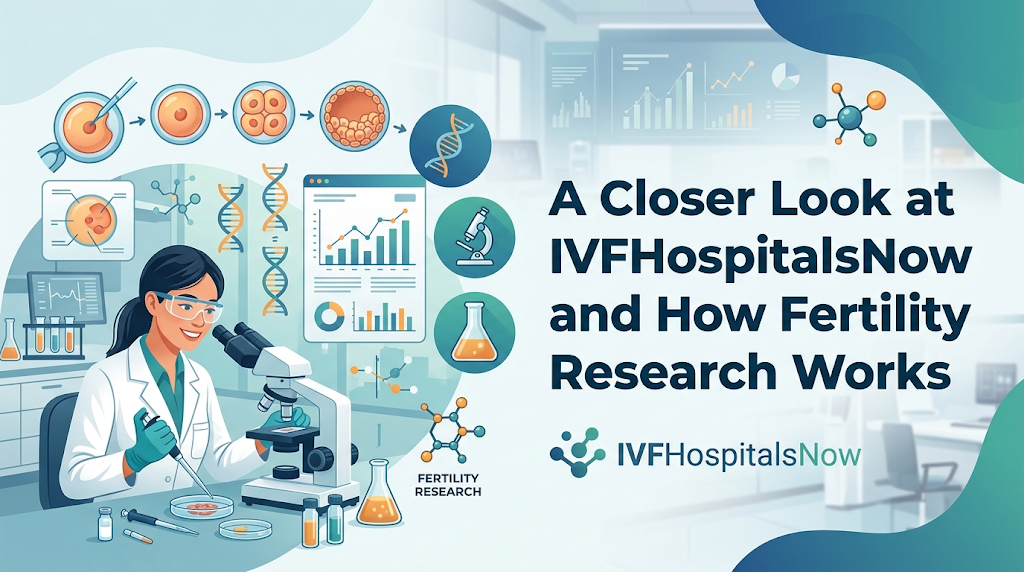
IVFHospitalsNow is an independent fertility-care education, research, and provider-discovery platform. It is intended for individuals and couples who are exploring assisted reproductive care and want to understand treatments, costs, outcomes, providers, and countries in an organized way.
This article describes what the platform offers and shows how its research approach can be applied step by step. It covers how IVF works, how to read costs and success figures, how to look at clinics and international care, and where egg freezing, ICSI, and other reproductive technologies fit. The content is for education only. It does not diagnose conditions, recommend treatments, or replace the advice of a qualified fertility specialist.
What Is IVFHospitalsNow?
IVFHospitalsNow is a platform that links fertility education with provider research. Its educational side offers medically reviewed information on topics such as IVF, ICSI, IUI, egg freezing, embryo transfer, fertility testing, medications, diagnostic tests, and treatment outcomes. Its research side offers resources for finding, understanding, shortlisting, and eventually comparing fertility providers.
The platform is designed for people at the research stage, whether they are just starting to learn or are already looking at particular treatments. It also provides country resources that cover major fertility markets, including the United States, the United Kingdom, India, Spain, Greece, the Czech Republic, Japan, and Australia, so that readers can look at costs, treatment availability, and regulations in different places.
The two sides are meant to work together. Education gives readers the vocabulary and background to judge what they find. Provider research then lets them apply that understanding to real information about doctors, locations, costs, and outcomes.
The platform does not rely on promotional “best clinic” rankings. It aims to rely on sourced information, a clear verification status, cost information, and outcome data that is interpreted correctly. The provider directory is still being developed, and providers are published only after verification. Transparency matters in this field because fertility care involves significant expense and personal consequences, and readers need to know where a piece of information comes from.
Why Careful Fertility Research Matters
No single fact can describe a fertility journey. The suitability of a treatment, the likely cost, and the meaning of outcome figures all depend on circumstances that differ from one person to the next.
A sound research process looks at these areas together:
- The type of treatment being discussed
- The total cost and what it includes
- The expected outcomes and how they are measured
- Diagnostic information and test results
- Details about clinics and their doctors
- The location and the country
- The regulations that apply to treatment
- The reproductive technologies on offer
Reliance on one source can mislead. A review tells the story of one person. A ranking may be based on criteria that are never shown. A single percentage may come from a group of patients very different from the reader. Used on their own, these can produce certainty that is not justified. Used together and in context, they help form a realistic picture that can then be discussed with a doctor.
Core Topics Every Reader Should Understand
From First Consultation to Pregnancy Test
IVF stands for in vitro fertilization, which means fertilization takes place in a laboratory rather than inside the body. IVF treatment is usually described as a sequence of stages, though the details change from patient to patient.
The sequence normally begins with a fertility assessment, where a specialist studies the medical history of the patient and, where relevant, the partner. Tests might include hormone levels, an ultrasound scan of the ovaries and uterus, and a semen analysis. These results guide the doctor’s advice on whether IVF is suitable.
Ovarian stimulation comes next. The patient uses hormone medicines so that the ovaries develop several mature eggs in one cycle. Regular scans and blood tests show how the body is responding. Once the eggs are mature, they are collected in a short procedure known as egg retrieval.
In the laboratory, the eggs are placed with sperm so that fertilization can occur. The embryology team then follows the growth of the embryos for several days. One or more embryos may be placed in the uterus during embryo transfer, and remaining embryos may be frozen when appropriate. A pregnancy test is done around two weeks later.
This is a general overview and not a personal plan. A treating specialist decides the medicines, timing, and steps for each individual.
Reading a Price List With Care
A single figure rarely describes IVF treatment cost accurately. The total depends on what is planned and who provides it, so the same headline price can mean different things at different clinics.
The cost is usually shaped by:
- The type of treatment
- Testing done before and during the cycle
- Medicines and the length of time they are needed
- Laboratory work
- Services connected to embryos, including freezing and storage
- Extra cycles, if more than one attempt is needed
- The clinic’s location
- The clinic’s fee structure
- The items placed inside a package
Before two prices are compared, each should be matched against the same list of services. A quote that leaves out medicines or monitoring may appear low but lead to a higher final amount. Requesting an itemized breakdown in writing is a practical way to see the full picture.
What a Success Percentage Really Measures
IVF success rates draw a great deal of attention, but a percentage means little until its method is clear. The same number can describe quite different things.
These details give a figure its meaning:
- Age group. Age strongly affects results, so figures are usually separated by age.
- Patient profile. The cause of infertility and general health influence outcomes.
- Type of treatment. Each treatment has its own results.
- Number of cycles. A rate may describe one attempt or a series of attempts.
- Embryo factors. Quality and whether embryos are fresh or frozen can change results.
- Reporting practice. Clinics may include or exclude different groups of patients.
- Pregnancy or live birth. A positive test and a baby born are different outcomes.
- Unit of measurement. The figure may be per cycle, per embryo transfer, or per patient.
Consider two clinics that publish 38% and 52%. If the lower figure shows live births per transfer and the higher figure shows early pregnancies per started cycle, the second clinic is not necessarily achieving more. The numbers measure different events. A published rate also summarizes past patients and cannot predict what will happen to a new one.
Information Worth Gathering About IVF Clinics
Looking at IVF clinics without a plan can lead to scattered notes and uneven comparisons. It is better to decide in advance which facts to collect and to gather the same facts for every provider.
Useful points include:
- Whether the provider has been verified and where the information comes from
- Which treatments and services are available
- The doctors and their listed qualifications
- The location and ease of access
- The laboratory technologies in use
- How clearly costs are presented
- Whether outcome data is shared and explained
- How open the provider is in answering questions
- What patient support exists during treatment
The goal is to understand each provider on its own terms, not to place providers in an order of preference.
Building a Fair Comparison
To compare fertility clinics in a way that is fair, the same questions must be asked of each one. Detailed study of one provider and a quick glance at another will tilt the result without any real basis.
A balanced review can include:
- Treatment availability
- Qualifications and specialist details
- Clarity of cost information
- How outcomes are reported
- Verification status
- Location and travel time
- Laboratory services
- Quality of communication and support
- The regulatory setting, where relevant
Giving too much weight to one item can distort the picture. A high reported percentage may come with unclear pricing. A lower price may mean fewer included services. A clinic close to home may not offer the treatment a patient wants to learn about. Using several factors together leads to a more honest assessment than any single ranking or success figure.
When Patients Look Beyond Their Own Country
Some people research IVF abroad. They may be seeking a treatment that is not easily available at home, comparing prices, or looking at how regulations differ in other countries.
Care in another country needs extra planning in these areas:
- Treatment availability and what is legally permitted
- Differences in cost and what each price includes
- Regulations that apply
- Travel, including the number of trips
- Language and clarity of communication
- Follow-up care after returning home
- The sharing of medical records between doctors
- Whether the clinic has been verified
- How treatment would continue if it needs to be repeated
- Local legal requirements
Price alone is not a sound reason to travel. A qualified specialist should first evaluate the medical situation, and the whole process, including aftercare, should be planned in advance.
How Location Changes the Price Tag
A comparison of IVF cost by country shows differences that can be large, and the reasons are usually practical:
- The healthcare system and how fertility treatment is funded
- Local costs for staff, premises, and equipment
- The price of medications in that country
- Laboratory expenses
- Taxes and additional fees
- The way treatment packages are structured
- The services included in a package
- Regulations that shape what clinics may offer
- Exchange rates, which affect any converted price
Country figures help as a first reference, but they are general. They cannot say what one patient will pay, because the final cost depends on the individual plan, the clinic, and the package.
A Closer Look at Egg Freezing
Egg freezing involves collecting a woman’s eggs, freezing them, and storing them for possible use later. People explore it for varied reasons. Some are about to receive a medical treatment that may affect fertility. Others are thinking about when they might want to have children.
The process starts like the first part of an IVF cycle. Hormone medicines help several eggs mature, and a short procedure collects them. The eggs are then frozen in a laboratory and placed in storage.
Age and personal health are important. They affect how many eggs may be collected and how likely those eggs are to be useful later. Frozen eggs do not ensure a future pregnancy, since they must be thawed, fertilized, and grown into embryos before any transfer can happen.
A discussion with a qualified fertility specialist is the right way to learn what this option might mean for a particular person.
Where ICSI Fits
ICSI stands for intracytoplasmic sperm injection. In standard IVF, eggs and sperm are placed together in a dish and fertilization takes place on its own. ICSI treatment differs because an embryologist chooses a single sperm and injects it directly into a mature egg.
ICSI is carried out within an IVF cycle. Stimulation and egg retrieval come before it, and embryo development and transfer come after it, much as in conventional IVF.
A specialist may consider ICSI in particular circumstances, such as concerns found in a semen analysis. The decision depends on the clinical picture. ICSI is not automatically better than standard IVF, and many patients proceed with conventional fertilization.
A Wider View of Treatment Choices
IVF is one approach within a larger field. A specialist may talk through several fertility treatment options, among them:
- Fertility testing, to look for possible causes
- Medication-based approaches
- IUI, or intrauterine insemination, in which prepared sperm is placed inside the uterus
- IVF
- ICSI, used as part of IVF
- Embryo transfer, with fresh or frozen embryos
- Egg freezing
- Other assisted reproductive approaches
Which approach is appropriate depends on the individual’s medical situation and the specialist’s evaluation. Knowing the range available helps readers understand why a doctor might favor one path.
Turning Research Into Useful Questions
The value of research shows most clearly when it shapes a consultation. Before contacting a provider, a reader can:
- Learn the basic terms used in fertility care
- Write down questions and concerns
- Look into costs and understand what drives them
- Review outcome information and how it was calculated
- Check the available information about the provider
- Compare the relevant factors across providers
- Understand how countries differ
- Discuss the findings with a qualified specialist
A clear set of notes helps the specialist see what is already understood and what needs further explanation.
Practical Research Process
- Learn the landscape. Read about the main categories of fertility care and the terms your doctor is likely to use.
- Record what you find. Note details on testing, treatment, cost, and outcomes, along with how each source defines its figures.
- Create a shortlist. Keep providers that offer clear, verifiable information and the services you want to ask about.
- Review each one the same way. Apply one checklist to every provider and avoid relying on a single number.
- Talk to a qualified specialist. Bring your notes to a fertility doctor, who can guide decisions based on your medical situation.
Common Research Mistakes
- Reading the quote but not the contents. Medicines, tests, and storage may be billed separately.
- Treating a rate as a prediction. It reflects a group of past patients, not you.
- Choosing by the biggest percentage. The method behind it may differ from other clinics.
- Skipping verification. Information that cannot be checked weakens a comparison.
- Focusing on cost when looking abroad. Regulations, travel, and follow-up care matter equally.
- Assuming the lowest price will cost least in total. Added cycles and extras can change the result.
- Expecting the same outcome for every patient. Medical situations are different.
- Using old or unsourced pages. Prices, practices, and rules can change.
Realistic Example
Imagine a couple who have met with a fertility specialist and were told that IVF is one of several approaches worth learning about. Before their follow-up visit, they create a simple folder of notes. One page lists the stages of IVF in their own words. Another records the costs from three providers, with a column showing which items each quote includes. A third page explains how each provider reports outcomes, noting that one reports live births per transfer by age group while another gives a single overall figure.
They also write down whether each provider’s details are verified and what rules apply in the country where each is located. At the follow-up visit, they share the folder with the specialist, ask which of the differences actually matter for their situation, and listen to guidance based on their medical history. The notes did not make the decision for them. They made the conversation clearer and more focused.
Useful Comparison Table
| Research Factor | What to Check | Why It Matters |
|---|---|---|
| Success-rate reporting | The age group, the outcome counted, and whether it is per cycle or per transfer | Figures built on different measures cannot be compared directly |
| Treatment cost | The services covered and those billed separately | Prices are comparable only when they describe the same care |
| Included services | Medicines, scans, tests, embryo freezing, and storage | Missing items can raise the final total |
| Provider verification | Whether the information is confirmed and sourced | Verified details make the research more dependable |
| Treatment availability | Whether the treatment you want to discuss is offered | An attractive price does not help if the service is absent |
| Location | Distance, travel time, and number of appointments | Treatment may need repeated visits |
| Country regulations | Local rules and legal requirements | Rules determine which treatments can be provided |
| Follow-up care | Support after treatment, especially in another country | Care continues after the main procedure |
Frequently Asked Questions
What is a fertility assessment?
It is the first stage of fertility care, in which a specialist reviews medical history and may order tests such as hormone checks, scans, or a semen analysis to understand the situation.
Why are medicines sometimes priced separately?
Medicine needs differ between patients, so some providers leave them out of the main fee. This is why reading a quote’s contents matters.
Can success figures from different countries be compared?
Only with care. Countries and clinics may measure and report results differently, so the method behind each figure should be understood first.
What does fertility testing involve?
Testing may include blood tests for hormones, imaging of the reproductive organs, and a semen analysis. The specific tests depend on the situation and are chosen by the specialist.
Are frozen eggs the same as frozen embryos?
No. Frozen eggs have not been fertilized, while frozen embryos have been created by combining egg and sperm before freezing. They are used differently in treatment.
How current should cost information be?
As current as possible. Prices and package contents change, so it is wise to confirm figures directly with a provider before relying on them.
Will every clinic be found in the provider directory?
Not necessarily. The directory is still being developed, and providers are published only after verification.
What should I prepare before speaking with a specialist?
Prepare your medical history, any test results, a list of questions, and your notes on costs, outcomes, and providers.
Conclusion
Sound fertility research rests on information that is sourced, explained in plain terms, and read in context. That applies to the meaning of treatments, to the real content of a price, and to what a success figure actually measures.
Providers and countries deserve to be reviewed on several points, never on one number alone, and every treatment decision belongs in a discussion with a qualified medical professional. IVFHospitalsNow supports the preparation that comes before that discussion.
