
Introduction
The way data is handled in the modern workplace has shifted. In the past, data was static and lived in silos. Today, it flows constantly. Managing this flow is no longer just a task for database administrators. It requires a specialized approach known as DataOps. The goal is to bring the speed of DevOps to the world of data. This guide explores how the Certified DataOps Architect (CDOA) program helps professionals master this shift. Whether you are an engineer in India or managing a global team, understanding these principles is the key to building reliable data pipelines.
What is CDOA – Certified DataOps Architect?
The CDOA is a professional program designed to teach the architecture of data operations. It focuses on the bridge between data engineering and automated operations. An architect in this field is responsible for creating systems where data is processed, tested, and deployed with high quality and speed. It is not just about moving data; it is about building the factory that moves it.
Why it Matters Today?
Data is the fuel for every modern application, yet most companies struggle with “data debt.” Projects are often delayed because the data is messy or the pipelines break. A DataOps approach solves these problems by applying automation and monitoring to data workflows. Businesses now demand professionals who can ensure data is always ready for analysis and machine learning models without manual intervention.
Why CDOA – Certified DataOps Architect Certifications are Important
Validation is necessary in a competitive job market. This certification proves that a professional understands how to reduce the cycle time of data analytics. It shows that the holder can manage data quality and ensure compliance automatically. For an engineer, it serves as a roadmap to transition from traditional data management to modern, automated architectures.
Why Choose DataOpsSchool?
The right environment is needed for learning complex technical skills. At DataOpsSchool, the focus is placed on real-world scenarios rather than just theory. The programs are designed by people who have spent decades solving data problems. Learners are given access to tools and environments that mimic actual production settings. This practical focus ensures that the knowledge gained can be applied to a job immediately. Support is provided by a community of experts who understand the challenges of modern data architecture.
Certification Deep-Dive: CDOA – Certified DataOps Architect
What is this certification?
This is an advanced-level program that focuses on the design and implementation of automated data pipelines. It covers the entire lifecycle of data from ingestion to consumption with a heavy focus on quality and speed.
Who should take this certification?
- Data Engineers looking to automate their workflows.
- DevOps Engineers moving into data-heavy environments.
- Platform Engineers building data infrastructure.
- Solution Architects designing modern data stacks.
Certification Overview Table
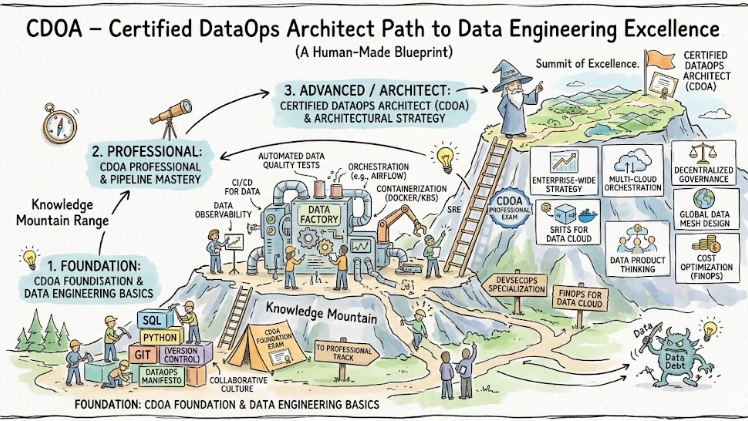
| Track | Level | Who it’s for | Prerequisites | Skills Covered | Recommended Order |
| DataOps Professional | Associate | Beginners | Basic SQL/Linux | Data Pipelines, Git | 1st |
| DataOps Engineer | Professional | Working Engineers | DevOps Basics | CI/CD for Data, Testing | 2nd |
| Certified DataOps Architect | Master | Senior Engineers | Engineering Exp | Architecture, Scaling | 3rd |
| MLOps Specialist | Specialist | ML Engineers | DataOps Basics | Model Deployment | 4th |
| Data Governance Lead | Leadership | Managers | CDOA Knowledge | Ethics, Compliance | 5th |
Skills You Will Gain
- Automated data pipeline construction.
- Implementation of “Data as Code” principles.
- Continuous Integration and Delivery (CI/CD) for data.
- Statistical process control for data quality.
- Cloud-native data architecture design.
- Monitoring and alerting for data flows.
Real-World Projects You Should Be Able to Do
- Build a self-healing data pipeline that detects schema changes.
- Create an automated testing suite for large-scale data warehouses.
- Design a multi-cloud data migration strategy with zero downtime.
- Implement a centralized data monitoring dashboard for an enterprise.
Preparation Plan
7–14 Days Plan (The Fast Track)
- Days 1-3: Focus on the core pillars of DataOps and the Manifesto.
- Days 4-7: Learn the tools used for data orchestration and version control.
- Days 8-14: Practice with sample exams and review architecture diagrams.
30 Days Plan (The Standard Track)
- Week 1: Deep dive into data engineering fundamentals and Linux.
- Week 2: Master CI/CD tools and how they apply to data scripts.
- Week 3: Focus on automated testing and data quality monitoring.
- Week 4: Build a capstone project and review the CDOA study guide.
60 Days Plan (The Deep Learning Track)
- Month 1: Comprehensive study of data platforms, cloud providers, and SQL optimization.
- Month 2: Hands-on labs every day, focusing on real-world troubleshooting and complex architecture design.
Common Mistakes to Avoid
- Focusing only on tools and ignoring the cultural shift of DataOps.
- Neglecting the importance of automated testing for data.
- Underestimating the complexity of data governance and security.
- Skipping the hands-on labs during the preparation phase.
Best Next Certification After This
- Same Track: MLOps Specialist.
- Cross-Track: Certified DevSecOps Professional.
- Leadership / Management: Data Governance and Ethics Lead.
Choose Your Learning Path
1. DevOps Path
This path is best for those who already manage infrastructure but want to handle data workloads. It focuses on using Jenkins, GitLab, and Docker to wrap around data tasks.
2. DevSecOps Path
Best for security-minded engineers. It teaches how to mask sensitive data and ensure privacy laws are followed automatically within the pipeline.
3. Site Reliability Engineering (SRE) Path
Ideal for engineers focused on uptime. This path teaches how to set Service Level Objectives (SLOs) for data pipelines and manage incident response for data breaks.
4. AIOps / MLOps Path
Designed for those working with Artificial Intelligence. It bridges the gap between data architecture and the training of machine learning models.
5. DataOps Path
The core path for data professionals. It focuses on the end-to-end lifecycle of data delivery and operational excellence.
6. FinOps Path
Best for those managing cloud costs. It teaches how to monitor the expenses of massive data processing and storage tasks to keep them within budget.
Role → Recommended Certifications Mapping
| Role | Primary Cert | Secondary Cert | Leadership Goal |
| DevOps Engineer | CDOA | DevSecOps | Engineering Manager |
| SRE | CDOA | AIOps | Platform Lead |
| Platform Engineer | CDOA | Cloud Architect | Head of Infrastructure |
| Cloud Engineer | CDOA | FinOps | Cloud Director |
| Security Engineer | DevSecOps | CDOA | CISO |
| Data Engineer | CDOA | MLOps | Chief Data Officer |
| FinOps Practitioner | FinOps | CDOA | Financial Controller |
| Engineering Manager | CDOA | Leadership | VP of Engineering |
Next Certifications to Take
One Same-Track Certification
The MLOps Specialist certification is a natural next step. It allows the architect to apply their data pipeline knowledge to the specific needs of machine learning models. This ensures that the entire AI lifecycle is automated.
One Cross-Track Certification
The Certified DevSecOps Professional program is highly recommended. As data becomes more sensitive, knowing how to integrate security into the automated workflow is a critical skill for any architect.
One Leadership-Focused Certification
The Data Governance and Strategy program should be considered. It moves the professional from technical implementation to high-level decision-making about how an entire organization uses and protects its data.
Training & Certification Support Institutions
DevOpsSchool
A premier institution known for its deep technical dives. Support is provided for various tracks, including DevOps and DataOps, with a focus on human-led training.
Cotocus
Specialized training is offered here for modern cloud technologies. Practical labs and real-world scenarios are used to prepare students for high-level certifications.
ScmGalaxy
A community-driven platform that provides extensive resources for software configuration and operations. It is a great place for technical documentation and guides.
BestDevOps
This site offers curated paths for those looking to excel in automation. It simplifies the learning process for complex engineering roles.
devsecopsschool.com
Everything related to the intersection of security and operations is taught here. It is a key resource for engineers wanting to protect their pipelines.
sreschool.com
The focus is placed entirely on reliability and systems engineering. It provides the tools needed to keep large-scale applications running smoothly.
aiopsschool.com
This institution explores the world of AI-driven operations. It is ideal for those looking to use machine learning to improve IT performance.
dataopsschool.com
The primary source for DataOps education. All levels of data operations, from associate to master, are covered with a focus on practical architecture.
finopsschool.com
Instruction is provided on managing the financial side of the cloud. It is essential for anyone looking to control infrastructure costs.
FAQs Section
1. What is the difficulty level of the CDOA exam?
The exam is considered to be at a master level. It requires a solid understanding of both data engineering and automation principles.
2. How much time is required to prepare for CDOA?
For an experienced engineer, 30 to 60 days of consistent study is usually enough to feel confident.
3. Are there any prerequisites for CDOA?
While anyone can take the course, having a background in SQL, Linux, and basic DevOps concepts is highly beneficial.
4. What is the recommended certification sequence?
It is usually best to start with a Professional DataOps Engineer cert before moving to the Certified DataOps Architect level.
5. What is the career value of this certification? Professionals with this cert often see increased interest from recruiters and can command higher salaries in data-driven industries.
6. Which job roles benefit most from CDOA?
Data Engineers, Platform Engineers, and Architects benefit the most from this specialized knowledge.
7. How does CDOA help with career growth?
It moves you from being a “doer” to a “designer.” You begin to lead projects rather than just working on them.
8. Is this certification recognized globally?
Yes, the principles taught in the CDOA program are used by top tech companies across the world.
9. Can I take the exam online?
Yes, the certification process is designed to be accessible from anywhere with a stable internet connection.
10. How long is the certification valid?
The certification is typically valid for two years, after which renewal is required to stay current with new technology.
11. Is there hands-on training provided?
The programs at DataOpsSchool include extensive lab work to ensure practical skills are developed.
12. Does this help with remote job opportunities?
Yes, companies looking for remote architects value certifications that prove you can handle complex, automated systems independently.
CDOA – Certified DataOps Architect Specific FAQs
1. Does CDOA cover specific tools like Spark or Airflow?
The program focuses on the architecture and principles, but these common tools are used in the practical labs.
2. How is CDOA different from a standard Data Engineering cert?
CDOA focuses on the operations and automation of the data, not just the code written to move it.
3. Is cloud knowledge required for CDOA?
Yes, since most modern DataOps is performed in the cloud, knowledge of AWS, Azure, or GCP is expected.
4. What kind of questions are on the CDOA exam?
A mix of scenario-based questions and technical architecture problems is used to test your knowledge.
5. Can a manager take this certification?
Yes, many engineering managers take it to better understand how to structure their teams and workflows.
6. Is there a community for CDOA holders?
Yes, a private network is available for those who have passed the exam to share ideas and job leads.
7. How often is the CDOA curriculum updated?
The content is reviewed regularly to ensure it includes the latest trends in the data industry.
8. Does CDOA cover data security?
Yes, basic security and governance are integrated into the architecture modules.
Testimonials
The skills I gained from this program allowed me to automate my company’s entire data flow. My confidence in handling large systems has grown tremendously. — Vikram
After completing the architect track, I finally understood how to bridge the gap between our data scientists and our operations team.— Sarah
This certification gave me the career clarity I was looking for. I moved from a general cloud role into a specialized data architect position. — Amit
The real-world projects were the best part. I was able to apply what I learned to our production environment the very next week. — Elena
As a manager, this helped me design better workflows for my team. We have seen a significant decrease in our data pipeline errors.— Rajesh
Conclusion
The Certified DataOps Architect (CDOA) certification is a powerful tool for anyone looking to lead in the age of data. By mastering the art of automated data operations, you protect your career from becoming obsolete. The ability to build fast, reliable, and secure data pipelines is in high demand across all industries. Investing in this certification is not just about a piece of paper; it is about adopting a strategic mindset that will benefit you for years to come. Start your learning path today and become the architect your organization needs.
