
Introduction
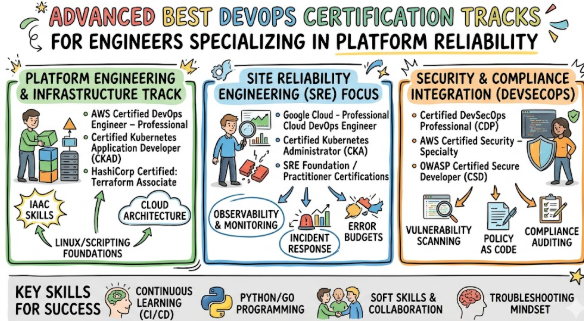
In today’s fast-paced software development landscape, DevOps is no longer just a trend—it is the industry standard for delivering high-quality software at scale. However, with the rapid evolution of cloud-native tools, Kubernetes, and AI/ML integration, professionals often struggle to identify which certifications actually provide career-defining value. Navigating the crowded space of IT credentials requires a strategic roadmap that aligns with your specific career goals, whether you are aiming for Site Reliability Engineering (SRE), DevSecOps, or advanced Platform Engineering roles.
What is a DevOps Certification?
A Best DevOps certification is a structured validation of your technical proficiency in bridging the gap between software development and IT operations. These programs move beyond theoretical knowledge, requiring candidates to demonstrate mastery of essential concepts like Continuous Integration/Continuous Deployment (CI/CD), infrastructure as code (IaC), containerization, and monitoring. By earning a certification, you provide tangible proof to employers that you possess the hands-on expertise to automate workflows, manage cloud infrastructure, and maintain system reliability.
Why DevOps Certifications Matter
Certifications serve as a catalyst for professional growth by providing a standardized framework to master complex technologies. They help you stay ahead of the curve in a field where toolsets change every few years.
The Certification Process:
- Identify Your Niche: Determine if you are leaning toward security (DevSecOps), infrastructure (Cloud/Kubernetes), or intelligence (MLOps/AI).
- Select Industry-Recognized Credentials: Choose certifications that are highly valued by employers and include significant hands-on lab components.
- Engage in Structured Learning: Leverage instructor-led training to understand core principles and architectural patterns.
- Prioritize Hands-On Labs: Apply tools like Terraform, Docker, and Kubernetes in real-world environments to solidify your learning.
- Achieve Certification: Take the exam to validate your skills and boost your professional credibility.
Who Should Take DevOps Certifications
These programs are designed for a broad spectrum of IT professionals looking to modernize their technical stack and career trajectory:
- Students & Freshers: Looking to build a strong foundation in modern software delivery.
- Software Engineers: Wanting to bridge the gap between code and production.
- System Administrators: Transitioning toward infrastructure-as-code and cloud management.
- Cloud & Platform Engineers: Seeking to master orchestration and scalable architecture.
- DevSecOps & SRE Professionals: Focused on system reliability, security integration, and automation.
- Data & ML Engineers: Aiming to apply DevOps principles to the machine learning lifecycle (MLOps).
Core Skills Covered
- CI/CD Pipeline Automation: Mastering tools to automate build, test, and deployment phases.
- Infrastructure as Code (IaC): Using declarative languages to provision and manage cloud resources.
- Containerization & Orchestration: Expert-level knowledge of running and scaling applications in container environments.
- Observability & Monitoring: Implementing systems to track health, performance, and log data.
- Cloud Security & Governance: Applying security policies across the software supply chain.
Table 1: Best DevOps Certifications
| Certification Name | Best For | Skill Level | Career Direction |
| DevOps Certified Professional (DCP) | Foundations | Beginner | DevOps Engineer |
| DevSecOps Certified Professional (DSOCP) | Security Integration | Intermediate | DevSecOps Engineer |
| Site Reliability Engineering (SRE) Certified Professional | System Reliability | Advanced | SRE |
| Master in DevOps Engineering (MDE) | Intermediate DevOps | Intermediate | Lead DevOps Engineer |
| Master in Azure DevOps | Azure Cloud | Intermediate | Cloud Architect |
| AWS Certified DevOps Professional | AWS Cloud | Advanced | Cloud Engineer |
| Master in Python Programming | Automation | Beginner | DevOps/ML Engineer |
| Hashicorp Certified Terraform Associate | Infrastructure as Code | Intermediate | Cloud/Platform Engineer |
| Certified Kubernetes Administrator (CKA) | Orchestration | Advanced | Kubernetes Admin |
| Docker Certified Associate (DCA) | Containerization | Intermediate | Platform Engineer |
| Envoy ISTIO Certification Training | Service Mesh | Advanced | Network/SRE |
| MLOps Certification Training Course | AI/ML Pipelines | Advanced | MLOps Engineer |
| Google Cloud Professional Cloud DevOps Engineer | Google Cloud | Advanced | Cloud Engineer |
| Master in Machine Learning | AI/ML Basics | Beginner | ML Engineer |
| Master in Artificial Intelligence | AI Fundamentals | Intermediate | AI Engineer |
| Master in AppDynamics | Monitoring | Intermediate | Observability Engineer |
| Master in Data Science | Data Engineering | Intermediate | Data Scientist |
| Master in Deep Learning | Neural Networks | Advanced | Research Engineer |
| Prometheus with Grafana | Monitoring | Intermediate | SRE/DevOps |
| GitOps Certified Professional (GOCP) | GitOps/Automation | Intermediate | Platform Engineer |
Certification Deep Dive
To succeed in any certification, you must understand how they fit into the broader technical landscape.
- Real-World Use Case: Imagine an e-commerce platform migrating from manual deployments to an automated pipeline. A certified professional uses Terraform to provision infrastructure, Kubernetes to scale services, and Prometheus to monitor site latency, ensuring 99.9% uptime.
- Skills You Will Learn: Cloud-native architecture, CI/CD pipeline design, container security, automated provisioning, and incident response.
- Career Scope: Roles range from entry-level automation engineers to senior architects and MLOps specialists.
- Difficulty Level: Ranges from foundational (DCP) to highly technical and lab-intensive (CKA, MLOps).
- Best Career Fit: Professionals looking to automate manual processes and manage large-scale cloud infrastructure.
- Who Should Take It: Anyone seeking to transition from traditional IT to modern, agile software delivery models.
- Hands-On Projects: Building end-to-end CI/CD pipelines, containerizing legacy applications, and setting up automated observability dashboards.
DevOps Certification Roadmap
| Career Goal | Recommended Certification Path | Why It Fits |
| DevOps Foundations | DCP → MDE | Builds a strong, comprehensive baseline. |
| Cloud Infrastructure | Terraform Associate → CKA | Focuses on professional infrastructure management. |
| Security Focused | DSOCP → GitOps Professional | Prioritizes secure, automated code workflows. |
| SRE & Operations | SRE Professional → Prometheus/Grafana | Targets system reliability and monitoring. |
| AI/ML Integration | Master in Python → MLOps | Bridges the gap between ML models and production. |
Common Mistakes to Avoid
- Ignoring Hands-On Practice: Relying solely on theory without deploying real infrastructure.
- Chasing Too Many Certifications: Collecting badges without deep-diving into the specific tools needed for your target role.
- Skipping Foundations: Jumping into advanced Kubernetes training without understanding Docker or OS basics.
- Lack of Project Documentation: Failing to document the projects you build during training for your resume.
- Ignoring Soft Skills: Overlooking the communication and collaboration aspects essential for DevOps culture.
Real-Life Examples
- A system administrator completes the CKA, allowing them to manage complex microservices architectures and reduce deployment bottlenecks.
- A software developer gains MLOps certification to automate the retraining and deployment of predictive models in a retail application.
- An IT manager uses the DSOCP framework to implement security checks early in the development lifecycle, preventing production vulnerabilities.
- A cloud engineer earns the Terraform Associate credential to standardize infrastructure provisioning across multiple global regions.
- A QA engineer transitions to a DevSecOps role by learning automated testing and CI/CD principles, shortening release cycles significantly.
FAQs
How long does it take to get DevOps certified?
It depends on your background and the certification level. Foundational certifications can take 4–8 weeks, while advanced architecture or SRE certifications may require 3–6 months of consistent study and practice.
Is experience required before taking a DevOps certification?
While some entry-level certifications are beginner-friendly, having a basic understanding of Linux, networking, and programming (like Python) significantly accelerates your progress and improves your grasp of the material.
Which certification should I start with?
If you are new to the field, start with the DevOps Certified Professional (DCP) program. It provides the necessary foundation in CI/CD, automation, and DevOps culture before you specialize in specific tools.
How do I choose between AWS and Azure certifications?
Choose based on your current organization’s cloud provider or your regional job market demand. If your target company uses Azure, focus on Azure DevOps paths; if they are AWS-centric, pursue AWS Professional certifications.
Do these certifications include labs?
High-quality programs, such as those provided by BestDevOps, prioritize instructor-led, lab-based training because practical application is essential for mastering DevOps toolsets.
Can a DevOps certification guarantee a job?
A certification is a powerful tool to get past screening filters and prove technical competency, but it must be combined with a strong portfolio of hands-on projects to demonstrate your ability to solve real business problems.
How often should I recertify?
Most industry-standard DevOps certifications have a validity of 2–3 years. This ensures that your knowledge remains relevant as new technologies and security standards emerge.
Is Kubernetes the most important DevOps skill?
Kubernetes is a critical skill for modern container orchestration, but it is part of a larger ecosystem. You should balance Kubernetes knowledge with expertise in CI/CD, cloud platforms, and observability.
Are online certifications valued by employers?
Yes, especially if the curriculum includes hands-on experience and industry-recognized toolsets. Employers look for candidates who can demonstrate they have successfully applied these tools in simulated or real environments.
Can I become an SRE without a DevOps background?
SRE and DevOps are closely related. You can transition to SRE by focusing on monitoring, system reliability, and automated incident management, often using foundations from DevOps training as a starting point.
How does MLOps differ from standard DevOps?
MLOps applies DevOps principles to the machine learning lifecycle, focusing on data versioning, model training pipelines, and monitoring AI model performance in production, which is distinct from traditional application code delivery.
Does this guide apply to non-technical managers?
Yes. Understanding the DevOps ecosystem helps managers effectively lead technical teams, plan project timelines, and understand the requirements for building scalable, secure, and resilient infrastructure.
Conclusion
Embarking on a DevOps certification journey is a structured way to transform your career. By following a role-based roadmap—starting with foundational knowledge, moving into specialized toolsets like Kubernetes or Terraform, and validating your skills through hands-on practice—you position yourself as a highly valuable asset in the IT industry. Remember that certifications are the starting point; the real mastery comes from consistently building, breaking, and fixing systems in real-world scenarios.
