
Introduction
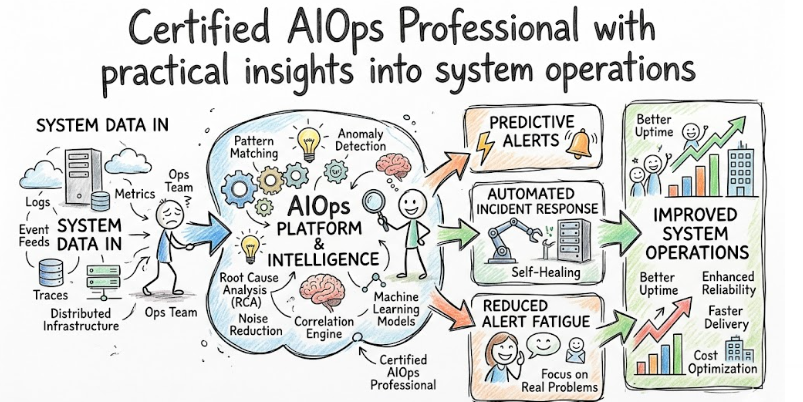
A shift in how modern infrastructure is managed is being observed across the global IT landscape. Traditional methods of monitoring and incident response are being found insufficient for the scale of today’s cloud environments. To address these challenges, Artificial Intelligence for IT Operations (AIOps) has been introduced. This guide is written to provide a clear understanding of the Certified AIOps Professional program. Insights are shared here to help engineers and managers navigate this advanced career path.
What is Certified AIOps Professional?
The Certified AIOps Professional is a specialized designation awarded to individuals who demonstrate mastery in combining AI and machine learning with IT operations. The focus is placed on the automation of routine tasks, the identification of patterns in telemetry data, and the prediction of system failures before they occur. It is designed to bridge the gap between traditional DevOps practices and intelligent, self-healing systems.
Why it matters today?
Data is being generated at a rate that exceeds human capacity for manual analysis. In modern enterprise environments, thousands of logs, metrics, and traces are produced every second. When outages happen, the root cause is often buried under a mountain of noise. AIOps is seen as the solution to this complexity. By utilizing algorithms, noise is filtered, and actionable insights are delivered to engineering teams. Efficiency is increased, and the time taken to resolve issues is significantly reduced.
Why Certified AIOps Professional certifications are important
The validation of technical skills is provided through formal certification. In a competitive job market, professional credibility is established when a recognized standard is met. This certification ensures that the principles of algorithmic IT operations are understood deeply. Furthermore, a structured learning path is offered, which prevents the confusion often caused by self-study. Career growth is accelerated when a professional can prove their ability to manage AI-driven infrastructure.
Why choose AIOps School?
Specialized knowledge is offered by AIOps School that is not found in general cloud training programs. The curriculum is curated by industry experts who have spent decades managing large-scale systems. Practical application is prioritized over theoretical lectures. By choosing this institution, access to a community of like-minded professionals is gained. Continuous support is provided to ensure that the certification exam is cleared and the concepts are applied successfully in real-world scenarios.
Certification Deep-Dive
What is this certification?
This program is a comprehensive validation of an engineer’s ability to implement AI and ML models within IT operations. It is focused on enhancing observability, automated root cause analysis, and predictive maintenance.
Who should take this certification?
The certification is intended for DevOps engineers, Site Reliability Engineers (SREs), and Cloud Architects. It is also highly recommended for Engineering Managers who wish to lead data-driven operations teams.
Certification Overview Table
| Track | Level | Who it’s for | Prerequisites | Skills Covered | Recommended Order |
| DevOps | Intermediate | Systems Admins | Basic Linux/Scripting | CI/CD, IAC, Docker | 1 |
| DevSecOps | Advanced | Security Engineers | DevOps Basics | Security Scanning, Compliance | 2 |
| SRE | Advanced | Platform Engineers | DevOps/Admin Exp | SLIs, SLOs, Error Budgets | 3 |
| AIOps/MLOps | Specialist | SREs/Data Engineers | Python/Statistics | ML Models, Data Pipelines | 4 |
| DataOps | Specialist | Data Engineers | SQL/Big Data | Orchestration, Quality | 5 |
| FinOps | Management | Managers/Architects | Cloud Knowledge | Cost Optimization, Billing | 6 |
Skills you will gain
- Large-scale data collection from distributed systems is mastered.
- Machine learning models are applied to IT telemetry data.
- Anomalies in system behavior are detected automatically.
- Noise reduction techniques are implemented in alerting systems.
- Automated incident response workflows are designed and deployed.
- Predictive analytics are used to forecast resource requirements.
Real-world projects you should be able to do after this certification
- An intelligent alerting system is built to reduce “alert fatigue.”
- A predictive scaling model is developed for cloud-native applications.
- Log patterns are analyzed using natural language processing to find bugs.
- A self-healing infrastructure is created that restarts services based on ML triggers.
- A dashboard is designed that visualizes the health of the entire stack using AI insights.
Preparation plan
7–14 days plan
The core concepts of AIOps and the official study guide are reviewed. Focus is placed on understanding the different types of machine learning algorithms used in IT operations. Practice questions are attempted to identify weak areas.
30 days plan
Daily study of two hours is maintained. Labs are performed to understand data ingestion and model training. The integration of AIOps tools with existing DevOps pipelines is explored in detail. Mock exams are taken weekly.
60 days plan
A deep dive into statistics and data science basics is conducted. Real-world case studies are analyzed to see how AIOps is implemented in large enterprises. The final two weeks are dedicated to intensive revision and hands-on project completion.
Common mistakes to avoid
- The importance of data quality is often underestimated.
- Attempting to automate everything at once is a common error.
- Statistical basics are ignored in favor of complex ML tools.
- The collaboration between data scientists and operations teams is overlooked.
- Exam preparation is rushed without sufficient hands-on practice.
Best next certification after this
- Same track: Certified MLOps Engineer (to deepen machine learning operationalization).
- Cross-track: Site Reliability Engineering (SRE) Foundation (to strengthen operational basics).
- Leadership / management: Certified FinOps Professional (to manage the financial impact of AI operations).
Choose Your Learning Path
DevOps Learning Path
This path is designed for those who focus on the software delivery lifecycle. Tools for continuous integration and deployment are learned. It is best for engineers who want to automate the path from code to production.
DevSecOps Learning Path
Security is integrated into every stage of the pipeline in this track. It is ideal for professionals who want to ensure that speed does not come at the cost of safety.
Site Reliability Engineering (SRE) Learning Path
Focus is placed on system availability and reliability. This path is suitable for those who enjoy solving complex production issues and building scalable systems.
AIOps / MLOps Learning Path
Intelligence is added to operations. This path is best for data-driven engineers who want to use machine learning to solve operational bottlenecks.
DataOps Learning Path
The flow of data within an organization is managed here. It is best for professionals working with big data, ensuring that data pipelines are reliable and high-quality.
FinOps Learning Path
The financial health of cloud infrastructure is the priority. This path is perfect for those who want to balance technical performance with cost-efficiency.
Role → Recommended Certifications Mapping
| Role | Recommended Certification |
| DevOps Engineer | Certified DevOps Master |
| Site Reliability Engineer (SRE) | Certified SRE Professional |
| Platform Engineer | Kubernetes Certified Administrator |
| Cloud Engineer | Certified Cloud Operations Specialist |
| Security Engineer | Certified DevSecOps Professional |
| Data Engineer | Certified DataOps Professional |
| FinOps Practitioner | Certified FinOps Specialist |
| Engineering Manager | Certified Digital Transformation Leader |
Next Certifications to Take
One same-track certification
The Advanced AIOps Implementation certification is recommended. Deep architectural patterns for AI integration are explored in this program.
One cross-track certification
The Certified MLOps Professional is a great choice. The gap between data science and production deployments is bridged by this certification.
One leadership-focused certification
The Engineering Management Excellence certification should be considered. Skills for leading high-performance technical teams are developed in this track.
Training & Certification Support Institutions
DevOpsSchool
Extensive training programs for all modern “Ops” tracks are provided here. A community-driven approach is used to help students master complex tools.
Cotocus
Corporate training and consulting services are delivered with a focus on digital transformation. Real-world scenarios are used to ensure that certification knowledge is practical.
ScmGalaxy
A vast repository of tutorials and technical guides is maintained by this institution. Support is offered for professionals looking to enhance their software configuration management skills.
BestDevOps
Curated learning paths for DevOps and SRE are offered. Simplification of technical concepts is the primary goal of their training programs.
devsecopsschool.com
A dedicated focus on security in the DevOps pipeline is provided. Hands-on labs are used to teach the latest security automation tools.
sreschool.com
Specialized training for Site Reliability Engineering is delivered. Concepts like error budgets and incident management are explored deeply.
aiopsschool.com
The leading platform for AIOps and MLOps education. Industry-recognized certifications and expert-led workshops are provided.
dataopsschool.com
Data pipeline automation and quality management are taught. This institution supports data engineers in building scalable data architectures.
finopsschool.com
Cloud cost management and optimization are the core subjects. Support is provided for professionals aiming to master the financial side of cloud computing.
FAQs Section
- What is the difficulty level of this certification?
The difficulty level is considered intermediate to advanced. A solid understanding of IT operations and basic data concepts is required. - How much time is required to prepare?
Usually, 4 to 8 weeks are needed depending on the prior experience of the candidate. - Are there any prerequisites for the exam?
No formal prerequisites are mandatory, but experience in DevOps or SRE is highly recommended. - What is the best certification sequence to follow?
It is suggested that DevOps is mastered first, followed by SRE, and then AIOps. - What is the career value of becoming a Certified AIOps Professional?
Significant salary increases and opportunities in top-tier technology companies are often observed. - Which job roles are suitable after this certification?
Roles such as AIOps Engineer, SRE, and Automation Architect are commonly pursued. - Is the exam conducted online?
Yes, the examination is delivered through a secure online proctoring system. - How long is the certification valid?
The certification is typically valid for two or three years, after which renewal is encouraged. - Are practical labs included in the training?
Yes, hands-on labs are a core component of the learning experience provided by AIOps School. - Does this certification help in moving to a management role?
Knowledge of AI-driven efficiency is highly valued in engineering management. - Is Python knowledge necessary?
Basic familiarity with Python is helpful as it is commonly used in ML models. - Can a beginner in IT take this certification?
It is better for a beginner to start with the DevOps Foundation before moving to AIOps.
Additional FAQs: Certified AIOps Professional
- How does AIOps differ from traditional monitoring?
Traditional monitoring is based on static thresholds, whereas AIOps uses dynamic AI models to find issues. - Is the Certified AIOps Professional recognized globally?
Yes, the certification is respected by major organizations across the world. - What tools are covered in the curriculum?
Various open-source and enterprise AIOps tools for logging, monitoring, and analysis are discussed. - How are ML models used in IT operations?
Models are used for clustering similar alerts and predicting when a disk might fail. - Does this certification cover MLOps as well?
The focus is primarily on IT operations, but the foundational principles of MLOps are introduced. - What kind of support is provided by AIOps School?
Mentorship, study materials, and access to a dedicated forum are provided to all students. - Are there mock exams available?
Multiple practice tests are offered to help candidates prepare for the actual exam environment. - What is the passing score for the exam?
A passing score of 70% is generally required to earn the certification.
Testimonials
Arjun
The understanding of how to manage noise in alerting systems was greatly improved. A clear path for implementing AI in my daily tasks was provided.
Chloe
Confidence in handling large-scale production incidents was gained. The predictive maintenance concepts are now being applied to our cloud infrastructure.
Sanjay
The complexity of machine learning was simplified. A better way to visualize system health was learned through this certification.
Elena
New skills for automating root cause analysis were acquired. The career clarity received from this program has been invaluable for my growth.
Marcus
The ability to lead a data-driven operations team was developed. This certification is a must for anyone moving into a senior engineering role.
Conclusion
The importance of the Certified AIOps Professional certification cannot be overstated in a world dominated by complex data. Long-term career benefits are secured by those who embrace the power of artificial intelligence in IT operations. Strategic learning and careful certification planning are encouraged for every professional who wishes to remain relevant. By completing this guide, the first step toward becoming a future-ready engineer has been taken.
