
Introduction
Planning a move abroad is an exciting journey, and Austria is one of the most beautiful, safe, and stable places to build your future. When you decide to make Austria your new home, the very first step is understanding how their immigration system evaluates you. The core of this process is the Red-White-Red Card, which uses a strict points-based structure to invite skilled professionals, founders, and key workers into the country. In my time helping professionals relocate, I always tell my clients that knowing exactly where you stand in this system is half the battle won. We will walk through exactly how you can measure your profile, what matters most to the Austrian authorities, and how to set yourself up for a successful and smooth move.
What is the Austria PR Points Calculator?
The Austria PR points calculator is a practical orientation tool that helps you estimate your eligibility for the Red-White-Red Card. It looks closely at your professional background, education, and personal details to see if you meet the country’s immigration standards.
Why it matters: It gives you a clear reality check before you invest time, emotion, and money into a visa application. It highlights your strong areas and shows you exactly where you might need a little improvement before submitting your file.
How it works:
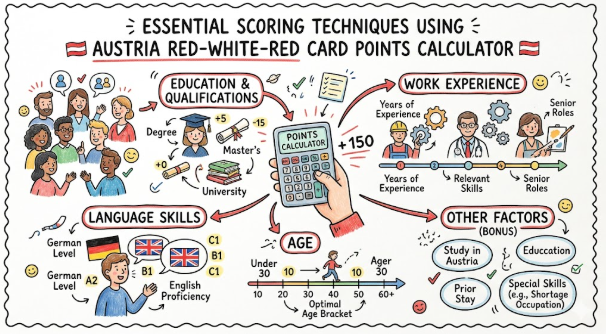
The system is beautifully logical. First, you choose a specific immigration route that matches your current career stage. Then, you evaluate your profile based on fixed criteria like education, age, language skills, and work history. Finally, the system tallies your score against a minimum required threshold for that specific route. If your score crosses that line, you are in a very good position to start the official paperwork.
Understanding the Eligibility Criteria
Every immigration route has its own minimum passing mark, generally ranging between 50 to 70 points. Here is a simple breakdown of the core elements that get counted:
- Minimum points required: Very Highly Qualified workers need 70 out of 100 points. Skilled workers in shortage occupations and other key workers need 55 out of 90. Start-up founders require 50 out of 85.
- Language skills: You get rewarded for knowing German or English. Even basic A1 or A2 levels add valuable points to your profile.
- Work experience: A steady work history is a huge advantage. You earn points for every half-year of relevant experience. If you have prior experience working inside Austria, you actually earn double the points.
- Age factor: Austria prefers younger migrants to help build their long-term workforce. You score the maximum age points if you are under 30 or 35 (depending on the route), and the points gradually decrease as you get older.
- Education benefits: Holding a university degree, especially in STEM subjects (Science, Technology, Engineering, Math) or a Ph.D., gives you a massive boost. Studying at an Austrian university also brings extra points.
How to Increase Your Austria PR Points
Sometimes, after doing the math, you might find yourself falling just short of the target. Do not worry. There are practical strategies to bridge that gap and secure your application.
- Learn basic German: This is the easiest and most controllable way to jump your score. Taking a foundational A1 or A2 German language course can easily add 5 to 10 points to your profile.
- Wait for a half-year work milestone: Since work experience is calculated in six-month blocks, sometimes continuing to work just a few more months in your home country can bump you to the next point level.
- Target an English-speaking company: If you are applying as a skilled worker or key worker, you can claim a 5-point bonus if English is the predominant language used at your new Austrian workplace.
- Pursue further certifications: Getting a specialized vocational certification or pushing for a higher degree makes your profile much more competitive if you have the time to invest.
Step-by-Step Guide to Calculate Your Austria PR Points
- Pick your exact route: Decide if you fit best as a Very Highly Qualified Worker, a Skilled Worker in a Shortage Occupation, an Other Key Worker, or a Start-up Founder.
- Note your education level: Check if your degree is a standard bachelor’s, a specialized vocational diploma, or a master’s/Ph.D. Write down the corresponding points.
- Count your work experience: Calculate your work history in half-years. Separate any work you did inside Austria from work done outside.
- Check your age bracket: Look at your exact age on the day you plan to submit your application, as this dictates your age score.
- Add your language scores: Be completely honest about whether you have official certificates for German or English.
- Add bonus points: Include specific additions like senior management salary history, start-up investment capital, or specific company language bonuses if applicable.
- Tally everything up: Add the numbers and compare the total to the minimum required for your chosen route.
Common mistakes people make (and how to avoid them):
- Overestimating language skills: You cannot just say you speak good English or German. You must have recognized, valid certificates (like Goethe or IELTS) to claim these points.
- Miscalculating work experience: Only relevant, documented work experience counts. Freelance work without proper tax records or experience completely unrelated to your job offer often gets rejected by the authorities.
- Ignoring the shortage list updates: The shortage occupation list changes every single year based on the local labor market. A job in demand last year might not be on the list this year. Always verify your occupation on the official government portal before applying.
Important documents needed:
- Valid passport and birth certificate.
- University degrees, diplomas, and academic transcripts.
- Employment letters, payslips, or tax documents proving past work experience.
- Official, recent language test results.
- Proof of a clean criminal record from your home country.
Quick Reference Tables
Table 1: Austria PR Routes Comparison
| Immigration Route | Minimum Points Needed | Max Possible Points | Best Suited For |
| Very Highly Qualified Workers | 70 | 100 | Top executives, Ph.D. holders, researchers |
| Skilled Workers in Shortage Occupations | 55 | 90 (+5 bonus) | Engineers, IT specialists, healthcare workers |
| Other Key Workers | 55 | 90 (+5 bonus) | Specialists with a specific job offer in Austria |
| Start-up Founders | 50 | 85 | Entrepreneurs bringing investment capital |
Table 2: Points Distribution (Example for Highly Qualified Workers)
| Category | Maximum Points Allowed | Key Criteria |
| Education & Skills | 40 points | University degrees, STEM focus, patents, awards |
| Work Experience | 20 points | 1 point per half-year (Bonus for Austria experience) |
| Language Skills | 10 points | A1/A2 German or English |
| Age | 20 points | Maximum points for applicants under 35 years old |
| Studies in Austria | 10 points | Completed a full degree program locally |
Real Stories from the Process
Rahul’s Journey (Software Engineer)
I wanted to move to Vienna, but I was nervous because I only had a bachelor’s degree and no German skills. When we calculated my points for the Shortage Occupation route, I was stuck at 50 points—just 5 points shy of the requirement. Instead of giving up, I spent four months intensely studying for a German A1 certificate. Passing that exam gave me the exact 5 points I needed. Today, I am working as a backend developer in Austria, and the struggle was absolutely worth it.
Priya’s Experience (Start-up Founder)
Launching my tech start-up in Europe was my dream, but the paperwork felt overwhelming. I realized the Start-up Founder route required 50 points. Because I was under 35 and had a solid business plan that secured admission into an Austrian business incubator, I gained massive bonus points. It took about six months of gathering the right financial and educational documents, but getting that Red-White-Red card in my hands completely changed my life.
Why You Should Consider Moving to Austria
- Exceptional Quality of Life: Cities like Vienna constantly rank at the top of global livability indexes.
- Strong Healthcare and Education: Access to world-class medical facilities and public schooling.
- Central European Hub: Easy travel and business access to the rest of Europe.
- Work-Life Balance: A culture that highly respects your personal time and family life.
Why understanding the points system is important:
- It prevents visa rejections and lost application fees.
- It highlights exactly what documents you need to prioritize.
- It gives you a roadmap to improve your profile if you fall short.
Frequently Asked Questions
1. Do I need a job offer to apply for the Red-White-Red card?
For most routes, yes. However, if you are a “Very Highly Qualified Worker,” you can apply for a 6-month Job Seeker Visa first to come to Austria and look for work.
2. Does freelance experience count towards my work points?
It is very difficult to claim. The authorities require strict proof of employment, such as tax returns, employer reference letters, and payslips. Freelance work is often scrutinized heavily.
3. How old can my language certificate be?
Generally, German and English language certificates should not be older than one year at the time you submit your application.
4. What happens if I turn older during the application process?
Your age is typically calculated based on the exact date your application is officially submitted to the authority, not the date it is processed.
5. Can I bring my family with me?
Yes. Once you hold a Red-White-Red Card, your spouse and minor children can apply for the “Red-White-Red Card Plus,” which also gives them free access to the labor market.
6. What counts as a ‘Shortage Occupation’?
This is a specific list published annually by the Austrian government detailing jobs where they lack local talent. It frequently includes IT professionals, mechanical engineers, and nurses.
7. How long is the initial Red-White-Red Card valid?
The initial card is issued for 24 months. After working for 21 months under the specific employer, you can upgrade to a Red-White-Red Card Plus.
8. Do I need to show bank balance proof?
While the points system doesn’t score bank balances (except for founders), you must prove you have enough funds to sustain yourself, especially if applying for the Job Seeker visa.
9. Can I change employers on my first Red-White-Red card?
The initial card is tied to the employer who sponsored you. If you wish to change jobs in the first 24 months, you must apply for a new card.
10. How long does the authorities take to process the points and application?
Typically, the Public Employment Service (AMS) and immigration authorities take about 8 to 12 weeks to process a complete application.
Conclusion
Relocating to Austria is a life-changing decision that requires careful planning, strict organization, and a clear understanding of your own professional value. The points system is not meant to be a roadblock; rather, it is a transparent map showing you exactly what Austria is looking for. By breaking down your education, age, and experience, you can confidently build a strong profile and take that first exciting step toward your new life in Central Europe.
