
Introduction
Many small business owners enter the digital world with high hopes, but they often feel overwhelmed by the sheer noise of the internet. You might have a website and social media profiles, yet you find that growth is stagnant. This confusion often leads to “random acts of marketing”—posting without a plan or launching websites that don’t convert visitors into customers.
Poor understanding of how digital channels work can lead to wasted budgets and missed opportunities. Digital excellence is the bridge between simply “being online” and actually “thriving online.” It isn’t just about having a logo or a Facebook page; it is about creating a cohesive, trustworthy, and efficient experience for your audience. This blog will explain how you can stop chasing trends and start building a foundation that supports long-term business success. Whether you are a local shop owner or an aspiring entrepreneur, understanding these concepts will help you build a presence that earns trust and converts interest into revenue.
Understanding Digital Excellence in Simple Words
Digital excellence is the practice of consistently delivering high-quality experiences through all your online channels. Think of it as your “digital storefront” being not just visible, but professional, welcoming, and efficient.
It involves three main parts:
- Strategic Intent: Knowing exactly why you are on a specific platform.
- Operational Quality: Ensuring your website loads fast, your content is accurate, and your links work.
- User-Centricity: Designing everything with the visitor’s needs in mind, not just your business goals.
Example: Instead of just posting product images on Instagram, digital excellence means you also provide helpful tutorials in the captions, answer comments quickly, and link to a fast-loading, mobile-friendly checkout page.
Common Misunderstanding: Many believe that “going digital” means being everywhere at once. In reality, it is better to be excellent on two platforms than mediocre on ten.
Why Digital Excellence Is Important
Digital excellence impacts every aspect of your financial and operational health:
- Savings: Efficient systems reduce the cost of customer acquisition.
- Investing: It helps you allocate marketing budgets to channels that actually bring returns.
- Trust: A polished online presence is often the first “proof” of legitimacy for new customers.
- Planning: Data-driven digital habits allow for better long-term forecasting.
The Real Problem Readers Face With Online Presence
Most businesses struggle because they lack a cohesive strategy. They treat social media, their website, and email marketing as separate silos. When a potential customer sees a professional post on Instagram but arrives at an outdated, broken website, they lose trust instantly. The core issue is the gap between the “digital image” and the “user experience.”
How Digital Excellence Works Step by Step
- Define Your Purpose: Identify exactly what you want the visitor to do (e.g., call, buy, sign up).
- Audit Your Assets: Review your website and profiles for broken links, outdated info, or low-quality images.
- Optimize for Mobile: Ensure your site loads in under three seconds on a phone.
- Create Valuable Content: Focus on solving a customer’s specific problem rather than just selling.
- Engage, Don’t Just Broadcast: Respond to comments and feedback as a priority.
- Implement Analytics: Use free tools to see what is working and what is failing.
- Iterate: Use your data to improve your approach every month.
- Ensure Security: Protect your site with SSL certificates and secure forms.
Key Factors That Influence Digital Excellence
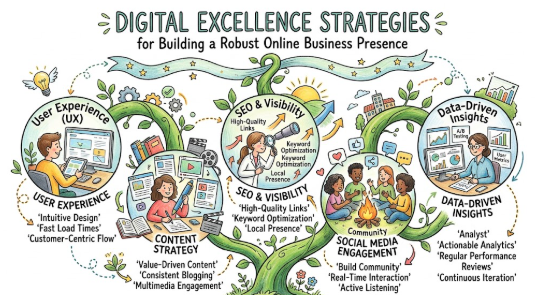
- User Experience (UX): Is the navigation intuitive?
- Content Relevance: Does it answer the user’s search intent?
- Technical Performance: Site speed and security protocols.
- Brand Consistency: Uniform tone, logo, and messaging across platforms.
- Engagement Quality: How helpful and authentic are your interactions?
- Data Integrity: Are you tracking the right KPIs, like conversions, rather than just “vanity” metrics like likes?
Detailed Breakdown of Digital Excellence
The Foundation: Your Website
Your website is your “digital headquarters.” It should be the final destination for all your marketing efforts.
- What to do: Focus on clear, professional design.
- Common Mistake: Having a website that looks beautiful but is impossible to navigate on a phone.
Content Strategy
Content is how you demonstrate authority.
- What to do: Write blog posts, guides, or FAQs that solve real customer problems.
- Common Mistake: Creating generic “filler” content just to keep the feed active.
Data & Analytics
- What to do: Use tools to track where visitors come from and why they leave.
- Common Mistake: Ignoring data and making decisions based on “gut feelings” or personal bias.
Common Mistakes Beginners Make
- Ignoring Analytics: Posting content without checking if it actually drives results.
- Inconsistent Branding: Using different logos, colors, or tones on different platforms.
- Ignoring Feedback: Deleting negative comments instead of resolving the underlying issue.
- Over-relying on Social Media: You don’t own your Instagram or Facebook followers; always try to move them to your email list or website.
“Don’t Do This” Checklist:
- Don’t buy fake followers.
- Don’t ignore security warnings on your website.
- Don’t promise services or quality you cannot consistently deliver.
- Don’t use automated, robotic replies for customer queries.
Practical Real-Life Examples
- Local Baker: Switched from only posting photos to posting “Behind the Scenes” stories, which built trust and increased pre-orders by 30%.
- Consultant: Replaced a static “About Me” page with a “Problem-Solver” landing page, resulting in more qualified leads.
- Small Retailer: Added a simple FAQ section to their site, which reduced customer support queries by half.
- Freelancer: Started a monthly email newsletter instead of just posting on Twitter, creating a loyal, direct connection with clients.
- Craft Business: Optimized mobile checkout, reducing cart abandonment by 20% in the first month.
Two Useful Tables for Better Understanding
Table 1: Presence Levels
| Feature | Basic Presence | Digital Excellence |
| Website | Static, slow, desktop-only | Fast, mobile-first, secure |
| Social Media | Just broadcasting sales | Engaging and solving problems |
| Strategy | Guesswork | Data-driven adjustments |
| Trust | Low (unreliable) | High (consistent) |
Table 2: Mistakes vs. Better Approaches
| Common Mistake | Better Approach |
| Ignoring mobile speed | Prioritizing fast load times |
| Posting only for “likes” | Creating educational value |
| Hiding contact information | Making contact easy and clear |
| Relying on one platform | Building a multi-channel ecosystem |
Tools, Methods, and Frameworks
- Google Search Console: Essential for monitoring how your site appears in search results.
- Google Analytics: The standard for understanding visitor behavior.
- Content Calendar: A simple spreadsheet to plan content ahead of time.
- Email Marketing Platform: A tool like Mailchimp or ConvertKit to own your audience.
- Speed Test Tools: (e.g., Google PageSpeed Insights) to ensure your site is fast.
Expert Tips to Make Better Decisions
- Prioritize Quality: Better to have one high-quality post a week than daily thin content.
- Listen to Your Customers: Use their questions as topics for your content.
- Check Your Links: A broken link is an immediate sign of a neglected business.
- Keep it Simple: Don’t use complex technical jargon on your landing pages.
- Be Transparent: If there’s a problem, address it clearly.
- Protect Data: Always prioritize customer privacy.
- Set Goals: Know what a “win” looks like before you start a campaign.
- Automate Smartly: Use tools for scheduling, but never automate conversations.
- Monitor Competitors: Observe what they do well, but don’t copy them.
- Review Regularly: Spend one hour every month checking your performance data.
Case Studies: How Better Understanding Changes Decisions
- The “Busy Cafe” Case: A cafe owner spent money on Facebook ads but had no website. After building a simple site with an online menu, they saved hours of time answering phone queries.
- The “E-Commerce Startup”: They ignored mobile users until data showed 90% of their traffic was mobile. Switching to a mobile-first design doubled their conversion rate.
- The “Service Provider”: Stopped posting generic motivational quotes and started sharing case studies of their successful work. They shifted from being seen as “another provider” to an “industry expert.”
Risk Awareness: What Readers Must Check First
- Data Security: Ensure your website uses HTTPS.
- Compliance: Respect local data privacy laws (like GDPR, if applicable).
- Platform Risk: Don’t put your entire business on a platform you don’t control.
- Reputation Risk: Be careful with the tone of your public responses.
Checklist Before Taking Action
- Is this content actually useful to my customer?
- Does my website load quickly on mobile devices?
- Have I verified all my links?
- Is my contact information easy to find?
- Did I check my analytics to see what worked last time?
- Is the tone of this post consistent with my brand?
Strategic Insights for Better Decision-Making
- Positioning: Focus on being the “go-to” expert in your niche.
- Customer Lifetime Value: Focus on retaining existing customers rather than constantly hunting for new ones.
- Consistency over Intensity: A steady presence is more effective than bursts of activity followed by silence.
Key Terms Explained for Beginners
- SEO (Search Engine Optimization): Improving your site so it shows up in Google searches.
- Conversion Rate: The percentage of visitors who take a desired action (e.g., buying).
- UX (User Experience): How easy and pleasant it is for a visitor to use your site.
- Landing Page: A specific page designed to convert a visitor into a lead or customer.
- KPIs: Key Performance Indicators—the metrics that matter, like sales or sign-ups.
Who Should Read This Blog
- Small Business Owners: Looking to gain more local or online customers.
- Freelancers: Who need to establish authority in their field.
- Beginner Bloggers: Wanting to move from a hobby to a professional standard.
- Students/Learners: Curious about the fundamentals of digital marketing.
Frequently Asked Questions
- What is digital excellence for small business?
It is the consistent delivery of high-quality, user-friendly, and strategic online experiences. - Why is digital excellence important for beginners?
It helps you build a solid foundation so you don’t waste time or money on ineffective marketing. - How can beginners start safely?
Start by auditing your current website and ensuring it is fast and mobile-friendly. - What is the biggest mistake to avoid?
Trying to be on every social platform instead of mastering a few. - Is this useful for salaried people?
Yes, building a professional online presence is a key way to advance a career as a consultant or expert. - What risks should I know?
Data breaches and losing control of your audience by relying too much on third-party platforms. - How can I compare options?
Look at your performance data versus your competitors’ public presence. - Should I take professional advice?
Yes, if you are unsure about technical setup or legal compliance. - How often should I review my plan?
Monthly reviews help you stay on track and pivot as needed. - What should I avoid before taking action?
Avoid acting on “shiny object syndrome”—jumping to new tools before mastering the basics. - How does this help with financial planning?
It helps you allocate marketing spend efficiently, reducing wasted costs. - What is the best next step?
Conduct a basic audit of your own website’s speed and mobile usability today.
Conclusion and Next Steps
Digital excellence is not a destination; it is a continuous process of refining how you show up for your customers. By focusing on your website, your content, and the data behind your performance, you can build an online presence that is not just visible, but truly impactful.
Remember, you don’t need a massive team or a huge budget to be excellent. You need clarity, consistency, and a deep commitment to serving your audience. Start by fixing one thing—perhaps your mobile loading speed—and move on to the next. Long-term success in the digital space is built on small, intentional improvements rather than overnight miracles. Stay disciplined, keep your focus on your customer, and let your digital presence grow as a result of that dedication.
