
Introduction
In the current era of digital transformation, data is considered the most valuable asset for any organization. Whether a small-scale startup is being managed or a large multinational corporation is being operated, the ability to process data with speed and precision is what determines success. However, the management of massive data sets is often found to be a complex challenge. This challenge is addressed by the principles of DataOps.
Understanding the Dataops Certified Professional Program
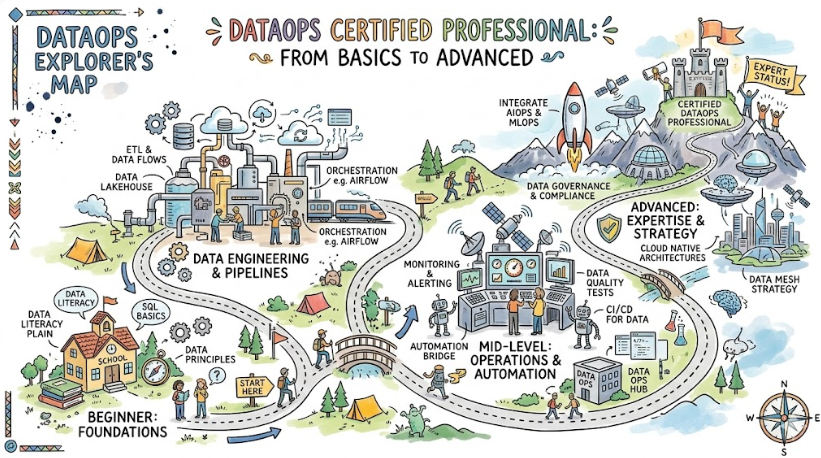
The Dataops Certified Professional is a specialized program that has been developed to teach the rigorous discipline of DevOps as applied to data management. It is not merely focused on the movement of data between systems. Instead, a repeatable, automated, and high-quality process for data delivery is established through this training. The program is designed to bring data engineers, data scientists, and operations professionals together so that a unified workflow can be maintained.
The Significance of DataOps in Modern Environments
In previous years, data was often handled in isolated silos, which led to significant delays and frequent errors. In the modern software ecosystem, real-time insights are required by businesses to make informed decisions. While cloud computing and automation have made rapid data processing possible, these benefits can only be realized if a structured framework is in place. Through a DataOps approach, data pipelines are treated with the same care as software code. These pipelines are tested, monitored, and deployed using automated tools, which ensures that manual intervention is minimized and the reliability of business information is maximized.
The Value of Professional Certifications for Careers
For an individual engineer, a certification such as the Dataops Certified Professional serves as a vital roadmap for skill acquisition. The right tools and methodologies are learned in a structured environment, and a verified level of expertise is proven to potential employers. For those in leadership roles, certifications are utilized to ensure that a common technical language is spoken by the entire team. A standard for quality and operational efficiency is set within the department. In a crowded job market, the possession of a specialized certification is often the primary factor that allows a candidate to be selected during the hiring process.
Certification Overview Details
| Track | Level | Intended Audience | Required Knowledge | Core Skills Covered | Suggested Sequence |
| DataOps | Professional | Engineers & Managers | Basic Data & Linux | Pipeline Automation & Quality | Follows DevOps Basics |
Why is DevOpsSchool Recommended?
When a career is being advanced, the choice of a training environment is critical. DevOpsSchool is frequently recommended because a strong emphasis is placed on practical, hands-on learning experiences. Theory is not just taught; the actual operation of systems in real-world production environments is demonstrated to the students. The instructors are chosen for their extensive industry experience, ensuring that the daily challenges faced by engineers are deeply understood. The curriculum is consistently updated so that the needs of the current industry are met. By choosing DevOpsSchool, entry is gained into a dedicated community of experts who are focused on the mastery of modern automation and data excellence.
In-Depth Look: Dataops Certified Professional
What is this certification?
This professional-level program is focused on the core principles of DataOps. The automation of data pipelines, the assurance of data quality through rigorous testing, and the fostering of collaboration between data and operations teams are all covered in detail.
Who is encouraged to pursue this certification?
- Data Engineers: Those who wish for their manual workflows to be fully automated.
- DevOps Engineers: Individuals looking for their expertise to be expanded into the realm of data management.
- Software Developers: Professionals who are responsible for handling large-scale data applications.
- Engineering Managers: Leaders who are required to oversee complex, data-driven projects.
Skills that are Acquired
- Automated Pipeline Management: The ability to build and oversee data pipelines that function without manual triggers is developed.
- Version Control for Data: Expertise in managing changes to data and models using version control systems is gained.
- Automated Quality Testing: Skills are refined in setting up tests that automatically verify the accuracy and health of data.
- Continuous Monitoring: Methods for tracking the performance and health of data systems in real-time are mastered.
- Cross-Functional Collaboration: Strategies for improving communication between technical teams are learned and implemented.
Real-World Projects to be Completed
- ETL Pipeline Automation: A fully automated “Extract, Transform, Load” pipeline is designed and deployed.
- Data Health Monitoring Systems: A system is built that provides immediate alerts whenever a drop in data quality is detected.
- Data-as-Code Implementation: A workflow is established where data infrastructure is managed using code in a cloud environment.
- Legacy System Migration: Older, manual data processes are migrated into a modern, containerized framework.
Preparation Strategies
The 14-Day Intensive Plan:
- During the first few days, the core definitions and the DataOps Manifesto are studied.
- High-level overview videos are watched to gain a conceptual understanding.
- The primary tools within the DataOps ecosystem are reviewed and identified.
The 30-Day Balanced Plan:
- Week 1: The philosophy and theoretical foundations of DataOps are explored.
- Week 2: Simple pipelines are practiced and built in a lab environment.
- Week 3: A focus is placed on data testing and the principles of quality assurance.
- Week 4: Practice exams are taken, and any weak areas are thoroughly reviewed.
The 60-Day Deep Mastery Plan:
- Month 1: A deep dive into technical tools and cloud integration is performed.
- Month 2: A comprehensive capstone project is worked on, and group discussions are joined to ensure the knowledge is solidified.
Mistakes to be Avoided
- Tool Obsession: The cultural shift required for DataOps is often ignored in favor of focusing solely on software tools.
- Skipping Fundamentals: Basic data quality and testing principles are sometimes bypassed, leading to long-term issues.
- Over-Automation: Attempts are often made to automate every process at once, rather than following an incremental approach.
Recommended Next Steps
- In the Same Track: The DataOps Master Level certification is pursued.
- In a Cross-Track: The MLOps Certified Professional program is considered.
- For Leadership: The Certified Engineering Manager program is recommended for career growth.
Structured Learning Paths
1. The DevOps Path
This path is intended for those who wish for general software delivery to be mastered. A focus is placed on CI/CD, infrastructure as code, and the management of cloud resources. It is considered the base for all other specialized tracks.
2. The DevSecOps Path
Specialization in security is the goal of this path. Security measures are integrated into every stage of the development cycle to ensure that speed is never prioritized over safety.
3. The SRE (Site Reliability Engineering) Path
This path is chosen by those who are passionate about system stability. Scalability and reliability are prioritized, and software engineering principles are applied to solve operational problems.
4. The AIOps and MLOps Path
Professionals working with Artificial Intelligence and Machine Learning are the target of this path. The lifecycle management of models and the use of AI to enhance IT operations are taught.
5. The DataOps Path
This is the ideal path for data professionals. DevOps principles are specifically applied to the management of data, ensuring that information is delivered both rapidly and accurately.
6. The FinOps Path
The financial aspects of cloud computing are explored in this path. Methods for managing cloud costs are taught, ensuring that maximum value is derived from every dollar spent on infrastructure.
Role-Based Certification Mapping
- DevOps Engineer: The DevOps Certified Professional and SRE certifications are recommended.
- SRE: Focus is placed on the SRE Certified Professional and AIOps tracks.
- Platform Engineer: Kubernetes and DevOps Professional certifications are prioritized.
- Cloud Engineer: Cloud Architect and DevSecOps Professional programs are suggested.
- Security Engineer: The DevSecOps Certified Professional is considered essential.
- Data Engineer: Dataops Certified Professional and MLOps Professional tracks are pursued.
- FinOps Practitioner: The FinOps Certified Professional program is followed.
- Engineering Manager: Certified Engineering Manager and DataOps Professional tracks are recommended.
Future Certifications for Career Growth
Professional growth is encouraged in three distinct directions:
- Internal Track Mastery: If expertise in DataOps is already held, more advanced architectural certifications should be sought.
- Cross-Track Knowledge: A DataOps professional is encouraged to explore MLOps so that the relationship between data and machine learning is understood.
- Leadership Development: Transitions into management are supported by certifications that focus on team leadership and financial oversight.
Support and Training Institutions
DevOpsSchool
This institution is recognized for a vast collection of technical courses. Deep-dive training in DevOps, Cloud, and Data sciences is provided to help students achieve their certification goals.
Cotocus
High-end technology consulting and training are the primary focus of this provider. Corporate teams often choose this institution when the upskilling of a large workforce is required.
ScmGalaxy
A well-known community and training platform is offered here. A wealth of resources for those interested in configuration management and integrated delivery is provided.
BestDevOps
Quality education in the field of DevOps is the mission of this platform. Structured paths are offered for both beginners and experienced professionals.
devsecopsschool.com
The intersection of security and operations is the sole focus of this site. It is a premier location for learning how security is baked into the automation process.
sreschool.com
A focused environment for the study of reliability is provided. The specific skills needed to become a high-performing SRE are taught here.
aiopsschool.com
The future of IT management is explored here through the lens of artificial intelligence. Training is provided on how complex infrastructure is managed using AI.
dataopsschool.com
This is a primary resource for learning how data workflows are streamlined. The bridge between data engineering and operational excellence is built here.
finopsschool.com
The growing discipline of cloud financial management is taught at this school. Professionals are helped to understand and control the costs associated with cloud infrastructure.
Frequently Asked Questions (FAQs)
1. Is the certification exam found to be difficult?
The difficulty level is considered moderate. If a background in data or operations is possessed, the exam is found to be manageable after a few weeks of study.
2. How much time is typically required for preparation?
It is found that 30 to 45 days of consistent study is usually sufficient for most working professionals.
3. Are there any prerequisites that must be met?
A basic understanding of data concepts is required, and experience with Linux or command-line tools is highly recommended.
4. What is the suggested sequence for these certifications?
It is often suggested that a general DevOps certification be obtained before a move into a specialized area like DataOps is made.
5. Is a promotion often helped by this certification?
Yes, a specialized skill set is demonstrated, which is frequently found to be in high demand by modern employers.
6. For which job roles can applications be submitted?
Roles such as DataOps Engineer, Data Engineer, and Analytics Operations Manager are made accessible.
7. Is global recognition provided for this certification?
Yes, the principles that are taught are recognized as industry standards across the globe.
8. Is extensive coding knowledge required?
While a basic understanding of scripting is beneficial, mastery of complex coding is not strictly required.
9. For how long is the certification considered valid?
A validity period of two to three years is typically offered, after which a refresher is recommended.
10. Can the exam be taken in an online format?
Yes, the exam is designed to be taken remotely from a home or office environment.
11. How are managers benefited by this program?
Technical hurdles faced by teams are better understood, and more effective solutions are implemented by managers who hold this certification.
12. What is the observed growth potential in this field?
The field of DataOps is experiencing rapid growth as more organizations migrate their data operations to the cloud.
Specific FAQs for Dataops Certified Professional
13. What is the primary focus of this specific program?
The focus is placed on the automation of data pipelines and the continuous testing of data quality.
14. Are modern cloud tools included in the curriculum?
Yes, the application of DataOps within major cloud platforms is covered in detail.
15. Is big data technology addressed?
The management of large-scale data sets using DataOps principles is a key part of the training.
16. Is there an emphasis on team collaboration?
Yes, strategies for breaking down silos between different departments are taught.
17. How is this distinguished from a standard Data Engineering course?
While pipelines are built in standard courses, the management and automation of those pipelines are the focus here.
18. Can a beginner enroll in this program?
Yes, the course is structured so that it is accessible to beginners, provided a technical curiosity is maintained.
19. What support is offered during the training period?
Lab access and mentor support are typically provided to assist with complex topics.
20. Is a certificate issued upon completion?
Yes, a digital certificate is granted once the exam is successfully passed.
Professional Testimonials
Arjun
“The depth of knowledge gained regarding automated pipelines was exceptional. Discussions with senior architects are now handled with much more confidence.”
Ishaan
“Practical examples from the real world were found to be the most valuable part of the course. The lessons were applied to my current projects almost immediately.”
Kavya
“The gap between SRE and data teams was successfully bridged through this training. The reliability of our systems has been significantly improved.”
Manish
“A very easy-to-follow preparation plan was provided, which allowed for study alongside a full-time job. Great clarity has been gained for my future career.”
Sneha
“The integration of security into data flows is now fully understood. Tools for protecting data are now utilized without any reduction in speed.”
Conclusion
The importance of the Dataops Certified Professional certification in today’s technical landscape cannot be overstated. By mastering the automation and quality of data, an individual is positioned as an indispensable asset to any organization. The long-term career benefits are found to include increased salary potential and the opportunity to lead high-impact projects. Strategic learning and certification planning are encouraged for anyone wishing to secure their future in the industry.
