
Artificial intelligence has shifted from a specialized field of computer science into the primary driver of technological change across global industries. Organizations of every size are evaluating how automated systems, machine learning models, and intelligent agents can improve operational efficiency, accelerate innovation, and create new value. However, the speed at which artificial intelligence tools and methodologies evolve creates a distinct challenge for professionals and enterprises alike: bridging the gap between theoretical understanding and production-grade implementation.
While foundational knowledge is widely accessible, moving an intelligent system from an initial conceptual prototype to a secure, monitored, and enterprise-ready service requires specialized expertise. Professionals must master complex operational disciplines, while business leaders require strategic frameworks to navigate risk, governance, and infrastructure planning.
AIUniverse was created to address this disconnect. Designed as a comprehensive ecosystem for learning, capability building, enterprise consulting, and technical research, AIUniverse provides structured pathways for individuals and organizations seeking to build, deploy, and scale artificial intelligence solutions effectively.
What is AIUniverse?
AIUniverse is a integrated ecosystem designed to support artificial intelligence education, skill development, enterprise transformation, and technical knowledge sharing. Rather than functioning solely as an instructional site or an advisory agency, AIUniverse combines specialized education, practical deployment frameworks, strategic consulting, and curated technical research into a unified platform.
The underlying vision of AIUniverse is to democratize access to production-grade artificial intelligence expertise. While many resources focus on basic concepts or isolated tools, AIUniverse centers its model on operational reality—helping learners and organizations understand how complex models function within live environments under real-world technical and organizational constraints.
The platform was developed to resolve several systemic challenges currently affecting the technology ecosystem:
- The Prototype-to-Production Gap: Many practitioners can construct basic scripts or run models in isolated notebook environments, but struggle with deployment, API integration, data pipeline security, and continuous monitoring.
- Fragmented Learning Resources: AI documentation, tool guides, and architectural frameworks are frequently scattered across disparate platforms, making structured skill acquisition difficult.
- Organizational Readiness Friction: Enterprise teams often struggle to align business objectives with technical execution, leading to stalled initiatives, unmanaged security risks, and unclear return on investment.
- Rapid Tool Evolution: With new frameworks, orchestration layers, and vector databases releasing constantly, professionals require objective evaluations to select the right technologies for their specific infrastructure.
AIUniverse resolves these issues by serving as an end-to-end knowledge hub. It offers structured learning pathways, industry-focused certification programs, targeted executive advisories, and deeply researched technical guides that allow developers, leaders, and teams to build sustainable internal capabilities.
Why AI Learning Has Become Essential
The modern technology landscape has entered an era defined by rapid automation and algorithmic decision-making. Software engineering, data processing, customer engagement, and business operations are increasingly integrated with machine learning models and intelligent workflows. As a result, maintaining digital competence requires continuous, structured upskilling.
Enterprise adoption of artificial intelligence is no longer restricted to experimental technology labs. Core business operations—ranging from financial auditing and supply chain forecasting to software quality assurance and automated support—are being restructured around data-driven systems. This transition creates an immediate demand for professionals who understand not only how to write prompts or train algorithms, but how to integrate these systems into resilient corporate architectures.
Digital transformation initiatives now require a dual-layer understanding of technology. On one side, technical teams need deep operational proficiency in disciplines such as model operations, workflow orchestration, and system evaluation. On the other side, management teams require sufficient literacy to assess technical feasibility, establish ethical guardrails, manage regulatory compliance, and guide organizational change.
Without structured education, self-directed learning often leads to fragmented knowledge, where critical aspects such as security, governance, data hygiene, and performance observability are overlooked. AIUniverse emphasizes structured, outcome-driven learning paths that connect theoretical concepts directly to enterprise execution.
Who Should Use AIUniverse?
Because the impact of artificial intelligence spans technical execution, executive planning, and academic inquiry, AIUniverse is structured to serve distinct user groups across the global technology ecosystem.
Students and Beginners
Individuals entering the technology sector face a vast array of terminology, frameworks, and conflicting guidance. AIUniverse provides beginners with clear entry points that establish foundational literacy before introducing advanced technical concepts. By focusing on fundamental principles—such as data preparation, basic model logic, ethical considerations, and practical tool usage—beginners construct a solid foundation that prevents reliance on memorized syntax or superficial prompts.
Developers and Software Engineers
Traditional software developers transitioning into machine learning and automated systems face a shift in paradigm: moving from deterministic code logic to probabilistic model behavior. Developers utilize AIUniverse to master API integrations, vector storage, agent orchestration, service containerization, and backend integration. Through practical projects, engineers learn to build deployable applications capable of executing multi-step operations cleanly.
Data Scientists, ML Engineers, and AI Professionals
For experienced practitioners, maintaining a competitive edge requires mastering advanced operational standards. AIUniverse supports data scientists and engineers looking to deepen their command of system monitoring, automated retraining, performance evaluation, retrieval-augmented pipelines, and autonomous agent design. The platform offers specialized tracks that help practitioners transition from data analysis roles into system architecture positions.
Businesses, Startups, and Enterprise Teams
Organizations scaling digital capabilities frequently encounter operational bottlenecks, talent gaps, and integration friction. Enterprise teams leverage AIUniverse for workforce upskilling, structured onboarding, and corporate training programs tailored to specific business contexts. Furthermore, startups and established companies use the platform’s strategic framework to streamline product development cycles and avoid costly infrastructure missteps.
Technology Leaders and Decision Makers
Chief Technology Officers, IT Directors, Solution Architects, and Innovation Executives require high-level clarity to make informed capital and architectural decisions. AIUniverse equips leadership with clear strategic frameworks covering technology stack selection, risk mitigation, resource allocation, regulatory compliance, and ethical governance. This enables leaders to evaluate vendor claims objectively and align artificial intelligence investments directly with long-term business goals.
Researchers and Continuous Learners
The pace of research in natural language processing, computer vision, and autonomous decision systems requires constant vigilance. Educators, researchers, and technology enthusiasts rely on AIUniverse as an updated central hub for technical analysis, methodology breakdowns, emerging architectural trends, and detailed comparisons of production tools.
AIUniverse Ecosystem
The AIUniverse platform operates through a multi-faceted ecosystem where education, technical research, corporate advisory, and practical tools support one another.
AI Certification Courses
At the core of AIUniverse are specialized instruction programs built to validate skills in real-world environments. Rather than focusing exclusively on general theoretical concepts, the platform offers targeted credentials in critical operational disciplines:
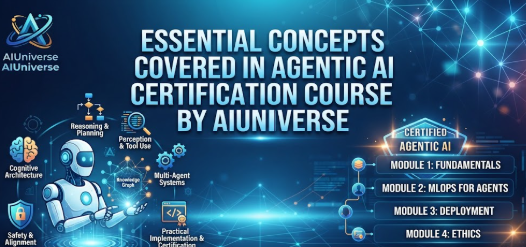
- Agentic AI: Programs focusing on autonomous workflows, tool integration, multi-agent coordination, decision planning, and memory management. Learners discover how to build software agents capable of breaking down complex goals into executable steps.
- MLOps (Machine Learning Operations): Courses covering continuous integration, automated model testing, artifact tracking, model registries, containerized deployment, and production monitoring.
- AIOps (Artificial Intelligence for IT Operations): Training focused on leveraging machine learning to automate system diagnostics, log analysis, anomaly detection, and IT service management.
- Foundational & Executive Credentials: Structured curricula designed to build core data literacy for non-technical managers and business strategists.
Participants seeking an Agentic AI certification course, an MLOps certification course, or an AIOps certification course find programs built around real-world deployment challenges rather than isolated exercises. These AI certification courses online help learners establish verifiable capabilities that align directly with industry hiring needs.
Corporate AI Training and AI Consulting
Organizations require tailored approaches to build internal expertise and integrate modern automation. AIUniverse provides Corporate AI training programs designed around an enterprise’s specific technology stack, industry constraints, and internal workflows.
Alongside corporate training, AIUniverse delivers specialized AI consulting services. Advisory engagements focus on evaluating organizational readiness, identifying high-impact use cases, designing scalable data architectures, establishing risk management policies, and supporting technical teams during complex deployment phases.
AI Learning Resources and Practical Knowledge
Learning extends beyond structured course modules. AIUniverse maintains an extensive repository of instructional guides, technical documentation, implementation blueprints, and architectural breakdowns. These resources break down complex topics—such as vector retrieval strategies, model quantization, API rate optimization, and fallback design—into clear, step-by-step documentation.
AI Tools, Comparisons, and Research
Choosing the right technology stack is a major hurdle for engineering teams. AIUniverse regularly publishes detailed evaluations, benchmarks, and practical comparisons of software components. Technical teams can reference deep-dive analysis covering the best prompt management tools, federated learning platforms, and the best MLOps tools available in open-source and commercial environments. These objective guides allow developers to select tools based on security, scalability, ease of integration, and performance.
Enterprise AI Adoption and Best Practices
Successful enterprise transformation requires clear operational policies. AIUniverse provides frameworks that address responsible innovation, ethical guidelines, data privacy regulations, and risk governance. Organizations learn to build security guardrails, manage data compliance across regional jurisdictions, and implement transparent monitoring standards that safeguard corporate IP while driving technological progress.
Continuous Learning and Future AI Trends
Because technological standards change quickly, AIUniverse regularly updates its content ecosystem to reflect shifting practices. By monitoring emerging architectural patterns, model breakthroughs, and operational shifts, the platform ensures that users remain informed about relevant developments without falling for brief industry hype cycles.
How AIUniverse Supports Different Learning Goals
Every professional enters the artificial intelligence field with different background knowledge, career ambitions, and technical requirements. AIUniverse accommodates these varying needs by offering modular learning pathways.
- Mastering Fundamentals: Learners begin with accessible introductions to model mechanics, data processing, feature engineering, and core vocabulary, building confidence before tackling advanced concepts.
- Building Practical Skills: Instructional pathways emphasize project execution, guiding learners through constructing working services, connecting APIs, configuring databases, and managing execution environments.
- Deploying Production Systems: Courses teach practitioners how to wrap algorithms in scalable service layers, handle error logging, manage memory usage, and secure user interactions.
- Mastering MLOps and AIOps: Specialized modules cover automated pipeline construction, model performance degradation tracking, automated retraining triggers, and infrastructure log automation.
- Designing Agentic Workflows: Advanced curriculum focuses on autonomous agent architectures, teaching developers how to combine model reasoning with external tool calls, persistent memory databases, and self-correction loops.
- Sustaining Knowledge Growth: Through continuous documentation updates, technological breakdowns, and reference architectures, users maintain updated technical skills as standard practices change.
AIUniverse for Businesses
For commercial organizations, adopting intelligent software is an operational imperative that carries significant execution risk. Poorly planned implementations often result in wasted budget, unmanaged data risks, and internal team frustration.
AIUniverse supports businesses throughout the technology integration lifecycle:
- Strategic AI Readiness: Helping leadership teams evaluate internal data infrastructure, security postures, and operational workflows to identify realistic implementation candidates.
- Workforce Upskilling: Delivering customized training tracks for non-technical teams, operational managers, and senior software developers to ensure organization-wide literacy.
- Structured AI Transformation: Providing actionable frameworks for transitioning legacy business applications into modern, data-driven operational workflows.
- Targeted Advisory Services: Offering dedicated expertise to guide custom enterprise builds, select technology vendors objectively, and audit internal deployment pipelines.
- Organizational Governance: Establishing policy guidelines for data protection, intellectual property security, user privacy, and responsible usage across all internal systems.
By connecting workforce upskilling directly with strategic planning, AIUniverse enables companies to build lasting, internal innovation capabilities rather than relying indefinitely on external vendors.
AIUniverse for Developers
Software engineers moving into machine learning often encounter a steep learning curve related to system architecture, resource management, and probabilistic software behavior. AIUniverse provides developers with practical, engineering-first resources:
- Hands-On Execution: Learning is anchored around concrete tasks—such as building retrieval pipelines, configuring vector databases, setting up evaluation frameworks, and deploying models as cloud services.
- Production Deployment Standards: Developers learn how to build resilient microservices, design fallback handlers, optimize inference latency, and limit token expenditure in commercial environments.
- Operational Observability: Instruction emphasizes real-time system tracking, helping engineers log inputs, monitor latency spikes, detect data drift, and evaluate output quality systematically.
- Modern Architectural Frameworks: Developers gain practical experience working with popular open-source and enterprise libraries, toolkits, and containerization frameworks used across top technology organizations.
AIUniverse for Technology Leaders
Engineering managers, CTOs, and IT directors face distinct managerial challenges when integrating modern automation into corporate ecosystems. They must balance innovation against risk, cost, and reliability.
AIUniverse supports tech leadership through focused guidance:
- Strategic Technology Stack Selection: Providing clear, vendor-neutral analysis to help leaders choose between proprietary API services, open-weight models, self-hosted deployments, and managed enterprise platforms.
- Governance and Risk Mitigation: Supplying comprehensive frameworks to manage data leakage risks, maintain compliance with changing privacy laws, and avoid algorithmic bias in public-facing services.
- Capability Building & Talent Retention: Guiding leaders on how to structure internal engineering teams, define clear career progression paths for AI specialists, and foster a culture of continuous learning.
- ROI Evaluation: Helping executives establish realistic key performance indicators (KPIs) to evaluate the actual business value generated by automation projects.
AIUniverse Knowledge Hub
In addition to structured courses and strategic consulting, AIUniverse operates a public Knowledge Hub dedicated to objective technical research, tool evaluations, and operational guides.
Key areas covered within the Knowledge Hub include:
- Tool Evaluations: Technical analyses identifying the best AI tools for business, evaluating components based on enterprise readiness, API stability, security standards, and operational costs.
- Prompt Management Frameworks: Comprehensive guides highlighting the best prompt management tools, detailing how teams can version control, test, collaborative edit, and audit complex prompts across engineering pipelines.
- Distributed Architecture Insights: Deep dives into federated learning platforms, explaining how organizations can train decentralized models while maintaining strict data privacy across distributed networks.
- MLOps Stack Comparisons: Objective reviews analyzing the best MLOps tools for model tracking, feature stores, automated orchestrators, and performance evaluation libraries.
- Implementation Blueprints: Step-by-step technical guides explaining practical solutions for multi-tenant data isolation, security sanitization, semantic caching, and real-time model monitoring.
Step-by-Step Guide to Getting Started with AIUniverse
Navigating a comprehensive platform requires a deliberate approach aligned with individual or organizational goals. Below is a structured 8-step guide to maximizing value from the AIUniverse ecosystem.
Step 1: Define Objectives
   │
Step 2: Choose Path/Certifications
   │
Step 3: Establish Fundamentals
   │
Step 4: Execute Practical Projects
   │
Step 5: Utilize Technical Research
   │
Step 6: Master Operational Systems (MLOps/AIOps)
   │
Step 7: Deploy Real-World Solutions
   │
Step 8: Maintain Continuous Skill Growth
Step 1 – Identify Your Primary Objective
Clarify your core purpose before diving into educational materials. Are you an engineer seeking production deployment skills, a business leader planning an enterprise strategy, or a beginner building foundational computer science literacy?
Step 2 – Explore Suitable Learning Paths and Certifications
Review the available specialized pathways. Software engineers and data scientists can enroll in target tracks such as an Agentic AI certification course or MLOps certification course, while business managers can select strategic leadership curricula.
Step 3 – Build Core Foundational Knowledge
Complete foundational modules to master essential concepts, data handling techniques, architectural terminology, and core governance requirements.
Step 4 – Complete Practical Hands-On Projects
Apply theoretical principles by completing real-world projects. Work through guided labs focused on vector store integration, model evaluation, custom agent building, and API service configuration.
Step 5 – Leverage Knowledge Hub Resources
Reference technical articles, implementation guides, and objective software benchmarks within the Knowledge Hub to select appropriate open-source and enterprise software components for your projects.
Step 6 – Expand into Operational Disciplines
Progress from simple model integration into advanced deployment concepts. Study MLOps workflows, AIOps diagnostic automation, continuous integration pipelines, and monitoring infrastructure.
Step 7 – Apply Skills in Real-World Environments
Deploy your applications or strategic frameworks within production settings. Utilize AIUniverse’s enterprise security, compliance, and governance frameworks to ensure safe operational deployment.
Step 8 – Engage in Continuous Skill Maintenance
Stay informed on emerging architectural shifts, research papers, software updates, and operational best practices by regularly consulting updated content within the AIUniverse platform.
Common Mistakes to Avoid
When learning or adopting artificial intelligence technologies, individuals and organizations frequently fall into predictable operational traps. Understanding these common pitfalls helps prevent project failures and wasted effort.
1. Learning Pure Theory Without Practical Deployment
Studying algorithm mechanics without building deployed systems leaves practitioners unprepared for real-world engineering challenges like system latency, API failures, memory management, and data noise.
Alternative: Combine theoretical study with real-world engineering labs and service deployment.
2. Random, Unstructured Skill Acquisition
Attempting to learn via fragmented video tutorials often results in gaps in foundational knowledge, security standards, and operational best practices.
Alternative: Follow structured, role-based learning roadmaps designed by experienced practitioners.
3. Selecting Tools Based on Hype
Adopting new software libraries or platforms purely because they are trending frequently leads to unstable architectures and vendor lock-in.
Alternative: Utilize objective tool evaluations to select stable frameworks aligned with long-term infrastructure goals.
4. Overlooking System Security and Governance
Deploying automated services without establishing strict input validation, data privacy boundaries, and access controls creates substantial organizational risk.
Alternative: Incorporate security guardrails, data governance policies, and ethical standards into initial system designs.
5. Ignoring Production Monitoring and MLOps
Assuming a model will maintain peak performance post-deployment without active tracking leads to silent errors, data drift, and service degradation.
Alternative: Implement MLOps principles, automated evaluation metrics, and real-time observability pipelines from day one.
Best Practices for Learning and Implementing AI
To build resilient systems and foster continuous professional growth, consider these established operational recommendations:
- Establish a Clear Learning Roadmap: Align your educational goals with specific, verifiable skill milestones rather than general reading goals.
- Prioritize Practical Execution: Write clean, modular code and deploy actual microservices rather than working exclusively inside isolated notebook environments.
- Emphasize Data Quality and Preparation: Recognize that model performance is fundamentally bounded by the quality, cleanliness, and structure of underlying data pipelines.
- Adopt Infrastructure Automation Early: Integrate continuous integration and continuous deployment (CI/CD) pipelines, model registries, and automated test suites early in development.
- Enforce Responsible Innovation: Build explicit guardrails around privacy, data compliance, model explainability, and bias detection across all production workloads.
- Maintain Architectural Flexibility: Design software systems using modular microservices and abstraction layers so individual models or vector stores can be updated without rebuilding whole applications.
- Commit to Continuous Upskilling: Set aside regular time to review updated research, evaluate new developer tooling, and refine operational processes.
Resource Overview Matrix
| AIUniverse Resource | Platform Purpose | Primary Users | Practical Benefit |
| Agentic AI Certification | Teaches design and orchestration of autonomous tool-using agents | Software Engineers, AI System Architects | Enables construction of multi-step, self-correcting autonomous application workflows |
| MLOps Certification | Covers production lifecycle management, deployment, and monitoring | ML Engineers, DevOps Specialists, Data Scientists | Streamlines continuous integration, deployment, and automated testing of production models |
| Corporate AI Training | Provides customized workforce upskilling for enterprise organizations | Enterprise Teams, Technical Managers, Employees | Closes organizational skill gaps and aligns technical execution with business strategy |
| Strategic AI Consulting | Delivers specialized advisory for enterprise adoption and architecture | Executive Leadership, CTOs, IT Directors | Reduces implementation risk, ensures security compliance, and optimizes infrastructure ROI |
| Knowledge Hub & Reviews | Offers objective evaluations of developer tools, stacks, and research | Tech Leads, Developers, Continuous Learners | Accelerates technology stack selection through vendor-neutral analysis and implementation guides |
Goal-to-Resource Alignment Matrix
| Learning Goal | Recommended AIUniverse Resource | Expected Outcome |
| Understand AI Fundamentals | Foundational Learning Pathways & Core Articles | Clear command of key vocabulary, model mechanics, and basic data processing workflows |
| Build Autonomous Applications | Agentic AI Certification Course | Practical capability to design, evaluate, and deploy multi-agent orchestration systems |
| Manage Production Deployment | MLOps Certification Course | Ability to build containerized deployment pipelines, model registries, and monitoring stacks |
| Drive Corporate AI Adoption | Corporate AI Training & Consulting Services | Successful enterprise digital transformation with built-in security and risk governance |
| Select Optimal AI Tooling | Knowledge Hub Tool Comparisons & Best Practices Guides | Confident technology stack selection optimized for performance, cost, and security |
Key Benefits of AIUniverse
AIUniverse provides a focused environment for mastering production-grade artificial intelligence concepts. Core platform advantages include:
- Centralized Learning Ecosystem: A single, structured platform combining foundational education, specialized credentials, technical research, and corporate advisories.
- Production-Oriented Curriculum: Instruction centered around real-world deployment challenges, API integrations, observability, and system maintenance.
- Targeted Professional Credentials: Specialized programs focusing on high-demand disciplines, including MLOps, AIOps, and Agentic AI workflow engineering.
- Customized Enterprise Support: Flexible corporate training modules and strategic consulting engagements tailored to unique industry requirements.
- Vendor-Neutral Technical Analysis: Objective, evidence-based comparisons of open-source libraries, prompt tools, vector storage options, and commercial platforms.
- Comprehensive Governance Frameworks: Integrated guidance covering ethical adoption, data privacy compliance, risk management, and security guardrails.
- Role-Specific Educational Pathways: Structured learning materials designed specifically for developers, executive leaders, data scientists, and beginners.
Frequently Asked Questions
1. What is AIUniverse?
AIUniverse is a comprehensive platform providing artificial intelligence education, technical certifications, strategic consulting, corporate upskilling, and objective technology research. It bridges the gap between theoretical knowledge and real-world system deployment.
2. Who should use AIUniverse?
AIUniverse is designed for software developers, data scientists, technology executives, corporate teams, enterprise leaders, students, and researchers who want to build, deploy, or manage modern artificial intelligence solutions.
3. What is covered in an Agentic AI certification course?
An Agentic AI certification course focuses on designing autonomous software agents capable of planning, using external tools, managing persistent memory, and executing complex, multi-step tasks within real-world application workflows.
4. What is covered in an MLOps certification course?
An MLOps certification course covers the operational lifecycle of machine learning systems, including continuous deployment (CI/CD), automated testing, model versioning, registry management, containerization, and production performance monitoring.
5. What is an AIOps certification course?
An AIOps certification course teaches professionals how to apply machine learning algorithms to automate and optimize IT operations, system diagnostics, log monitoring, network anomaly detection, and incident response management.
6. How does Corporate AI Training help organizations?
Corporate AI training delivers customized education tailored to an enterprise’s specific technology stack and industry requirements, helping upskill employees, bridge talent gaps, and ensure smooth digital transformation.
7. What industries can benefit from AIUniverse?
Organizations across technology, finance, healthcare, manufacturing, retail, logistics, and professional services can leverage AIUniverse to guide technology adoption, train staff, and deploy secure automated systems.
8. Does AIUniverse offer consulting services?
Yes. AIUniverse provides specialized AI consulting services to help enterprises evaluate technical readiness, design production system architectures, establish governance guardrails, and implement tailored digital strategies.
9. How can beginners start learning AI on AIUniverse?
Beginners can start by following foundational learning paths that explain core data concepts, basic system logic, and essential tools in simple language before advancing to hands-on engineering projects.
10. Why is structured AI learning important?
Structured learning ensures that professionals master essential engineering standards—such as security, system observability, data hygiene, and deployment architecture—rather than acquiring fragmented knowledge from unverified online tutorials.
Conclusion
The rapid growth of artificial intelligence presents remarkable opportunities alongside genuine technical and operational challenges. Successfully navigating this landscape requires moving past superficial prompts and isolated experiments toward structured, production-grade capabilities. Whether you are an individual developer building deployable software skills, a data scientist mastering continuous operational pipelines, or an executive guiding enterprise transformation, success depends on a clear, structured learning strategy.
AIUniverse serves as a practical, comprehensive partner across this journey. By uniting specialized certification programs, hands-on engineering labs, enterprise consulting, and objective technical research within a single ecosystem, AIUniverse equips individuals and organizations with the expertise required to build, deploy, and scale intelligent systems securely and effectively.
