
In an increasingly digitized Indian socio-economic landscape, legal challenges can emerge without warning—from a sudden contractual disagreement or an online financial fraud to intricate real estate title complications or personal family disputes. For decades, navigating the Indian legal matrix required navigating an opaque network of personal referrals, unverified local contacts, and confusing statutory terminology. Today, the initial reaction for most citizens and business executives faced with a legal conflict is to seek clarity online before engaging professional counsel. Modern digital platforms have reshaped this experience by organizing complex legal environments into structured, navigable resources. Platforms like WakilSahab operate as bridge-building legal directories across India, enabling users to evaluate practice areas, review advocate credentials, understand location-based court jurisdictions, and book flexible online or in-person legal consultations. Equipping yourself with verified information and finding targeted legal representation ensures your rights are safeguarded efficiently from day one.
What is WakilSahab?
WakilSahab is an Indian legal discovery and legal information platform engineered to simplify how individuals, families, startups, and corporations locate and consult with legal advocates across the country. The platform functions as a comprehensive legal ecosystem where users can research specific legal domain areas, explore detailed professional profiles of advocates, understand statutory requirements, and request online or in-person legal consultations based on their distinct requirements. By organizing vast amounts of legal information into accessible categories, the platform demystifies the process of finding specialized legal representation across various states, judicial jurisdictions, and court levels in India.
The core purpose of the platform is to eliminate the guesswork and opacity historically associated with finding qualified legal representation in India. Traditionally, individuals relied almost exclusively on informal word-of-mouth recommendations, local referral networks, or haphazard searches when seeking legal help. This unstructured approach often led to hiring advocates who lacked specific experience in the precise domain required for the matter at hand. The platform addresses this systemic challenge by maintaining an organized legal directory in India that categorizes legal professionals based on verified qualifications, primary practice areas, years of courtroom experience, spoken languages, geographic location, and available consultation modes.
The platform serves a broad spectrum of users across India, ranging from an individual seeking a criminal lawyer near me for an urgent bail hearing, to a family attempting to draft a valid property distribution document, to a startup founder evaluating corporate governance rules. Furthermore, the platform integrates legal awareness resources, practice-area guides, statutory explanations, and educational blog content. This empowers users to gain a preliminary understanding of their legal standing before sitting down for a formal consultation. Whether a user requires a quick preliminary discussion or structured document vetting, the platform offers flexible pathways to connect with professionals through digital channels or scheduled face-to-face appointments.
Why Choosing the Right Lawyer Matters
Selecting an advocate whose specific domain expertise matches the exact nature of your legal matter is one of the most critical decisions you will make during any legal proceeding. The Indian judicial system relies heavily on specialized procedures, distinct limitation periods, rigorous evidentiary standards, and strict adherence to procedural rules. An advocate who primarily handles civil property disputes may not possess the immediate procedural fluency needed to handle a high-stakes cyber fraud prosecution or a complex cross-border corporate arbitration. Securing appropriate legal counsel ensures that your fundamental constitutional and statutory rights are thoroughly protected from the moment a legal dispute begins.
Proper legal representation significantly influences how a case is framed, documented, and presented before judicial bodies, tribunals, or arbitrators. Effective advocates spend considerable time reviewing background facts, analyzing statutory provisions, evaluating relevant judicial precedents, and compiling necessary documentary evidence before filing petitions or written statements. Inadequate preparation or poorly drafted legal pleadings can severely compromise a party’s legal position, sometimes resulting in non-bailable warrants, dismissed petitions, or long-term financial liabilities that are difficult to overturn on appeal.
Beyond courtroom advocacy, a skilled lawyer plays a critical role in strategic risk reduction and dispute prevention. In corporate, property, and contractual matters, proactive legal review of agreements, notices, and compliance filings can identify ambiguous clauses, hidden liabilities, and regulatory gaps before they escalate into costly litigation. Furthermore, an experienced advocate understands local court procedures, filing mechanics, and alternative dispute resolution mechanisms, such as mediation and arbitration, which can often resolve conflicts faster and more economically than prolonged court battles.
Legal Services and Practice Areas Available Through Specialized Legal Directories
To make legal assistance accessible and organized, modern legal platforms structure advocate listings and information guides into distinct legal practice areas. Understanding these primary divisions helps individuals and business entities pinpoint the precise legal domain relevant to their circumstances.
Criminal Law
Criminal law deals with offenses against the state or public order, governed primarily by the Bharatiya Nyaya Sanhita (BNS), the Bharatiya Nagarik Suraksha Sanhita (BNSS), and the Bharatiya Sakshya Adhiniyam (BSA), alongside specialized penal statutes. Matters falling under criminal law include anticipatory bail applications, regular bail proceedings, police complaints, criminal trials, financial fraud investigations, assault charges, and appeals. Individuals facing police inquiries or criminal charges often search specifically for a specialized criminal lawyer near me to secure immediate representation, protect fundamental rights during custodial interrogation, and draft urgent court petitions.
Divorce & Family Law
Family law governs personal relationships, domestic affairs, marriage, dissolution of marriage, child custody, guardianship, adoption, maintenance, and succession. Because family law in India involves personal laws tied to religious traditions—such as the Hindu Marriage Act, the Special Marriage Act, and Muslim Personal Law—handling these cases requires deep sensitivity and technical legal knowledge. Individuals navigating marital disputes frequently seek a divorce lawyer near me to handle mutual consent divorce filings, contested divorce petitions, interim maintenance applications, and child visitation arrangements through structured court proceedings or court-annexed mediation.
Property Law
Property law covers real estate transactions, title verification, land acquisition, landlord-tenant disputes, partition suits, boundary conflicts, and ancestral property rights. Given the complexity of property records, revenue documentation, and local land laws across different Indian states, seeking professional advice before executing sale deeds, lease agreements, or mortgage deeds is essential. Parties facing illegal encroachment, title ambiguity, or succession disagreements regularly search for a property lawyer near me to conduct due diligence, draft legal notices, file suits for declaration and injunction, and protect valuable real estate assets.
Corporate Law
Corporate law governs the creation, operation, governance, and dissolution of companies and commercial partnerships. It encompasses compliance with the Companies Act, SEBI regulations, contract drafting, shareholder agreements, joint ventures, mergers and acquisitions, and regulatory filings. Businesses operating within competitive markets rely heavily on a qualified corporate lawyer in India to negotiate commercial contracts, manage structural reorganization, ensure regulatory compliance, and resolve complex inter-company commercial disputes before national tribunals or commercial courts.
Cyber Crime Law
With the rapid expansion of digital financial transactions, online e-commerce platforms, and digital communication networks, cyber offences have increased significantly. Cyber crime law addresses digital financial fraud, identity theft, unauthorized system access, data breaches, online harassment, phishing schemes, and intellectual property infringement over digital media under the Information Technology Act and related penal codes. Individuals and businesses affected by digital fraud or online security breaches frequently search for a cyber crime lawyer near me to assist with filing formal complaints with cyber crime police cells, initiating regulatory actions, and pursuing recovery proceedings.
Civil Law
Civil law addresses non-criminal disputes involving rights, obligations, property interests, contractual breaches, tortious liabilities, and financial recoveries. Governed procedurally by the Code of Civil Procedure (CPC), civil practice includes drafting legal notices, filing civil suits for recovery of money, seeking temporary and permanent injunctions, enforcing specific performance of contracts, and managing execution proceedings. Civil litigation focuses on restoring rights, granting compensation, and resolving disputes between private individuals, business entities, or state bodies.
Consumer Law
Consumer protection law safeguards buyers of goods and consumers of services against unfair trade practices, defective products, deficient service delivery, and misleading advertisements under the Consumer Protection Act. Consumer commissions operating at district, state, and national levels provide specialized forums for speedy dispute resolution. Consumers facing unaddressed product failures, medical negligence, insurance claim rejections, or real estate project delays can utilize consumer law provisions to seek refunds, replacement of goods, and monetary compensation for mental agony and financial loss.
Tax Law
Tax law encompasses direct taxation, such as income tax and corporate revenue tax, as well as indirect taxation, primarily governed by the Goods and Services Tax (GST) framework. Tax legal practice involves structuring financial transactions for tax efficiency, managing administrative responses to statutory audit notices, challenging arbitrary tax assessments, representing clients before appellate authorities and tax tribunals, and handling complex cross-border transfer pricing inquiries for international commercial enterprises.
Intellectual Property Law
Intellectual property (IP) law protects intangible human creations, innovations, artistic works, brand identifiers, and proprietary business concepts. Key branches include patents, trademarks, copyrights, industrial designs, and trade secrets. IP advocates assist creators, inventors, startups, and established brands with clearing trademark availability, filing registration applications, negotiating licensing agreements, handling opposition proceedings, and litigating against commercial counterfeiting or unauthorized copyright usage.
Immigration Law
Immigration law manages the movement of individuals across national borders, governing visas, passport clearances, long-term residency permits, overseas citizenship applications (OCI), work authorizations, and extradition requests. Advocates specializing in immigration law assist foreign nationals, Indian citizens moving abroad, international students, and multinational corporations transferring employees with navigating complex statutory visa requirements, responding to deportation notices, and securing compliance with immigration authorities.
How WakilSahab Helps Individuals and Businesses
The platform offers tailored discovery and educational support designed to meet the distinct legal requirements of different demographics across India:
- Individuals: Everyday citizens often face sudden, unfamiliar legal challenges, such as receiving a formal legal notice, resolving an employment dispute, or filing a consumer complaint. The platform provides easy access to educational articles explaining basic rights and helps individuals locate domain-specific legal professionals near their residential area.
- Families: Family matters involving property distribution, drafting wills, arranging family settlement deeds, or resolving sensitive matrimonial disagreements require careful legal support. Families use the platform to discover advocates who practice personal law, facilitate structured family mediation, and prepare legally binding family documents.
- Startups: Early-stage companies face a complex web of legal requirements, including entity incorporation, co-founder agreements, intellectual property registration, vendor contracts, and employment compliance. The platform connects startup founders with corporate legal experts who specialize in early-stage corporate structuring, investor term sheets, and regulatory filings.
- Businesses: Established small and medium enterprises (SMEs) and commercial corporations require ongoing legal support to manage commercial contract disputes, debt recovery proceedings, regulatory compliance, labor law matters, and tax appeals. The platform assists commercial entities in identifying specialized corporate litigators and legal consultants to protect their ongoing operational interests.
- Non-Resident Indians (NRIs): NRIs frequently encounter unique legal challenges involving ancestral property management, power of attorney execution, tenancy disputes, and family matters in India while residing abroad. The platform enables NRIs to research legal standards remotely and arrange an online lawyer consultation India to manage their legal affairs effectively without requiring immediate physical travel.
- Students: Law students, young legal researchers, and academics access the platform’s educational resources, practice guides, and legal blog updates to deepen their practical understanding of Indian statutes, landmark court judgments, and emerging legal technology trends.
- Senior Citizens: Elderly individuals often require assistance with drafting wills, establishing family trusts, managing pension disputes, and securing protection under senior citizen welfare legislation. The platform allows senior citizens and their caregivers to search for accessible, compassionate legal representation and arrange home-based or remote video consultations.
Benefits of Using WakilSahab
Modern legal discovery platforms provide distinct operational and information advantages that help individuals and corporate decision-makers select appropriate legal counsel efficiently:
+-------------------------------------------------------------------------------+
|                        KEY ADVANTAGES OF PLATFORM USE                         |
+-------------------------------------------------------------------------------+
|  1. Broad Domain Filtering     -->  Target specific practice fields easily   |
|  2. Location Precision         -->  Find advocates near local jurisdictions  |
|  3. Flexible Consultation      -->  Choose between in-person & online modes  |
|  4. Profile Transparency       -->  Review qualifications & courtroom experience|
|  5. Legal Education Focus      -->  Understand legal concepts before consulting|
+-------------------------------------------------------------------------------+
- Streamlined Lawyer Discovery: Instead of relying on random online searches or informal word-of-mouth recommendations, users can browse an organized platform structured specifically around legal qualifications, judicial jurisdictions, and practice domains.
- Location-Based Search Precision: Legal proceedings depend heavily on court jurisdiction and physical location. The platform allows users to refine searches by city, court level, and state, ensuring they connect with advocates who regularly practice before the specific judicial forum handling their matter.
- Flexible Online and In-Person Options: Recognizing that different legal tasks require varying levels of interaction, the platform supports both traditional face-to-face appointments and digital consultations via phone or secure video conferencing.
- Specialized Practice-Area Filtering: Users can filter advocates precisely according to their specific issue—whether it involves criminal defense, real estate due diligence, intellectual property protection, or consumer rights.
- Transparent Advocates’ Profiles: Detailed advocate listings display essential information, including professional educational background, years of practice, court enrollment details, primary fields of expertise, spoken languages, and available consultation hours.
- Rich Legal Awareness Resources: The platform hosts an extensive library of educational articles, statutory overviews, legal guides, and practical explanations of legal processes, helping users become informed clients before initiating formal legal proceedings.
- Significant Time Efficiency: By consolidating lawyer profiles, legal background information, and direct consultation scheduling within a single digital ecosystem, the platform drastically cuts down the time required to locate suitable counsel.
- Empowered Decision-Making: Access to structured advocate information, practice disclosures, and background legal materials helps users evaluate their options objectively and choose an advocate who aligns with their goals and communication preferences.
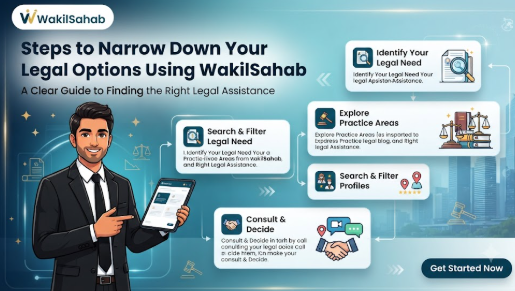
Step-by-Step Guide to Finding the Right Lawyer Using WakilSahab
Locating suitable legal representation requires an organized, methodical approach. Following a structured selection process ensures that you choose an advocate equipped to handle your specific legal issue effectively:
- Identify Your Specific Legal Issue: Clearly define the main subject matter of your legal problem. Determine whether your issue primary involves a financial transaction breach, a domestic family dispute, property title verification, corporate regulatory compliance, or criminal defense.
- Select the Corresponding Practice Area: Match your identified issue with the appropriate legal specialization. For example, if you are handling a tenant eviction or property division issue, select real estate and property law rather than general civil litigation.
- Perform a Location-Based Search: Use the search functionality to specify your preferred city, district, or court location. Finding an advocate who routinely appears before the local court or tribunal handling your case ensures they possess practical familiarity with local court administrative procedures.
- Explore Advocate Profiles: Examine several advocate listings matching your domain and location requirements. Review their educational background, bar association registrations, continuous years of active practice, and specific sub-specialization areas.
- Evaluate Domain Experience and Background: Look closely at an advocate’s specific courtroom or advisory experience regarding issues similar to yours. A lawyer with focused experience in technical cyber crime prosecutions, for example, offers higher practical utility for a digital fraud case than a generalist civil lawyer.
- Shortlist Suitable Candidates: Select two or three qualified advocates whose profiles, practice focus, spoken languages, and consultation options align with your needs.
- Request a Legal Consultation: Choose your preferred consultation channel—whether an online video discussion, a phone call, or an in-person meeting—and submit a formal consultation request through the platform based on available schedule slots.
- Organize Your Case Files and Documents: Gather and organize all relevant physical and digital documentation, court notices, correspondence, receipts, and agreements chronologically in preparation for your scheduled meeting.
Step-by-Step Guide to Preparing for Your First Legal Consultation
Maximizing the value of your initial legal consultation requires proactive preparation. An organized client enables an advocate to understand the core facts quickly and deliver precise preliminary guidance:
+-------------------------------------------------------------------------------+
|                  FIRST CONSULTATION PREPARATION CHECKLIST                     |
+-------------------------------------------------------------------------------+
|  [ ] Chronological Event Summary   -->  Write down key dates and events clearly |
|  [ ] Master Document File          -->  Organize deeds, notices, & agreements |
|  [ ] Target Questions List         -->  Prepare specific legal & procedural queries|
|  [ ] Fact Disclosure Plan          -->  Commit to sharing full facts honestly |
|  [ ] Action Item Notepad           -->  Be ready to note recommended next steps |
+-------------------------------------------------------------------------------+
- Gather and Structure All Relevant Documentation: Compile all supporting material related to your legal issue. This includes signed contracts, legal notices received or sent, police reports, bank statements, property deeds, email exchanges, and digital messaging records.
- Draft a Chronological Summary of Events: Prepare a clear, concise written timeline outlining key events in order of occurrence. List specific dates, involved parties, key actions taken, financial sums transferred, and formal communications exchanged.
- Formulate Specific Questions in Advance: Prepare a written list of key questions covering your immediate legal exposure, available defense options, court filing timelines, procedural expectations, and required supporting evidence.
- Disclose All Facts Openly and Honestly: Share complete, truthful details with your advocate during the consultation, including facts that may seem unfavorable to your position. Professional legal privileges protect confidential communications, and full disclosure is essential for building an effective strategy.
- Maintain an Organized Physical or Digital Record Folder: Keep duplicate copies of all original documents organized in labeled folders. Never hand over sole original documents during an initial consultation unless formally required for court submission against an official receipt.
- Record Recommended Action Items and Next Steps: Take notes during your discussion regarding the advocate’s preliminary assessment, required follow-up documentation, statutory limitation deadlines, and recommended preliminary action items.
Common Legal Situations Where Professional Guidance Is Helpful
Real-life legal challenges frequently arise unexpectedly. Understanding how professional legal guidance applies across typical scenarios underscores the value of timely legal assistance:
- Purchasing Residential Real Estate: A homebuyer planning to purchase a property discovers conflicting land ownership entries in historical revenue records. Engaging a property lawyer to conduct title searches across 30 years of public registry entries helps identify unrecorded mortgages, legal heirs’ claims, or land acquisition notices prior to signing a binding purchase agreement.
- Handling Unfair Consumer Trade Practices: An individual buys a commercial vehicle that develops severe, persistent engine failures within weeks of delivery. When the authorized dealership refuses repairs or replacement, consulting a consumer law advocate allows the buyer to send a formal legal notice and initiate a structured claim before the District Consumer Disputes Redressal Commission.
- Navigating Matrimonial Disagreements: A married couple experiencing irreconcilable differences decides to separate permanently. By seeking guidance from an advocate specializing in family law, both parties can discuss mutual consent divorce terms, draft a clear settlement agreement covering asset distribution and child custody, and complete judicial proceedings smoothly.
- Structuring Early-Stage Startup Partnerships: Two technology entrepreneurs found a digital health enterprise and intend to onboard external equity investors. Engaging a corporate legal consultant ensures they draft sound shareholder agreements, protect underlying software IP, set clear vesting schedules, and meet statutory corporate filing standards.
- Responding to Digital Banking Fraud: An individual falls victim to a sophisticated phishing fraud that results in unauthorized bank withdrawals. Consulting a cyber crime advocate enables the victim to immediately file formal reports with cyber law enforcement authorities, file statutory complaints under the Banking Ombudsman scheme, and preserve essential digital forensic evidence.
Common Mistakes People Make While Choosing a Lawyer
Selecting legal representation under stressful circumstances often leads individuals to make procedural or judgment errors. Recognizing these common pitfalls can help you avoid costly mistakes:
- Choosing Based Solely on General Word-of-Mouth: Relying exclusively on recommendations from friends or relatives without verifying whether the recommended advocate specializes in your specific legal domain often results in mismatched representation.
- Confusing Practice Domains: Hiring an advocate who primarily handles civil property disputes to manage a complex criminal trial or tax appeal can compromise your case strategy due to differences in procedural rules and evidentiary standards.
- Ignoring Local Jurisdictional Experience: Failing to consider whether an advocate regularly appears before the specific court, district tribunal, or appellate panel handling your case can result in procedural delays.
- Delaying Legal Consultation Until Crisis Points: Waiting until an arrest warrant is issued, a property is attached, or statutory limitation periods expire before seeking legal counsel limits available defense strategies and legal remedies.
- Failing to Clarify Fee Structures and Billing Terms: Proceeding with legal representation without reaching a clear, upfront understanding regarding legal fees, court expense handling, drafting charges, and appearance fees can lead to misunderstandings later on.
- Overlooking Communication and Responsiveness: Selecting counsel who fails to explain complex legal proceedings clearly, ignores case status inquiries, or leaves you uninformed creates unnecessary anxiety throughout the legal process.
Best Practices Before Hiring a Lawyer
Adopting clear best practices when evaluating legal counsel ensures a productive, professional relationship built on mutual trust and transparency:
- Verify Professional Credentials and Standing: Confirm that your chosen advocate is duly enrolled with the relevant State Bar Council and possesses active membership with local bar associations.
- Schedule an Initial Preliminary Consultation: Use an initial legal consultation to explain your case details, assess the lawyer’s approach, evaluate their communication style, and gauge their familiarity with relevant law.
- Request a Clear Explanation of Available Legal Options: Ask the advocate to outline potential legal strategies, including court litigation, out-of-court settlements, or formal mediation, along with the risks and expected timelines of each approach.
- Discuss Expected Timelines and Procedural Stages: While no advocate can control judicial scheduling, an experienced lawyer can explain the typical procedural stages, filing requirements, and estimated turnaround times for your matter.
- Establish Clear Communication Protocols: Agree upon regular updates, preferred contact methods, and designated times for reviewing case progress, receiving court order copies, and discussing upcoming hearing dates.
- Maintain Orderly Personal Records: Keep organized duplicates of all pleadings filed, court orders issued, legal notices served, and receipts for administrative fees paid throughout your legal matter.
Latest Trends in Online Legal Services in India
The legal sector in India is undergoing a significant transformation, driven by digital technology, evolving client expectations, and systemic administrative modernization:
- Expansion of Digital and Remote Legal Consultations: Secure video conferencing, cloud file sharing, and remote scheduling tools now allow clients across India—including those in tier-2 and tier-3 cities—to consult with specialized advocates without long-distance travel.
- Growth of Public Legal Awareness Platforms: Digital legal technology platforms increasingly provide free access to plain-language legal articles, statutory explainers, and educational video content, helping everyday citizens understand their legal rights before initiating legal proceedings.
- Integration of Technology in Judicial Infrastructure: The Indian judicial system’s ongoing e-Courts initiative has introduced e-filing portals, digital display boards, online cause lists, virtual court hearings, and mobile application tracking, making legal processes faster and more transparent.
- Virtual Document Preparation and Secure Sharing: Modern legal workflows increasingly utilize cloud repository systems, digital document drafting, e-stamping mechanisms, and electronic signatures, reducing reliance on physical paperwork for preliminary contract reviews and legal vetting.
- Data-Driven Advocate Discovery and Categorization: Legal service directories now use structured categorization, domain tagging, location mapping, and multi-parameter filtering to help users locate specialized legal practitioners accurately and efficiently.
Comparison of Major Legal Practice Areas in India
The following comparison table outlines primary legal practice areas, the core governing legislation, typical dispute scenarios, and the primary legal remedies sought under Indian law:
| Legal Practice Area | Core Governing Legislation / Framework | Typical Dispute Scenarios & Matters Handled | Primary Legal Remedies Sought |
| Criminal Law | Bharatiya Nyaya Sanhita (BNS), BNSS, BSA | Financial fraud, assault, theft, bail applications, police investigations | Bail orders, acquittal, quashing of complaints |
| Divorce & Family Law | Hindu Marriage Act, Special Marriage Act, Personal Laws | Contested/mutual divorce, child custody, alimony, maintenance claims | Dissolution decree, custody orders, maintenance awards |
| Property Law | Transfer of Property Act, Real Estate (RERA) Act | Title disputes, illegal encroachment, partition suits, lease breaches | Title declaration, eviction orders, injunctions |
| Corporate Law | Companies Act, Insolvency & Bankruptcy Code (IBC) | Breach of contract, governance disputes, M&A, regulatory non-compliance | Damages, specific performance, corporate restructuring |
| Cyber Crime Law | Information Technology Act, BNS penal provisions | Phishing, digital financial fraud, data breaches, online harassment | Asset recovery, formal prosecution, digital takedown |
| Civil Law | Code of Civil Procedure (CPC), Contract Act | Debt recovery, contract default, easement rights, tort claims | Monetary recovery decree, permanent injunction |
| Consumer Law | Consumer Protection Act | Product defects, service deficiencies, real estate project delays | Full refund, monetary compensation, product replacement |
| Intellectual Property | Trademarks Act, Patents Act, Copyright Act | Trademark infringement, patent disputes, copyright theft | Interlocutory injunctions, damages, IP destruction |
Comparison of Legal Consultation Methods
This comparison table highlights the practical advantages, ideal use cases, and key considerations associated with different legal consultation modes:
| Consultation Mode | Key Practical Advantages | Ideal Use Cases & Situations | Primary Considerations to Keep in Mind |
| In-Person Consultation | Direct personal interaction, seamless physical review of extensive paper documents | Complex property title reviews, trial strategy planning, sensitive criminal defense | Requires travel time, local office availability, and pre-scheduled appointments |
| Video Consultation | High convenience, remote face-to-face discussion, screen sharing for digital documents | Initial legal case evaluations, NRI consultations, contract reviews, strategic guidance | Requires stable high-speed internet and digital file formats |
| Phone Consultation | Immediate accessibility, minimal technical requirements, rapid preliminary discussion | Urgent legal advice, quick clarification of court notices, brief follow-ups | Limited ability to review voluminous original physical documents live |
| Online Legal Query | Flexible, asynchronous written responses, allows structured presentation of query details | Preliminary legal information inquiries, basic legal rights questions | Lacks real-time back-and-forth discussion; limited to general guidance |
Expert Tips for Selecting and Working with a Lawyer
Implementing practical recommendations from experienced legal professionals can improve your overall legal representation experience:
- Select Counsel Based on Case-Specific Expertise: Choose an advocate whose primary focus matches your specific case details rather than selecting a generalist for a highly technical matter.
- Organize Supporting Materials Chronologically Before Consulting: Presenting your documents and written event history in clear chronological order helps your advocate understand your case quickly and accurately.
- Be Entirely Honest About All Case Facts: Disclose all background facts fully during your consultation. Concealing unfavorable information limits your advocate’s ability to build an effective legal defense strategy.
- Establish Clear Operational and Financial Terms Upfront: Request clarity regarding professional fees, prospective court filing costs, drafting charges, and appearance fees in writing before commencing formal work.
- Maintain Duplicate Sets of All Case Pleadings: Retain digital and physical copies of every document, application, written statement, order, and receipt issued throughout your court proceedings.
- Treat Educational Information as Background Context Only: Use legal articles, guides, and informative platform resources to build basic legal awareness, while relying on custom advice from your advocate for active legal decisions.
Frequently Asked Questions (FAQs)
1. How do I find a specialized advocate for my legal issue in India?
You can search organized online lawyer discovery directories like WakilSahab, which allow you to filter advocate listings by specific practice areas (such as criminal, property, or family law), physical location, court jurisdiction, years of experience, and preferred consultation modes.
2. What is the difference between an in-person legal consultation and an online lawyer consultation in India?
An in-person consultation involves meeting an advocate at their office or court chambers, which is ideal for reviewing physical original documents and complex trial matters. An online legal consultation allows you to discuss your matter remotely via video or phone call, offering flexibility for preliminary advice, contract reviews, or non-resident legal needs.
3. What steps should I take if I need a criminal lawyer near me urgently for a bail matter?
If you require urgent assistance for a bail matter, gather all available details regarding the police complaint or First Information Report (FIR), locate a criminal law advocate using a localized legal directory, and schedule an immediate consultation to prepare an interim or anticipatory bail application before the appropriate judicial magistrate or sessions court.
4. What legal documents are required for an initial consultation regarding a property dispute?
You should bring all available property title deeds, sale agreements, revenue entries, mutation records, ancestral partition documents, encumbrance certificates, legal notices exchanged, and photos or maps showing physical land possession.
5. How can a corporate lawyer in India assist a newly established startup?
A corporate lawyer assists early-stage companies by drafting co-founder agreements, structuring employee stock options (ESOPs), registering intellectual property, drafting customer terms of service, ensuring Companies Act compliance, and reviewing commercial supply contracts.
6. What should I do if I fall victim to an online financial fraud or cyber crime?
You should immediately report the unauthorized transaction to your bank to freeze impacted accounts, preserve digital records (such as transaction screenshots, SMS messages, and email headers), file a formal complaint on the national cyber crime reporting portal or local cyber police station, and consult a cyber crime advocate to pursue formal legal recovery steps.
7. Can I obtain free legal advice online in India?
Many legal awareness platforms, informative legal blogs, and government legal services authorities provide basic statutory overviews, legal informative materials, and free legal aid for eligible categories under the Legal Services Authorities Act. However, detailed, case-specific strategy requires a dedicated formal consultation with a qualified advocate.
8. Why is it important to verify an advocate’s primary legal practice area before hiring?
Indian law encompasses diverse procedural codes, specialized tribunals, and complex statutory frameworks. An advocate specializing in your specific legal domain possesses the required procedural fluency, familiarity with current precedents, and targeted courtroom experience needed to manage your case effectively.
9. How should I prepare for a mutual consent divorce consultation with a divorce lawyer near me?
Prepare details regarding your marriage date, marriage registration certificate, current residential details of both spouses, a list of joint and individual assets, liabilities, income proofs, and a clear outline of agreed terms regarding alimony, child custody, and property division.
10. Are information and guides available on legal directories a substitute for formal legal representation?
No. Educational articles, statutory overviews, online practice guides, and legal blog posts provide general legal awareness only. Every legal dispute depends on specific background facts, documentation, and statutory limitation periods, requiring customized advice from a qualified advocate.
Final Summary
Securing favorable outcomes within the Indian legal system begins with early preparation and selecting legal counsel whose specific court experience aligns directly with your case requirements. Whether you are a startup founder protecting intellectual property, an individual resolving a civil property claim, or a family navigating sensitive personal law matters, platforms like WakilSahab help simplify advocate discovery across India. By bringing structure, location precision, and practice-area transparency to the legal consultation process, such resources help everyday citizens and enterprises make informed decisions. While educational platforms serve to demystify complex legal frameworks and foster public legal awareness, remember that legal rules apply differently to every set of facts. Always treat general guides as an educational foundation and consult directly with a qualified advocate to address your individual circumstances.
