
Introduction
Navigating the world of international migration can feel like solving a complex puzzle where the pieces are constantly shifting. For many aspiring global citizens, a hub for strategic planning and professional growth. At the heart of this journey lies a critical digital tool: the PR Points Calculator.
A PR (Permanent Residency) Points Calculator is a specialized algorithm used by immigration departments to rank and select candidates based on their potential to contribute to the local economy. Instead of a first-come, first-served basis, modern immigration is a meritocracy. Your age, your education, and even the language you speak are assigned a numerical value.
Why does this matter?
Because in the competitive landscape of global mobility, your score is your ticket. It determines whether you receive an “Invitation to Apply” (ITA) or remain in a pool of hopefuls.
Consider the story of a lead developer named Anita. Anita had a stellar career and a deep desire to move her family to a country with a more robust healthcare system. She spent months researching visas, feeling overwhelmed by legal jargon. It wasn’t until she used a PR Points Calculator that she realized her Master’s degree and high English proficiency gave her a significant advantage. The tool transformed her vague dream into a concrete, point-by-point roadmap. Like Anita, thousands of professionals use these calculators to bridge the gap between “I want to move” and “I am eligible to move.”
What Is a PR Points Calculator?
The concept of a points-based immigration system was pioneered to remove bias and focus on economic contribution. A PR Points Calculator is the digital interface of this system. It allows a user to input their personal and professional details to receive an estimated score.
The Logic of Points-Based Immigration
Governments use these systems to manage high volumes of applications. Instead of manually reviewing every person who wants to migrate, the system automatically filters for the “highest quality” candidates. This ensures that the individuals who are granted permanent residency are those most likely to find high-paying jobs, pay taxes, and integrate successfully into the workforce.
Determining Visa Eligibility
Your PR points act as a gatekeeper. Most countries set a “cutoff” or a minimum threshold. If your points fall below this line, you may not be eligible to even submit an application. The calculator allows you to see where you stand before you invest thousands of dollars in application fees, medical exams, and legal consultations.
How Points Systems Work
While every country has its own unique scoring rubric, most points-based systems share a core set of criteria. These “Human Capital Factors” are the building blocks of your score.
Key Scoring Factors
The following table outlines the standard factors used across major immigration hubs to determine a candidate’s value.
| Factor | Description | Strategic Importance |
| Age | Points are usually highest for those in the 25–35 range. | Targets individuals with a long remaining career span. |
| Education | Higher points for Master’s, PhDs, or specialized diplomas. | Ensures the labor force is highly skilled and educated. |
| Language Proficiency | Scores based on IELTS, PTE, or TOEFL results. | Critical for workplace integration and social cohesion. |
| Work Experience | Points for years of relevant professional history. | Demonstrates a track record of economic productivity. |
| Job Offer | Bonus points for having a valid offer from a local employer. | Guarantees immediate contribution to the economy. |
| Partner Skills | Points for a spouse’s education or language skills. | Encourages the migration of high-value “power couples.” |
How Factors are Scored
Points are generally weighted. For instance, language proficiency is often weighted more heavily than age because a 40-year-old who speaks the language fluently is often seen as more “employable” than a 22-year-old who cannot communicate in a professional setting. The scoring is objective; there is no room for negotiation. You either have the document to prove the point, or you don’t.
Country-Specific Sections
Canada PR Points Calculator
Canada’s Express Entry system is perhaps the most famous points-based model in the world. It uses the Comprehensive Ranking System (CRS) to rank candidates in the pool.
The CRS Breakdown:
The system is out of 1,200 points.
- Core Human Capital: Up to 500 points (Age, Education, Language, Experience).
- Skill Transferability: Up to 100 points (Combining factors like foreign experience + language).
- Additional Points: Up to 600 points (Provincial nomination, job offer, siblings in Canada, or French language skills).
Step-by-Step Scoring Example:
An applicant who is 29 years old (110 points), has a Master’s degree (135 points), maxes out their English test (136 points), and has 3 years of work experience (usually combined in transferability) would sit in the high 400s. If they secure a Provincial Nomination, they gain an automatic 600 points, making their total nearly 1,100—a guaranteed invitation.
Australia PR Points Calculator
Australia utilizes a points test for its General Skilled Migration (GSM) visas, such as the Subclass 189, 190, and 491.
Key Factors:
- Age: 30 points for ages 25–32.
- English: 20 points for “Superior” English (e.g., IELTS 8 in all bands).
- Employment: Points for both Australian and overseas experience.
- Qualifications: 20 points for a Doctorate, 15 for a Bachelor/Master.
To even be considered, you usually need a minimum of 65 points, though competitive occupations often require 85 to 95 points to receive an invitation in the current climate.
New Zealand PR Points Calculator
New Zealand’s Skilled Migrant Category (SMC) has recently moved toward a more simplified “6-point system” to streamline the process.
The 6-Point Logic:
Applicants must claim points from one of the following:
- Professional registration (3–6 points).
- High-level qualification (3–6 points).
- High income (3–6 points).
Additionally, they can claim 1 point for every year of skilled work in New Zealand, up to a maximum of 3 points. The goal is to reach a total of 6 points plus a job offer in a skilled role.
Japan Highly Skilled Professional Points System
Japan offers a “Fast Track” to permanent residency through its Highly Skilled Professional (HSP) visa. Unlike other countries that may take 5–10 years for PR, the HSP system can grant it in as little as 1 to 3 years if your points are high enough.
Scoring Tiers:
- 70 Points: Eligible for the HSP visa (3-year path to PR).
- 80 Points: Eligible for the “High-Level” path (1-year path to PR).
Points are awarded for academic background, professional career (years of experience), and annual salary. Younger professionals with high salaries and advanced degrees are heavily favored.
Global Points System Overview Table
| Country | System Name | Minimum Threshold | Top Weighted Factor | PR Timeline |
| Canada | Express Entry (CRS) | Varies (Market-led) | Language & Education | 6–12 Months |
| Australia | Points Test (GSM) | 65 Points | Regional Nomination | 12–24 Months |
| New Zealand | Skilled Migrant (SMC) | 6 Points | NZ Job Offer | 12–18 Months |
| Japan | HSP System | 70 Points | Annual Salary | 1–3 Years |
Benefits of Using a PR Points Calculator
Why should a professional bother with these tools? The benefits go beyond simple curiosity.
Quick Eligibility Assessment
Instead of reading hundreds of pages of government policy, a calculator gives you an answer in five minutes. It identifies immediately if you are “in the game” or if you need to go back to the drawing board.
Planning to Improve Your Score
The calculator is a diagnostic tool. If you see that your score is 420 and the latest cutoff was 470, you can see exactly where those 50 points could come from. Maybe you need to retake a language test or gain one more year of work experience.
Selecting the Best Country or Program
You might find that while you don’t have enough points for Canada, your specific occupation is in high demand in Australia, giving you a much higher relative score there. The calculator allows for a comparative strategy.
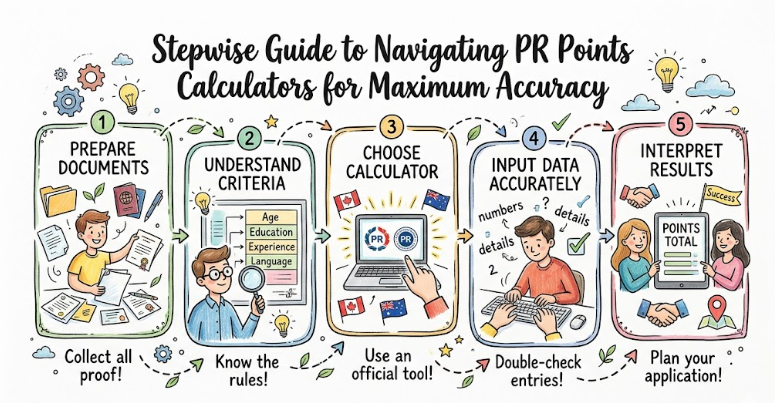
Step-by-Step Guide to Calculate Your Points
To get an accurate result, you must be honest and precise with your data. Here is the universal walkthrough.
- Identify Your NOC/ANZSCO Code: Before calculating, you must find your specific job code to ensure your work experience is “skilled.”
- Gather Your Education Credentials: Do not guess. Check if your degree requires an Educational Credential Assessment (ECA).
- Input Your Age: Use your current age at the time of intended application.
- Simulate Your Language Scores: If you haven’t taken the test yet, input the scores you realistically expect to achieve.
- Calculate Partner Points: If married, run the calculator both with and without your partner to see which scenario yields a higher score.
Example Profiles
Profile A: The Young Specialist (Single)
- Age: 26 (Max points)
- Education: Bachelor’s Degree
- Experience: 2 Years
- Language: Native speaker / High IELTS
- Outcome: Strong candidate for Australia and Canada, though may need a year more of experience for a top-tier score.
Profile B: The Senior Manager (Married)
- Age: 39 (Lower age points)
- Education: Master’s Degree
- Experience: 12 Years
- Partner: Also has a Master’s and high English.
- Outcome: The partner’s scores “cushion” the age points loss. This couple is highly competitive for Canada’s Express Entry.
How to Maximize Your PR Points
If your initial calculation is lower than you’d like, don’t panic. The system is designed to reward improvement.
- Improving Language Scores: This is the fastest way to jump 20–30 points. Moving from an IELTS 7 to an 8 can be the difference between rejection and residency.
- Gaining More Work Experience: In many systems, the jump from 2 years of experience to 3 years provides a significant points “bump.”
- Higher Education: Completing a one-year post-graduate certificate can sometimes add enough points to cross the threshold.
- Provincial or State Nomination: This is the “Golden Ticket.” Many regions look for specific skills and will “nominate” you, adding hundreds of points to your profile regardless of your age or other factors.
Common Mistakes to Avoid
A PR Points Calculator is only as good as the data you give it. Avoid these pitfalls:
- Miscalculating Work Experience: Not all work is “skilled” work. If your experience is in an entry-level, non-technical role, it may not count toward your points.
- Using Outdated Calculators: Immigration laws change frequently. Ensure you are using a tool updated for the current year’s regulations.
- Ignoring the Spouse Factor: Sometimes, including a spouse with low language scores can actually lower your total points. It is vital to calculate both “Single” and “Accompanied” scores.
- Overestimating Language Ability: Many people assume that because they work in English, they will get a perfect score. The tests are academic and specific; without preparation, your points will suffer.
Practical Case Studies
The Strategic Pivot: David’s Story
David, a 34-year-old software analyst, initially calculated his points for Canada. He was sitting at 435, while the invitations were being sent at 470. Instead of giving up, David used the calculator to simulate a “Provincial Nomination.” He noticed that the province of Ontario had a specific “Tech Draw” for his job code. He focused his energy on an Ontario-specific application, received a nomination, and his score skyrocketed to over 1,000. He received his PR invitation within weeks.
The Educational Advantage: Mei’s Story
Mei was a marketing professional from Singapore looking to move to Australia. At age 32, she had 65 points—the bare minimum. She realized that by completing a Master’s degree in Australia, she would not only gain points for a higher qualification but also “Study in Australia” points and potentially “Regional Study” points. She adjusted her strategy, moved as a student first, and used the extra points gained from her degree to successfully transition to PR after graduation.
FAQs
What is a PR points calculator?
A PR points calculator is a digital tool that evaluates an individual’s eligibility for permanent residency based on specific criteria like age, education, and work history.
How accurate are these tools?
While highly useful for estimation, they are not official government documents. The final score is always determined by an immigration officer after reviewing your physical evidence.
How many points are required for Canada PR?
There is no fixed number. The CRS cutoff changes with every draw, but generally, scores above 470–500 are considered highly competitive.
Can I improve my points after submission?
Yes, in systems like Canada’s Express Entry, you can update your profile with new test scores or higher education levels while you are still in the pool.
What are the differences between Canada, Australia, and NZ systems?
Canada uses a massive pool and frequent draws. Australia focuses heavily on state nominations and specific occupation lists. New Zealand emphasizes job offers within the country.
Does my spouse need to take a language test?
While not always mandatory, having a spouse take the test can often add valuable bonus points to your total score.
What happens if my points are exactly at the cutoff?
Most systems use a “tie-breaking rule,” where candidates who entered the pool earlier are prioritized over those who entered later.
Are points deducted for age?
Points aren’t usually “deducted,” but they decrease as you get older. For example, you might get 110 points at age 29, but only 95 points at age 35.
Do I need a job offer to get PR points?
Not necessarily. Many people secure PR in Canada and Australia based solely on their “Human Capital” (skills and education) without a job offer.
Is there a limit on how many times I can calculate my points?
No, you can use these tools as many times as you like to test different “what-if” scenarios for your future.
Conclusion
A PR Points Calculator is more than just a piece of software; it is a strategic compass for your international career. By understanding the underlying mechanics of how points are awarded, you can take control of your immigration journey.
Whether you are aiming for the snowy landscapes of Canada, the vibrant cities of Australia, the serene beauty of New Zealand, or the technological frontier of Japan, your points are the foundation of your success. Take the time to calculate your score accurately, identify your areas for improvement, and stay persistent. The world is looking for skilled professionals, and with the right strategy, you can be the next success story.
