
Introduction
In today’s fast-paced market, businesses are often defined by how quickly they can adapt. Whether you are a local retailer moving online or a service-based firm automating client intake, the bridge between where you are and where you want to be is digital innovation. Many growing businesses feel overwhelmed by the sheer volume of new technologies—from artificial intelligence to cloud accounting. They often ask, “Is this necessary for my growth?” The answer is rarely about adopting every new tool; it is about choosing the right ones to solve real problems.
Digital innovation is not just for tech giants; it is a survival and growth mechanism for businesses of all sizes. By integrating digital solutions, you reduce manual errors, save time, and create a scalable foundation. This guide serves as a practical, beginner-friendly resource to help you navigate the landscape of digital growth. We will demystify the process, provide a structured approach, and highlight how to manage risks effectively. Whether you are aiming to stabilize your cash flow or expand your reach, understanding digital strategy is your most valuable asset.
What Is Digital Innovation for Growing Businesses?
Digital innovation is the process of using new digital technologies to solve existing business problems, improve customer experiences, or create new value. It is not just about “going paperless.” It involves rethinking how your business interacts with customers, processes data, and delivers services. For a growing business, this is intrinsically linked to finance and sustainability. A better digital system means cleaner financial reporting, faster tax preparation, and more accurate budgeting.
Why This Topic Matters
Ignoring digital progress in a competitive market is a silent risk to your bottom line. Without digital tools, businesses often face “bottleneck syndrome,” where growth is limited by how much manual work the team can perform. Implementing the right strategies helps you avoid costly mistakes, such as losing track of invoices or failing to engage returning customers. When you build a digital-first culture, you gain visibility into your business’s financial health, enabling better decision-making and long-term stability.
Detailed Breakdown of Digital Transformation
Successful digital transformation requires balancing three pillars: Technology, Process, and People.
- Technology Selection: Always prioritize solutions that solve a specific pain point rather than adopting tech for the sake of trends.
- Process Optimization: Before digitizing a bad process, simplify it. Digitizing a broken workflow only makes it faster to be broken.
- Data Security: As you move business operations online, protecting your financial data and customer information becomes paramount. This involves secure cloud storage, multi-factor authentication, and regular backups.
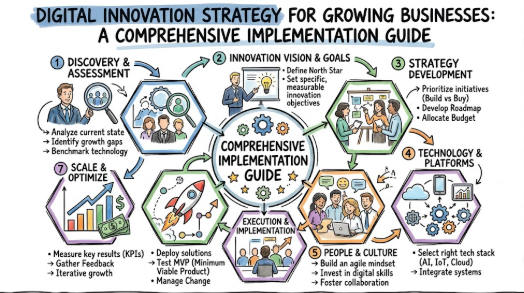
Step-by-Step Practical Guide
- Assess Your Current State: Identify the most time-consuming manual task in your business.
- Define Clear Objectives: Set a measurable goal, such as “reduce invoice processing time by 30%.”
- Research Suitable Tools: Look for software that integrates with your existing financial or CRM systems.
- Prioritize User-Friendly Solutions: If your team finds a tool too difficult, it will not be used.
- Pilot Testing: Implement the tool in one department or with a small set of tasks first.
- Training and Support: Invest time in teaching your team how to leverage the new system.
- Monitor Performance: Review if the tool is meeting the KPIs set in step 2.
- Iterate and Expand: Once successful, scale the solution to other areas of the business.
Practical Real-Life Examples
- Situation: A boutique consultancy struggled with late payments. Action: They integrated an automated invoicing tool that sent reminders. Result: Cash flow improved by 20%.
- Situation: A retail shop relied on manual inventory logs. Action: They used a basic POS system that tracked stock levels. Result: Reduced overstocking and saved capital.
- Situation: A service firm lost client leads in emails. Action: Implemented a simple digital lead tracker. Result: Higher conversion rates.
- Situation: A business owner did manual tax calculations. Action: Switched to cloud-based accounting software. Result: Stress-free tax filing and fewer errors.
- Situation: A company was overwhelmed by support queries. Action: Set up a FAQ chatbot on their website. Result: Freed up 10 hours a week for the team.
Common Problems Readers Face
Businesses often fall into the trap of “tool fatigue,” where they purchase too many subscriptions that do not talk to each other. Another common issue is resistance to change from team members, which usually happens when the benefits of the new system aren’t communicated clearly. Additionally, many owners focus on “cool features” rather than the return on investment (ROI) a tool provides.
Mistakes to Avoid
- Don’t automate processes you don’t understand yet.
- Don’t share administrative credentials with everyone; follow the principle of least privilege.
- Don’t rely on a single vendor for all your critical infrastructure without a backup plan.
- Don’t skip data security protocols to save time.
- Don’t ignore the learning curve; productivity often dips before it rises when adopting new tech.
Table 1: Good Practice vs. Bad Practice
| Feature | Good Practice | Bad Practice |
| Tool Selection | Solving specific problems | Adopting tools because they are trending |
| Data Handling | Regular backups and encryption | Storing sensitive data on local, unprotected drives |
| Implementation | Gradual rollout and team training | Implementing everything at once without guidance |
| Financial View | Real-time digital tracking | Manual ledger keeping with high error rates |
Tools, Methods, or Frameworks
The “Start Small, Scale Smart” framework is effective for growing businesses.
- Audit Phase: Use a simple spreadsheet to list all manual tasks.
- Selection Phase: Compare tools based on cost, integration capabilities, and user reviews.
- Execution: Use a 30-day trial period to test viability before committing to an annual contract.
Expert Tips
- Focus on cloud-native tools for remote accessibility.
- Prioritize cybersecurity from day one.
- Ensure all your digital tools can “talk” to each other (API integrations).
- Focus on mobile-first interfaces.
- Document every new digital process for the team.
- Regularly review your subscriptions to cancel unused ones.
- Train your team on phishing awareness.
- Start with automating your most repetitive tasks first.
- Keep your digital infrastructure simple; complexity breeds maintenance issues.
- Treat data privacy as a customer service priority.
Case Studies
- Profile: Small E-commerce Store. Problem: High return rates due to poor product descriptions. Approach: Integrated a video-based product review tool. Result: Returns dropped by 15%.
- Profile: Freelance Graphic Designer. Problem: Inconsistent project delivery times. Approach: Used a project management board. Result: Delivery became predictable and client satisfaction rose.
- Profile: Local Logistics Firm. Problem: Fuel costs ballooning due to inefficient routing. Approach: Adopted GPS-integrated route optimization software. Result: Reduced fuel expenses by 12%.
Risk Awareness Section
Digital innovation carries inherent risks. Market risk exists if your technology becomes obsolete quickly. Data privacy risk involves potential leaks or hacks. Operational risk occurs if a key digital system goes down. Always maintain offline backups, consult with IT security professionals, and ensure your digital strategy complies with local data protection regulations.
Checklist Before Taking Action
- Verify the specific problem the tool solves.
- Check the security reputation of the provider.
- Review the total cost of ownership, including hidden fees.
- Ensure the team has the capacity to learn the new system.
- Confirm the tool integrates with existing workflows.
- Evaluate the potential impact on customer data privacy.
- Establish a fallback plan if the digital tool fails.
- Set clear performance benchmarks to judge success.
Table 2: Digital Strategy Comparison
| Strategy | Focus | Best For |
| Lean Automation | Removing manual steps | Very early-stage startups |
| Full Digital Integration | Creating a connected ecosystem | Scaling businesses needing data insights |
| Hybrid Approach | Manual/Digital mix | Businesses transitioning from traditional models |
Key Terms Explained
- Cloud Computing: Accessing software and storage over the internet instead of on local hardware.
- API: A bridge that allows two different pieces of software to communicate.
- Automation: Using software to perform repetitive tasks without human intervention.
- Dashboard: A visual representation of your business’s key data and metrics.
- Encryption: The process of turning information into a code to prevent unauthorized access.
- Scalability: The ability of your systems to grow along with your business demands.
- KPI (Key Performance Indicator): A measurable value that demonstrates how effectively you are achieving business goals.
- CRM (Customer Relationship Management): Software used to manage interactions with current and potential customers.
- ERP (Enterprise Resource Planning): A suite of integrated apps that manage core business processes.
- Cybersecurity: The practice of protecting systems, networks, and programs from digital attacks.
Who Should Read This Blog
This guide is essential for small business owners, entrepreneurs, managers, and operational leads who are looking to modernize their workflows. It is also highly relevant for finance professionals who need to understand how digital tools impact business transparency and tax compliance.
Frequently Asked Questions
- What is the best way to approach the Complete Guide to Digital Innovation for Growing Businesses?
Start by auditing your most repetitive tasks. Don’t try to change everything at once; identify one bottleneck and solve it with a single, effective tool. - Does digital innovation always require a large budget?
No. Many effective tools are cloud-based and operate on a subscription model, making them accessible to businesses of all sizes. - How can a Complete Guide to Digital Innovation for Growing Businesses help with tax filing? Modern accounting software provides real-time financial tracking, which simplifies tax season by keeping all records categorized and audit-ready throughout the year.
- How do I protect my business data during digital transformation?
Use multi-factor authentication, choose reputable providers with strong security protocols, and perform regular data backups on a separate, secure drive. - Is digital transformation risky for small businesses?
There are risks like data breaches or system downtime, but these can be managed through careful vendor selection, staff training, and robust security policies. - Should I use free tools for my business?
Free tools can be a good starting point, but always consider the long-term support, security, and scalability of the product as your business grows. - How do I convince my team to adopt new digital tools?
Focus on how the tool makes their specific job easier rather than how it helps the company “save money.” Focus on removing their frustrations. - What if the digital tool I choose fails?
Always have a manual or backup process in place. Never let your business entirely depend on a single, untested digital solution without a safety net. - What is the role of data in a Complete Guide to Digital Innovation for Growing Businesses?
Data is the fuel. Digital tools allow you to collect, analyze, and act on insights about your customers, finances, and operational performance. - How often should I review my digital infrastructure?
Aim for a quarterly review to ensure all your tools are still serving their purpose, are cost-effective, and remain secure. - Can digital innovation help in reducing business costs?
Yes, by eliminating manual errors, reducing time spent on administrative tasks, and providing insights that help you optimize resource allocation. - What is the first step in digital innovation?
The first step is a mindset shift—accepting that modernization is necessary and committing to learning how to use new tools to improve efficiency.
Conclusion and Next Steps
Digital innovation is an ongoing journey rather than a destination. By systematically applying the steps outlined in this guide, you are not just adopting technology; you are building a resilient, data-driven foundation for your business’s future. The key to long-term success is to remain curious and adaptable. As your business grows, your digital needs will evolve, and your ability to choose the right tools will become a core competitive advantage.
Start by auditing one process this week. Choose the one that causes the most friction and research a digital solution that can alleviate that pressure. Remember, the goal is not complexity; the goal is clarity and efficiency. Always keep your team informed and your data secure as you move forward. Your commitment to improving your business processes today will pay significant dividends in stability and growth tomorrow. Continue learning, stay vigilant about security, and always keep the needs of your customers at the center of your digital strategy.
