
Introduction
A business may invest in websites, cloud platforms, automation software, customer relationship systems, data tools, and artificial intelligence, yet still struggle with slow processes, unhappy customers, poor communication, and rising costs. The problem is often not the technology itself but the absence of a clear strategy connecting technology with business needs. Digital transformation can feel confusing because every department may want different tools, employees may resist unfamiliar systems, and leaders may expect immediate results. A practical strategy helps a company decide what must change, why the change matters, who will be responsible, how progress will be measured, and which risks must be controlled. This guide explains why every business needs a clear digital transformation strategy and how organizations can modernize operations through careful planning rather than rushed technology purchases.
What is Digital Transformation Strategy ?
A digital transformation strategy is a structured plan for using technology to improve business operations, customer experiences, employee productivity, decision-making, and long-term competitiveness.
It does not mean replacing every manual activity with software. It means identifying areas where digital tools can solve real problems and create measurable improvements.
For example, a small distributor may receive customer orders through telephone calls, handwritten notes, emails, and messaging applications. Because information is scattered, employees may enter the same order several times, make mistakes, or delay delivery.
A digital transformation strategy could help the business introduce:
- A centralized order management system
- Digital inventory records
- Automated customer notifications
- Online payment options
- Sales and delivery dashboards
- Standard approval processes
The important point is that the company does not begin by purchasing random software. It first studies its order process, identifies the main problems, defines the expected result, and then selects suitable technology.
How Digital Transformation Works
Digital transformation usually connects four areas:
- People: Employees, leaders, customers, suppliers, and partners
- Processes: The activities used to deliver products or services
- Technology: The digital tools supporting those activities
- Data: The information used to understand performance and make decisions
A successful strategy balances all four areas. Technology alone cannot fix unclear responsibilities, weak processes, poor-quality data, or employee resistance.
Why Businesses Search for Digital Transformation Guidance
Organizations usually explore digital transformation when they experience challenges such as:
- Slow manual processes
- High operating costs
- Poor customer response times
- Repeated data-entry errors
- Difficulty working across locations
- Weak reporting and visibility
- Increasing competition
- Outdated systems
- Cybersecurity concerns
- Difficulty scaling operations
Common Misunderstanding
A common misunderstanding is that digital transformation means creating a new website or adopting the latest artificial intelligence tool. These activities may be part of transformation, but they are not a complete strategy.
A website redesign does not solve back-office delays. An automation tool does not help when the underlying process is unclear. An analytics system cannot produce reliable insights when the source data is inaccurate.
Practical Takeaway
Start with the business problem, not the technology. The correct question is not, “Which software should we buy?” It is, “Which business outcome must improve, and what combination of people, process, data, and technology will help us improve it?”
Why Every Business Needs a Clear Digital Transformation Strategy
Digital transformation affects almost every part of a modern organization. A clear strategy helps the business make connected decisions instead of running separate technology projects without common direction.
It Connects Technology With Business Goals
A company may want to increase revenue, improve customer retention, reduce operational costs, enter new markets, or improve service quality. A digital transformation strategy connects technology investments with these goals.
For example, introducing customer relationship management software should not be treated as an isolated information technology project. It should support business objectives such as improving lead follow-up, reducing missed opportunities, understanding customer needs, and strengthening sales forecasting.
The common mistake is selecting software because competitors use it. The better approach is defining the business outcome first and evaluating whether the technology supports that outcome.
It Helps Control Technology Spending
Without a strategy, departments may purchase overlapping tools. Sales may use one customer platform, marketing may use another, and support teams may maintain separate spreadsheets.
This increases subscription costs, creates duplicate data, complicates reporting, and weakens security.
A transformation strategy introduces governance for selecting, approving, integrating, and reviewing technology. It helps the organization invest in systems that support several departments rather than creating disconnected digital environments.
It Improves Customer Experience
Customers expect convenient communication, accurate information, timely service, secure transactions, and consistent experiences across channels.
A strategy helps the business examine the complete customer journey, including:
- Product discovery
- Enquiry
- Purchase
- Payment
- Delivery
- Support
- Feedback
- Repeat purchase
The common mistake is improving only the visible digital channel while ignoring the operational process behind it. A modern website cannot create a good customer experience when inventory records are inaccurate or support requests remain unanswered.
It Supports Better Decisions
Businesses collect information from sales, finance, operations, customer service, websites, and supply chains. Without integration and governance, this data may remain fragmented or unreliable.
A digital transformation strategy establishes how data will be:
- Collected
- Stored
- Secured
- Standardized
- Shared
- Analyzed
- Used in decisions
This allows managers to understand what is happening and respond using evidence rather than assumptions.
It Makes Growth More Manageable
A process that works for 50 customers may fail when the business reaches 5,000 customers. Manual approvals, scattered spreadsheets, and informal communication become difficult to manage as the organization grows.
A clear strategy identifies which processes must be standardized, automated, or redesigned before growth creates operational pressure.
It Builds Business Resilience
Businesses face changing customer behaviour, supply disruptions, cybersecurity threats, economic uncertainty, and new competition. Digital capabilities can help organizations adapt more quickly.
Cloud-based collaboration, digital records, automated workflows, secure remote access, and real-time reporting can reduce dependence on a single office, person, or manual process.
Practical Scenario
Consider a service company that tracks customer complaints through emails and messaging applications. Complaints are sometimes forgotten, duplicated, or assigned to the wrong employee.
Without a strategy, the company may purchase a help-desk tool and expect the problem to disappear. However, the real solution also requires service categories, response standards, escalation rules, employee training, performance metrics, and customer communication templates.
Technology becomes valuable only when it is connected to a better operating model.
The Real Problems Businesses Face During Digital Transformation
Most digital transformation failures do not begin with a technical problem. They begin with unclear goals, weak ownership, poor communication, or unrealistic expectations.
Lack of a Clear Business Problem
Some businesses begin transformation because digitalization is popular. They adopt software without identifying the exact problem it should solve.
This creates activity without meaningful improvement.
A better approach is to describe the problem in measurable terms. Instead of saying, “We need automation,” the company could say, “Invoice approvals currently take seven working days because documents move through email. We want to reduce delays and improve approval visibility.”
Too Much Confusing Advice
Business leaders are exposed to many technologies, including cloud platforms, artificial intelligence, automation, analytics, blockchain, customer platforms, and collaboration tools.
Attempting to adopt everything creates confusion. The organization should prioritize technologies based on business value, readiness, risk, and available resources.
Departmental Silos
Different departments may have separate goals, systems, budgets, and data definitions. One team may define an active customer differently from another team.
Without coordination, digital projects create more fragmentation.
A strategy should establish shared definitions, integration requirements, decision rights, and ownership.
Employee Resistance
Employees may fear job loss, increased monitoring, difficult systems, or additional work. Resistance becomes stronger when people are informed after major decisions have already been made.
The better approach is to involve employees early, explain why the change is necessary, collect their feedback, and provide practical training.
Unrealistic Expectations
Technology vendors and internal teams may describe transformation as fast and simple. In reality, process redesign, data cleaning, integration, training, and adoption require sustained effort.
Leaders should distinguish between early improvements and long-term transformation.
Ignoring Process Problems
Automating a poor process makes the poor process faster. Before introducing technology, the company should remove unnecessary approvals, duplicate steps, unclear responsibilities, and outdated rules.
Weak Measurement
Businesses sometimes declare a project successful because the software was installed. Installation is not the business outcome.
Success should be measured using results such as:
- Reduced processing time
- Fewer errors
- Better customer satisfaction
- Higher employee adoption
- Lower operating cost
- Improved sales conversion
- Faster reporting
- Stronger compliance
Depending Only on Technology Teams
Digital transformation is a business responsibility supported by technology. It requires leadership from operations, finance, sales, marketing, human resources, customer service, and management.
The information technology team can implement systems, but business teams must define processes, requirements, controls, and expected outcomes.
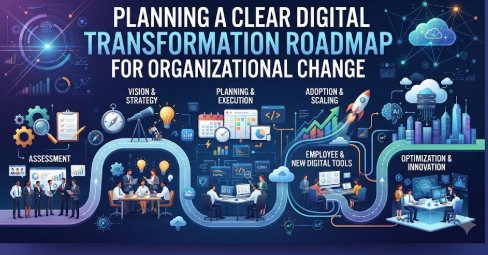
How Digital Transformation Works Step by Step
Step 1: Assess the Current Business Position
The first step is understanding how the business currently operates. Review important workflows, systems, data sources, customer complaints, employee challenges, operating costs, security weaknesses, and reporting gaps. This matters because a company cannot design the right future state without understanding its current condition. For example, a retailer may discover that stock information is maintained separately in stores, warehouses, and accounting software. A common mistake is relying only on senior management opinions. The better approach is combining leadership input with employee interviews, process observation, system reviews, and customer feedback.
Step 2: Define Clear Business Outcomes
The business should decide what the transformation must achieve. Goals may include faster service, lower costs, stronger security, improved customer retention, better reporting, or easier expansion. Each goal should be specific enough to measure. For example, the organization may aim to reduce customer onboarding time from several days to one working day. A common mistake is using broad goals such as “become more digital.” The better approach is connecting every project with a measurable business outcome, responsible owner, deadline, and review method.
Step 3: Prioritize Processes and Opportunities
A company cannot transform every department at the same time. It should rank opportunities according to customer impact, financial value, operational urgency, implementation difficulty, and risk. A high-volume process with frequent errors may deserve attention before a low-impact activity. A common mistake is choosing the most visible project rather than the most valuable one. The better approach is selecting a balanced portfolio containing quick improvements, essential infrastructure work, and longer-term strategic initiatives.
Step 4: Design the Future Process
Before selecting technology, the organization should define how the improved process will work. This includes responsibilities, approvals, data requirements, controls, exceptions, customer interactions, and reporting. For example, a digital purchase approval process should specify who can request, review, approve, reject, and audit each transaction. A common mistake is copying the old process directly into new software. The better approach is simplifying the process first, removing unnecessary steps, and then configuring technology around the improved workflow.
Step 5: Select Suitable Technology
Technology should be evaluated according to business requirements, integration capability, security, usability, scalability, vendor reliability, support quality, and total cost. The least expensive tool may create higher costs later if it cannot integrate or scale. A common mistake is allowing impressive demonstrations to replace detailed evaluation. The better approach is using documented requirements, practical test cases, employee feedback, security reviews, and pilot projects before making a major commitment.
Step 6: Prepare People and Manage Change
Employees must understand what is changing, why it is changing, how their responsibilities will be affected, and where they can get help. Training should be based on real work situations rather than general software features. For example, customer service employees should practise handling actual complaint scenarios in the new platform. A common mistake is providing one training session immediately before launch. The better approach is offering role-based learning, practical exercises, support materials, managers’ guidance, and follow-up coaching.
Step 7: Launch in Controlled Phases
A phased launch allows the company to test the new process, collect feedback, resolve problems, and reduce disruption. The pilot may begin with one branch, product category, or department. A common mistake is launching across the entire organization before testing important integrations and exceptions. The better approach is defining pilot success criteria, monitoring results closely, documenting lessons, and expanding only after essential issues have been resolved.
Step 8: Measure, Improve, and Govern
Digital transformation continues after implementation. The company should review adoption, performance, customer feedback, security, costs, and business outcomes regularly. For example, a new sales platform may be technically operational but produce little value if employees continue maintaining private spreadsheets. A common mistake is closing the project after software deployment. The better approach is assigning long-term ownership, reviewing performance indicators, improving workflows, updating training, and removing tools that no longer provide value.
Key Factors That Influence Digital Transformation
Leadership Commitment
Leaders must provide direction, resources, accountability, and visible support. Employees are unlikely to take transformation seriously when leaders continue using old processes or allow departments to ignore new standards.
Effective leadership does not mean controlling every technical decision. It means clarifying priorities, resolving conflicts, supporting responsible experimentation, and keeping attention on business outcomes.
Organizational Culture
A culture that punishes every mistake may prevent employees from testing better methods. A culture that accepts every new idea without review may waste resources.
Businesses need a balanced environment where teams can experiment on a controlled scale, evaluate results honestly, and learn from failures without ignoring accountability.
Employee Skills
New technology creates limited value when employees cannot use it confidently. Skills may be required in data handling, digital collaboration, cybersecurity, automation, process improvement, and analytics.
The company should assess existing capabilities and create a practical learning plan rather than assuming every employee requires the same training.
Process Maturity
Digital tools work best when processes have clear steps, ownership, controls, and performance measures. Highly informal processes may need standardization before automation.
A company should not confuse flexibility with disorder. A flexible process can still have clear decision rules and responsibilities.
Data Quality
Incorrect, duplicated, outdated, or incomplete data weakens reporting, automation, and artificial intelligence.
Before transferring data to a new system, the organization should define data standards, remove duplicates, assign ownership, and establish validation controls.
Technology Architecture
Systems should exchange information securely and reliably. When every department adopts isolated tools, employees spend time transferring information manually.
A transformation strategy should consider integration, identity management, access controls, application programming interfaces, backup, recovery, and long-term scalability.
Customer Expectations
Technology investments should reflect actual customer needs. Some customers value self-service, while others require personal assistance.
Businesses should use customer research, service data, feedback, and journey analysis instead of assuming that every customer wants a completely automated experience.
Financial Capacity
Digital transformation involves software costs, implementation services, training, integration, security, process redesign, maintenance, and internal employee time.
The organization should consider the total cost of ownership rather than only the initial purchase price.
Detailed Breakdown of a Digital Transformation Strategy
Business Vision and Strategic Alignment
The strategy should begin with a clear explanation of what the business is trying to become.
A manufacturer may want to improve production visibility. A professional services firm may want to deliver projects more consistently. A retailer may want to connect online and physical customer experiences.
The digital vision should support the broader business strategy. It should not exist as a separate technology statement.
Customer Experience Transformation
Customer experience transformation examines every interaction between the customer and the organization.
Important areas include:
- Finding accurate product or service information
- Receiving timely answers
- Completing transactions conveniently
- Tracking orders or requests
- Resolving problems
- Managing returns or cancellations
- Protecting personal information
A common mistake is creating more digital channels without improving consistency. Customers should not receive different information from the website, store, call centre, and sales team.
Business Process Automation
Automation can reduce repetitive work, delays, errors, and dependency on manual follow-up.
Processes suitable for automation may include:
- Invoice routing
- Employee onboarding
- Appointment reminders
- Inventory alerts
- Lead assignment
- Document approvals
- Customer notifications
- Routine reporting
However, automation should include exception handling. Not every situation follows the standard path. Employees must know what to do when information is missing, approval limits are exceeded, or a customer has a special requirement.
Data and Analytics
A data strategy explains which information is important, where it comes from, who owns it, how it is protected, and how it will support decisions.
Useful analytics may help a business understand:
- Customer acquisition
- Product profitability
- Service delays
- Employee capacity
- Inventory movement
- Supplier performance
- Payment patterns
- Customer retention
The common mistake is creating dashboards with many metrics but no clear decisions attached to them. Each important measure should help someone make or review a decision.
Cloud Adoption
Cloud technology can improve flexibility, collaboration, access, and scalability. However, moving to the cloud does not automatically improve a business process.
Organizations must consider:
- Data sensitivity
- Access management
- Service availability
- Vendor dependency
- Backup and recovery
- Regulatory requirements
- Integration
- Ongoing cost
The better approach is selecting cloud services based on workload requirements and risk rather than treating cloud migration as a complete transformation strategy.
Cybersecurity and Privacy
Digital operations increase dependence on systems and data. Security must therefore be included from the beginning.
Businesses should address:
- User access
- Password and authentication policies
- Data encryption
- Security updates
- Employee awareness
- Backup testing
- Incident response
- Vendor security
- Privacy obligations
The common mistake is adding security controls after the system has already been designed. Security should be part of requirements, vendor evaluation, configuration, testing, and daily operations.
Workforce Transformation
Technology may change tasks, decision rights, team structures, and skill requirements.
Some repetitive work may decline while analysis, customer interaction, exception management, and process improvement become more important.
Leaders should explain these changes honestly. Employees need opportunities to learn and adapt rather than receiving only technical instructions.
Operating Model and Governance
Governance defines who can approve technology, set standards, access data, accept risks, and measure results.
A practical governance model may include:
- An executive sponsor
- Business process owners
- Technology leaders
- Data owners
- Security representatives
- Employee change champions
- Project managers
- Performance reviewers
Governance should enable responsible progress rather than create unnecessary approvals.
Common Mistakes Businesses Make With Digital Transformation
Buying Technology Before Understanding the Problem
This happens when organizations react to trends or persuasive sales demonstrations.
The risk is that the software may not address the actual business challenge. Employees may avoid using it, and the organization may continue paying for an unused system.
The better approach is documenting the problem, desired outcome, users, process requirements, and success measures before selecting technology.
Treating Transformation as an IT Project
Technology teams cannot redesign business operations without active participation from process owners.
When business teams remain uninvolved, requirements may be incomplete, workflows may not match reality, and adoption may remain low.
The better approach is creating shared ownership between leadership, business functions, technology, security, and employees.
Digitizing Inefficient Processes
Moving a complicated paper approval process into software does not make it efficient.
The company may simply create digital delays instead of paper delays.
The better approach is removing unnecessary steps, clarifying decision rights, and simplifying the process before automation.
Ignoring Employee Feedback
Employees often understand operational problems better than senior leaders because they perform the work every day.
Ignoring their feedback can create systems that are difficult to use or fail to support common exceptions.
The better approach is involving representative users during process mapping, evaluation, testing, training, and improvement.
Underestimating Data Problems
A new system may expose years of inconsistent customer names, duplicate supplier records, missing product codes, and inaccurate contact details.
Poor data can delay implementation and weaken trust in the new platform.
The better approach is beginning data assessment and cleanup early.
Expecting Immediate Financial Returns
Some improvements, such as stronger cybersecurity, reliable data, or system integration, may create long-term value without producing immediate revenue.
The better approach is evaluating financial and non-financial outcomes, including risk reduction, speed, quality, capacity, resilience, and customer experience.
Launching Too Many Projects
Too many simultaneous projects compete for employee attention, budgets, leadership decisions, and technical resources.
The result may be transformation fatigue and unfinished initiatives.
The better approach is prioritizing a manageable portfolio and completing important foundations before expanding.
Ignoring Cybersecurity
New integrations, accounts, devices, and vendors can increase exposure to security threats.
The better approach is completing security and privacy reviews before implementation and maintaining controls after launch.
Failing to Measure Adoption
A platform may be available while employees continue using email, paper, or private spreadsheets.
The better approach is measuring active usage, process compliance, user satisfaction, and business results rather than counting licences.
Depending on One Vendor Without an Exit Plan
Heavy dependency can create pricing, service, data-access, and migration risks.
The better approach is reviewing contract terms, data export options, integration standards, service commitments, and business continuity plans.
“Don’t Do This” Checklist
- Do not purchase technology only because it is popular.
- Do not automate a process before reviewing it.
- Do not exclude employees from design decisions.
- Do not assume installation means adoption.
- Do not move poor-quality data into a new platform without review.
- Do not ignore integration and security requirements.
- Do not begin too many major projects at once.
- Do not set vague goals that cannot be measured.
- Do not hide implementation problems from leadership.
- Do not expect every employee to learn in the same way.
- Do not rely completely on vendor claims.
- Do not forget long-term ownership and maintenance.
Practical Real-Life Examples of Digital Transformation
Example 1: A Small Retail Business
Situation: A retailer tracks inventory manually and often discovers stock shortages after receiving customer orders.
Challenge: Employees update records at different times, creating inaccurate information.
Better action: The retailer introduces centralized inventory records, barcode-based updates, and reorder alerts after simplifying the stock-handling process.
Learning: Technology creates value when operational responsibilities and data-entry rules are clear.
Example 2: A Professional Services Firm
Situation: Consultants store client documents in personal folders and exchange updated versions through email.
Challenge: Teams lose time identifying the latest file and may use outdated information.
Better action: The firm establishes document naming standards, access permissions, version control, and a shared collaboration platform.
Learning: Digital collaboration requires both software and consistent working practices.
Example 3: A Manufacturing Company
Situation: Production managers receive machine and output reports at the end of each shift.
Challenge: Problems may continue for several hours before managers become aware of them.
Better action: The company introduces real-time production monitoring, exception alerts, and escalation responsibilities.
Learning: Real-time information is useful only when teams know how and when to respond.
Example 4: A Healthcare Service Provider
Situation: Patients must call repeatedly to book, confirm, or change appointments.
Challenge: Staff spend significant time on routine communication, while patients experience delays.
Better action: The provider introduces online scheduling and automated reminders while maintaining telephone assistance for patients who need support.
Learning: Digital transformation should improve convenience without excluding users who prefer human help.
Example 5: A Small Distribution Company
Situation: Sales representatives accept orders through phone calls, messaging applications, and handwritten forms.
Challenge: Orders may be entered incorrectly or processed late.
Better action: The company creates a standardized digital order process connected to inventory and billing.
Learning: Standardization should come before automation and integration.
Table 1: Digital Activity Versus Strategic Transformation
| Basic Digital Activity | Clear Digital Transformation Approach |
|---|---|
| Purchasing software without defined goals | Selecting technology after defining business outcomes |
| Converting paper documents into files | Redesigning document creation, approval, storage, and access |
| Creating dashboards with many metrics | Tracking measures connected to specific decisions |
| Moving systems to the cloud | Reviewing security, integration, cost, resilience, and process impact |
| Offering a mobile application | Improving the complete customer journey behind the application |
| Automating existing steps | Simplifying the process before automation |
| Conducting one-time training | Providing role-based training, support, and follow-up |
| Measuring project completion | Measuring adoption, performance, risk, and business value |
Table 2: Common Problem and Better Strategic Response
| Business Problem | Weak Response | Better Strategic Response |
|---|---|---|
| Slow approvals | Purchase a workflow tool immediately | Map delays, remove unnecessary approvals, then configure workflow |
| Poor customer service | Add another communication channel | Connect channels, define ownership, and measure response quality |
| Inaccurate reporting | Build more dashboards | Improve data definitions, ownership, validation, and integration |
| Employee resistance | Make usage compulsory without support | Explain purpose, involve employees, train by role, and collect feedback |
| High software spending | Cancel tools without analysis | Review usage, overlap, integration, business value, and contract terms |
| Cybersecurity concerns | Buy isolated security products | Establish access, data, vendor, incident, backup, and employee controls |
| Difficulty scaling | Hire more people for manual tasks | Standardize processes and automate suitable high-volume activities |
| Failed implementation | Blame employees or vendors | Review goals, process design, requirements, governance, and change support |
Tools, Methods, and Frameworks Readers Can Use
Digital Maturity Assessment
A digital maturity assessment examines the organization’s current capabilities across strategy, leadership, process, technology, data, people, customer experience, and security.
Beginners can score each area using simple levels such as basic, developing, established, and advanced.
This prevents the mistake of assuming the company is ready for complex technology when basic process or data foundations are missing.
Process Mapping
Process mapping visually documents the steps, decisions, participants, delays, and information involved in a workflow.
Teams can begin with sticky notes or simple flowchart software. The goal is understanding the actual process, including exceptions, rather than documenting only the official policy.
This method helps avoid automating unnecessary or duplicated steps.
Customer Journey Mapping
A customer journey map describes what customers do, think, need, and experience at each interaction.
Businesses can use interviews, support records, website data, complaints, and employee observations to create the map.
It helps prevent the mistake of improving isolated digital channels while ignoring the overall customer experience.
Impact-Effort Prioritization
This framework compares initiatives according to expected business impact and implementation effort.
High-impact, manageable-effort projects may become early priorities. High-impact, high-effort projects may require phased planning.
The method helps prevent leaders from selecting projects only because they are exciting or highly visible.
Business Case Template
A business case explains:
- The current problem
- Affected users
- Proposed change
- Expected benefits
- Costs
- Risks
- Alternatives
- Timeline
- Success measures
- Ownership
It helps beginners compare initiatives consistently and prevents decisions based only on vendor presentations.
Pilot and Feedback Method
A pilot tests a new process or system with a limited group before broader implementation.
The pilot should include realistic data, common exceptions, user feedback, performance measures, and clear decision criteria.
This reduces the risk of organization-wide disruption.
Change-Readiness Review
A change-readiness review evaluates leadership support, employee awareness, available skills, workload, communication, and training needs.
It helps prevent the mistake of assuming that technical readiness automatically means organizational readiness.
Benefits-Tracking System
A benefits-tracking system records expected outcomes and reviews whether they are achieved after implementation.
It may track time savings, error reduction, customer satisfaction, revenue improvement, adoption, or risk reduction.
This avoids declaring success based only on project completion.
Expert Tips to Make Better Digital Decisions
1. Begin With a Business Outcome
Write down the result that must improve before discussing technology. This matters because clear outcomes guide process design, vendor evaluation, budgeting, and measurement. For example, define a goal such as reducing order errors instead of simply requesting an order management platform.
2. Study the Existing Process Directly
Do not depend only on policy documents or management assumptions. Observe how employees actually complete the work. This reveals informal steps, duplicate activities, delays, and exceptions that may not appear in official documentation.
3. Involve Frontline Employees Early
Employees who perform the work can identify practical requirements and adoption barriers. Include representative users in workshops, evaluations, testing, and training design. This creates better solutions and reduces resistance.
4. Prioritize a Few Valuable Initiatives
Focus on projects with clear customer, financial, operational, or risk benefits. A smaller number of well-managed initiatives usually produces more value than a large collection of incomplete experiments.
5. Simplify Before Automating
Review whether each step, approval, document, and handoff is necessary. Automation should support an improved process rather than preserve outdated complexity.
6. Treat Data as a Business Asset
Assign ownership for important customer, product, supplier, financial, and operational data. Establish definitions, validation, access, and maintenance rules. Reliable data improves reporting and automation.
7. Include Cybersecurity From the Beginning
Review access, data protection, integration, vendor security, backup, and incident response during planning. Adding controls after launch can be more expensive and disruptive.
8. Evaluate Total Cost of Ownership
Include licences, implementation, customization, integration, training, support, maintenance, internal employee time, and future upgrades. This produces a more realistic comparison between options.
9. Use Pilots for High-Risk Changes
Test assumptions with a limited group before organization-wide rollout. Define what the pilot must prove, collect evidence, and resolve critical issues before expanding.
10. Measure Adoption and Outcomes Separately
Adoption shows whether people use the new system. Outcomes show whether the system improves the business. Both are necessary because high usage without business improvement is not enough.
11. Protect Human Support Where It Adds Value
Not every interaction should be fully automated. Customers may require empathy, judgement, negotiation, or complex problem-solving. Use automation for suitable tasks while maintaining human assistance for exceptions.
12. Review the Strategy Regularly
Customer needs, business priorities, regulations, security threats, and technology options change. Review the transformation roadmap periodically and adjust priorities using evidence.
13. Build Internal Capability
External consultants and vendors can provide expertise, but the business should maintain internal knowledge of its processes, data, architecture, controls, and strategy. This reduces long-term dependency.
14. Communicate Honestly
Explain expected benefits, limitations, risks, and changes to employees. Avoid presenting every initiative as simple or guaranteed. Honest communication builds trust.
15. Stop Projects That No Longer Create Value
Continuing an initiative only because money has already been spent can increase losses. Review evidence and be willing to redesign, pause, or stop projects that no longer support business goals.
Case Studies: How Better Understanding Changes Decisions
Case Study 1: Regional Retail Chain
Profile: A retail company operates several physical stores and a growing online channel.
Situation: Customers frequently order products online that are unavailable in the nearest store. Employees maintain inventory information in separate systems.
Problem: The company initially believes it needs a more attractive e-commerce website.
Wrong approach: Management plans a full website redesign without addressing inventory synchronization, store processes, or product data.
Better approach: The company maps the complete order journey, standardizes product codes, improves inventory updates, connects online and store records, and introduces order-status notifications. The website redesign is included only after the operational foundation is defined.
Result or learning: The organization understands that customer experience depends on connected front-end and back-end processes. The project becomes an operational transformation rather than a visual redesign.
Key takeaway: A digital channel cannot provide reliable service when the underlying data and processes remain fragmented.
Case Study 2: Professional Services Company
Profile: A consulting business manages multiple client projects with teams working from different locations.
Situation: Project information is stored across email, spreadsheets, messaging applications, and personal folders.
Problem: Managers cannot easily understand project status, capacity, deadlines, or commercial risk.
Wrong approach: The company purchases a complex project management platform and launches it without standardizing project stages or responsibilities.
Better approach: Leaders define common project phases, status rules, document standards, ownership, and reporting requirements. A small team tests the platform using real projects, and training is designed for consultants, managers, and finance staff separately.
Result or learning: The organization learns that software cannot create consistent project management without shared working methods.
Key takeaway: Process standards and role clarity are essential foundations for successful digital adoption.
Case Study 3: Small Manufacturing Business
Profile: A manufacturer produces customized components for business customers.
Situation: Machine downtime, production delays, and quality issues are recorded manually at the end of each shift.
Problem: Management receives information too late to respond effectively.
Wrong approach: The company considers purchasing advanced artificial intelligence tools before improving basic production data.
Better approach: It first defines downtime categories, assigns data responsibilities, introduces simple real-time reporting, and creates escalation rules. After reliable data is available, the company evaluates predictive maintenance for selected machines.
Result or learning: The organization builds capabilities in stages and avoids investing in advanced technology before establishing trustworthy information.
Key takeaway: Digital maturity develops progressively. Basic data quality and operating discipline should come before advanced analytics.
Risk Awareness: What Businesses Must Check First
Strategic Risk
Strategic risk occurs when digital initiatives do not support important business goals.
This matters because the organization may spend money and employee time without improving customers, operations, revenue, or resilience.
Reduce this risk by connecting every major project with a documented business objective and measurable outcome.
Financial Risk
Transformation costs may exceed the original estimate because of integration, customization, training, migration, support, or delays.
Reduce financial risk through realistic budgeting, phased commitments, total-cost analysis, and regular benefit reviews.
Operational Risk
A new system may interrupt critical activities, create delays, or fail to handle exceptions.
Reduce this risk through process testing, pilot launches, backup procedures, support plans, and controlled deployment.
Cybersecurity Risk
New systems, integrations, vendors, accounts, and devices may create security weaknesses.
Reduce this risk using strong authentication, access controls, encryption, updates, monitoring, backup testing, vendor reviews, and employee awareness.
Data Privacy Risk
Businesses may collect, store, or share more personal information than necessary.
Reduce privacy risk by defining a lawful and legitimate purpose, limiting data collection, controlling access, maintaining retention rules, and reviewing third-party handling.
Vendor Risk
The organization may depend on a provider for availability, support, data access, security, and pricing.
Reduce vendor risk by reviewing service commitments, financial stability, security practices, data export options, contract terms, and exit arrangements.
Integration Risk
Systems may not exchange information correctly, creating duplicate work or inconsistent records.
Reduce integration risk by documenting data flows, testing interfaces, assigning monitoring responsibilities, and planning error handling.
Employee Adoption Risk
Employees may avoid the new system because it is difficult, poorly explained, or unsuitable for their work.
Reduce adoption risk through early involvement, role-based training, support, feedback channels, and visible leadership usage.
Misinformation Risk
Leaders may make decisions using exaggerated claims, incomplete data, or technology trends.
Reduce misinformation risk by validating claims, requesting demonstrations using realistic scenarios, speaking with independent experts, and reviewing evidence.
Compliance Risk
Digital systems may affect financial controls, employment records, customer rights, data protection, or industry obligations.
Reduce compliance risk by involving qualified legal, tax, financial, security, and industry professionals where required.
Checklist Before Taking Action
- The business problem is clearly documented.
- The expected business outcome is measurable.
- Customers, employees, and process owners have been consulted.
- The current workflow has been mapped.
- Unnecessary steps have been removed.
- Technology options have been compared using written requirements.
- Security and privacy risks have been reviewed.
- Data quality and migration needs are understood.
- Integration requirements have been documented.
- Total cost of ownership has been estimated.
- Employee training and change support are planned.
- A pilot or phased launch has been considered.
- Success measures and review dates are defined.
- Long-term ownership is assigned.
- Vendor contract and exit conditions have been reviewed.
- Backup and business continuity plans are available.
- Regulatory or professional review has been obtained where necessary.
- The initiative supports the wider business strategy.
Businesses should use this checklist before approving a major digital initiative. It can also be reused during project reviews to identify missing controls, unclear ownership, or changes in business priorities.
Strategic Insights for Better Decision-Making
Build Capabilities in the Correct Sequence
Advanced analytics and artificial intelligence require reliable data. Automation requires stable processes. Self-service requires clear customer journeys. Cloud platforms require security and governance.
Businesses should identify these dependencies before creating the roadmap. Attempting an advanced initiative without foundational capabilities increases cost and failure risk.
Balance Quick Wins With Foundational Work
Quick improvements can build confidence and demonstrate value. However, businesses must also invest in less-visible foundations such as data standards, integration, cybersecurity, process ownership, and employee skills.
A roadmap containing only quick wins may create temporary improvements without long-term scalability.
Create a Portfolio, Not a List of Projects
Transformation initiatives should be managed as a connected portfolio.
For example, a customer experience project may depend on customer data cleanup, system integration, employee training, and process redesign. Reviewing these projects together helps leaders manage dependencies and resources.
Separate Experimentation From Core Operations
Businesses should experiment with emerging technologies in controlled environments. Critical operations require stronger testing, governance, and continuity planning.
This allows innovation without placing essential customer, financial, or operational activities at unnecessary risk.
Define Decision Rights
Transformation slows down when nobody knows who can approve requirements, accept risk, change processes, or resolve conflicts.
The strategy should define clear decision rights for executives, process owners, technology teams, security teams, data owners, and project leaders.
Measure Value Over Time
Some benefits appear quickly, while others require sustained adoption and process improvement.
Businesses should track leading indicators, such as training completion and system usage, together with outcome indicators, such as processing time, customer retention, quality, and cost.
Design for Change
A rigid system may become expensive when the company introduces new products, locations, regulations, or business models.
Technology and processes should be designed with reasonable flexibility, clear interfaces, documented ownership, and maintainable configurations.
Maintain Human Accountability
Automation can recommend, route, calculate, or generate content, but the organization remains responsible for decisions and outcomes.
Critical financial, legal, safety, employment, and customer decisions may require human review and documented accountability.
Key Digital Transformation Terms Explained for Beginners
- Digital Transformation: The structured use of technology, data, process improvement, and organizational change to improve how a business operates and serves customers.
- Digital Strategy: A plan showing how digital capabilities will support business goals, customer needs, operational improvements, and long-term growth.
- Digital Maturity: The level of an organization’s ability to use technology, data, processes, skills, leadership, and governance effectively.
- Automation: The use of technology to complete repetitive tasks or workflow steps with limited manual effort.
- Cloud Computing: The delivery of computing services, storage, applications, or infrastructure through remotely managed platforms.
- Data Governance: The rules, responsibilities, and controls used to maintain data quality, access, security, ownership, and proper use.
- System Integration: The connection of different applications so that information can move between them accurately and securely.
- Customer Journey: The complete set of interactions a customer has with a business, from discovery and purchase to service and repeat engagement.
- Change Management: The structured process of preparing, supporting, and guiding employees through organizational or technological change.
- User Adoption: The extent to which intended users actively and correctly use a new process, system, or tool.
- Key Performance Indicator: A measurable value used to review whether a process, project, team, or business goal is achieving the expected result.
- Legacy System: An older technology system that may still support important operations but can be difficult to maintain, integrate, secure, or scale.
- Cybersecurity: The practices used to protect systems, accounts, networks, devices, and data from unauthorized access or disruption.
- Scalability: The ability of a system or process to handle business growth without unacceptable cost, delay, or performance problems.
- Total Cost of Ownership: The complete long-term cost of technology, including purchase, implementation, training, integration, support, maintenance, and internal resources.
Who Should Read This Blog
Business Beginners
Beginners can use this guide to understand that digital transformation is a business improvement process rather than a simple software purchase.
Students
Students studying management, information technology, business operations, or entrepreneurship can learn how strategy, people, process, data, and technology work together.
Salaried Employees
Employees can understand why organizations introduce new systems, how roles may change, and why training and feedback are important.
Small Business Owners
Small business owners can use the frameworks and checklists to prioritize affordable, practical improvements without following every technology trend.
Entrepreneurs
Entrepreneurs can design scalable processes and digital foundations before rapid growth creates operational problems.
Managers
Managers can use the guidance to define outcomes, involve teams, manage adoption, and evaluate whether projects create measurable value.
Investors
Investors can assess whether a company’s digital initiatives support real business capabilities or consist mainly of technology-related claims.
Technology Learners
Technology learners can understand the business context behind cloud platforms, automation, analytics, cybersecurity, and artificial intelligence.
Operations Teams
Operations professionals can use process mapping, automation, data, and performance measurement to improve daily work.
Finance Professionals
Finance teams can evaluate costs, business cases, controls, benefits, vendor commitments, and return expectations.
Marketing and Customer Service Teams
These teams can connect digital channels with customer journeys, service operations, data quality, and consistent communication.
People Trying to Avoid Business Mistakes
Any decision-maker planning a major technology investment can use this guide to identify risks, ask better questions, and avoid rushed implementation.
Frequently Asked Questions
1. What is a digital transformation strategy?
A digital transformation strategy is a structured plan for using technology, data, process improvement, and organizational change to achieve business goals. It defines priorities, responsibilities, risks, investments, and success measures.
2. Why does every business need a clear digital transformation strategy?
Every business needs a clear digital transformation strategy because disconnected technology purchases can increase costs and complexity. A strategy connects digital investments with customer needs, operational improvements, security, growth, and measurable business value.
3. Is digital transformation only for large companies?
No. Small businesses can also improve ordering, billing, customer communication, inventory, collaboration, and reporting through digital transformation. The scale of investment should match the company’s needs, resources, and readiness.
4. What is the first step in digital transformation?
The first step is assessing the current business situation. The company should identify process delays, customer problems, data issues, security weaknesses, employee challenges, and strategic priorities before selecting technology.
5. How is digital transformation different from digitization?
Digitization converts physical information into digital form, such as scanning paper records. Digital transformation redesigns processes, responsibilities, customer experiences, data usage, and business capabilities using digital technology.
6. How can small businesses create a digital transformation roadmap?
Small businesses can begin by selecting a few high-impact problems, mapping current processes, defining measurable outcomes, comparing affordable tools, and launching improvements in phases. The roadmap should remain realistic and manageable.
7. What is the biggest digital transformation mistake?
The biggest mistake is buying technology before clearly understanding the business problem. This can create unused systems, employee resistance, duplicated tools, poor integration, and weak returns.
8. How long does digital transformation take?
Digital transformation is usually an ongoing process rather than a one-time project. Individual improvements may be completed in phases, but organizations must continue reviewing systems, processes, skills, security, and customer needs.
9. How should businesses measure digital transformation success?
Success should be measured through business outcomes such as faster processing, fewer errors, improved customer experience, stronger adoption, reduced risk, better reporting, lower costs, or increased operational capacity.
10. Why is employee involvement important?
Employees understand daily processes, exceptions, customer problems, and practical system requirements. Involving them early improves design quality, reduces resistance, and helps the organization create more useful training.
11. Does a digital transformation strategy need professional support?
Some businesses can manage smaller initiatives internally. Complex projects involving cybersecurity, data privacy, legal obligations, financial controls, integration, or major organizational change may require qualified professional support.
12. What should a business do after reading this guide?
The best next step is to identify one important business problem and assess its current process, users, data, risks, and desired outcome. The company can then create a limited, measurable improvement plan before purchasing technology.
Conclusion
Why every business needs a clear digital transformation strategy becomes easier to understand when transformation is viewed as a business improvement journey rather than a technology shopping exercise. Digital tools can improve customer service, productivity, reporting, collaboration, scalability, security, and resilience, but they cannot independently repair unclear processes, weak leadership, poor-quality data, or employee resistance. A strong strategy begins with a measurable business problem, examines the current process, defines the desired outcome, assigns ownership, evaluates risks, and selects technology only after requirements are understood. Businesses should prioritize a manageable number of initiatives, simplify processes before automating them, involve employees from the beginning, and introduce major changes through controlled phases. They should also measure both system adoption and business outcomes, because software installation alone does not prove that transformation has succeeded. Cybersecurity, privacy, integration, vendor dependency, regulatory obligations, and total cost should be reviewed before commitments are made.
