
Introduction
A rental trip is made of many small pieces of information. There is the vehicle you picked, the dates you chose, the price you saw, the documents you need and the promises the provider made. When these pieces live only in your head, some of them are lost by the time you reach the counter. When they are written down in one place, the rental becomes much easier to manage.
People rent bicycles, scooters, motorcycles and cars in China for commuting, holidays, business travel and long journeys. This article follows the whole path, from the first search to the final return, and shows what to record at each stage. It also explains where MotoShare, a vehicle-rental platform for China, fits into that path.
Understanding MotoShare and Why It Exists
MotoShare is a China-focused platform for finding and booking rental vehicles. According to its description, it serves international travellers, local residents, commuters, road-trip fans and riders who want flexible transport.
The listings cover motorcycles, scooters, bicycles and cars, with rental periods that can be hourly, daily, weekly or longer. The vehicles come from local rental providers, so the platform works as a marketplace that brings renters and providers together. The description also mentions clear pricing, no extra booking fee from the platform itself, CFMOTO and Benelli motorcycles, listings in places such as Beijing and Lanzhou, and city pages for locations like Shanghai and Shangri-La.
A rental usually passes through three stages, and each leaves something worth saving. When you search, you see what exists in a place on your dates. When you compare, you learn how the options differ in cost and rules. When you confirm, you agree to one final set of terms. Keep a short note from each stage, because the final agreement is easier to judge when you remember what you first expected. Also remember that no platform can promise every vehicle in every city, so the listing for your own dates is what counts.
Why Different Travellers Pick Different Vehicles
A family arriving with children and suitcases may want the space and shelter of a car. A commuter may want something small that is cheap to run and easy to park. A person who likes a slow, short outing may be happy with a bicycle. An experienced rider may look at a motorcycle for a longer trip. Many people compare more than one type before choosing.
The right choice depends on five things: the journey, the budget, the experience of the person driving or riding, the local rules and the vehicles that are actually free on the dates. Write those five things at the top of a notes page before you start looking. Every later decision gets easier when they are clear.
The Main Details, Step by Step
Understanding Motorcycle Types and Their Uses
Begin with your notes: where you will ride, how experienced you are, how much you carry and how comfortable you need to be. Then read each motorcycle type as a possible match.
If your notes say short trips and little experience, a commuter motorcycle fits best. It is light and simple, though it has little space for bags. If they say speed and confident handling on good roads, a sports bike may appeal, but its forward-leaning seat is tiring on long days. If they say several days with luggage, a touring motorcycle gives comfort and carrying room, at the cost of extra weight. If they say mixed roads and long distances, an adventure motorcycle copes well, though its tall seat needs confidence. If they say a wish for more power and features, premium models deliver that, usually at a higher price and with more skill needed.
The MotoShare description mentions CFMOTO and Benelli. A brand name, however, does not prove that a certain model is free on your dates, so record only what the listing itself shows.
Exploring Motorcycle Options Across Major Chinese Cities
Make one notes entry for each city, using the same headings every time: pickup place, available dates, models shown, total price, provider terms. With the same headings, differences between cities show up quickly.
For example, a search for motorcycle rental Beijing and a search for motorcycle rental Shanghai may return different bikes, prices and conditions for the very same dates. Do not carry assumptions from one city to the other. Local traffic rules may also limit where two-wheelers can go, and registration rules can differ, so write down what you find from the local authority or the provider, not what you guess.
A general search for motorcycle rental China can give you a first picture of the choices. A single listing, though, is what tells you what applies to your trip.
Picking Between Bikes, Scooters and Cars
Take the notes you wrote about your trip and read each vehicle against them.
A bicycle is quiet and slow, carries little and suits short, easy outings. Many people exploring bike rental China options want exactly that. A scooter is lighter and usually easy to ride, often with an automatic gearbox, and it suits quick city trips. It is smaller and lighter than a motorcycle, which makes it less suited to fast, long roads, and it is a common choice for people searching for scooter rental China. A motorcycle offers more range and power but needs more skill and gives little protection from rain.
A car carries more people and bags and keeps you dry, but it is harder to park and costs more to run. Anyone weighing car rental China options should remember that the largest or cheapest car is not automatically the right one. Pick the vehicle that matches your notes, not the one that merely looks best on a screen.
Understanding How Online Discovery and Booking Fit Together
A rental marketplace gathers many vehicles in one place, so you can filter by city and date. To use it well, keep three records.
The first is the search record: what you looked for and which options appeared. The second is the comparison record: the details of each serious option, written in the same order. Include the rental period, the total price, the deposit, the insurance, any mileage limit, the fuel arrangement, the cancellation rules, the pickup place and the return conditions. The third is the confirmation record: the final terms you agreed to, saved in full.
Providers can have different rules, even on the same platform, so never assume that two listings work alike. Read the final terms before you confirm, and keep a copy.
Renting a Car in China as a Foreign Visitor
For a visitor, the key is to separate two kinds of paperwork. One kind lets you rent the car. The other kind gives you the legal right to drive it. They are different, and having the first does not give you the second. This difference sits at the centre of car rental China for foreigners.
It helps to sort documents by when you need them.
Before you travel. Check the official rules. Official Chinese government pages say that Chinese law does not recognise international driving licences, and an international driving permit alone is not accepted. A visitor who wants to drive generally needs a Chinese temporary driving permit. The Chongqing government lists the usual application documents: a passport with a valid visa or entry stamp, the original foreign licence, an official Chinese translation of it and a white-background photo. A short traffic-safety video is part of the process, and some airports offer help with applications. For short stays the permit is commonly valid for about three months, though the length can depend on visa status. Procedures can differ by city, so confirm them locally.
Before you pay. Ask the provider what it requires, such as identification, a deposit and its own insurance rules, and write the answer down.
While you drive. Official guidance says to carry the permit, your foreign licence with its translation and the rental contract.
One more fact belongs in your notes. The official Chongqing FAQ says that for people renting vehicles in China, the temporary permit it describes covers only small automatic vehicles. A permit that works for a car should not be assumed to work for a motorcycle, so ask the authority and the provider which vehicle types apply.
Understanding Self-Drive Car Arrangements
Self-drive means that the customer rents the car and drives it personally, within the law and the rental terms. A driver is not provided.
People choose it for family trips, business visits, sightseeing and journeys with a lot of luggage. Interest in self drive car rental China options usually comes from wanting to set your own timetable.
Write down a few decisions before you compare cars. How many seats do you need? How much luggage must fit? Then compare the total cost, the insurance, the mileage limit, the fuel policy and the pickup and return arrangements for each car. A smaller car is easier to park in a crowded city, so bigger is not always better.
Preparing Well for an Adventure Motorcycle Journey
Choose the motorcycle by the route, the distance, the weather, the road conditions, your luggage and your own experience. A very powerful bike is not always the safest or most suitable choice, and one you can handle calmly is usually better.
Then build a short routine you can repeat every morning of the trip. Check the tyres, brakes, lights and chain. Put on your helmet, gloves, jacket and boots. Look at your navigation, the fuel stops ahead and the rest breaks you planned. Keep an emergency contact where you can reach it quickly.
If you are comparing adventure motorcycle rental China options, remember that not every road or destination is open to motorcycles, so check access first and write down what you learn.
Planning a Cross-Country Motorcycle Trip
Keep a simple trip log. For each day, write the distance you expect, the weather risk, the fuel stops, the place to sleep and any local rule you need to remember. Leave a spare day, because delays happen.
For any motorcycle road trip China plan, check local traffic rules, vehicle limits and whether the places on your route allow motorcycles. Take distances, travel times and road conditions from reliable local sources, and mark clearly which items you have verified and which you have not. Before any of this, confirm that you are legally allowed to ride the type of motorcycle you want, because that answer can change the whole route.
Understanding Rental Costs and Their Conditions
The advertised daily rate rarely covers everything. Keep a cost log with one line for each charge, and write beside it when that charge could apply: the rental price, the deposit, the insurance, fuel, mileage charges, late return fees and cancellation terms.
Prices in China are shown in Chinese yuan (RMB or CNY), and amounts and terms can differ by vehicle, city, provider and date. Add up the log for each option and compare the totals, not the daily rates. A listing with a low rate and strict conditions can cost more than a clearer one that looks slightly dearer.
Preparing for an Easy Rental Experience
Treat the rental like a small file. Put these things in it: your passport, permit and licence with its translation, a copy of the rental agreement, the pickup details and the provider’s contact number.
At pickup, walk around the vehicle and photograph every scratch, dent and worn tyre, and ask the provider to write down any damage that is already there. Add the photos to your file. At return, keep any receipt, and keep everything until the deposit is settled. These are general habits and not confirmed MotoShare procedures.
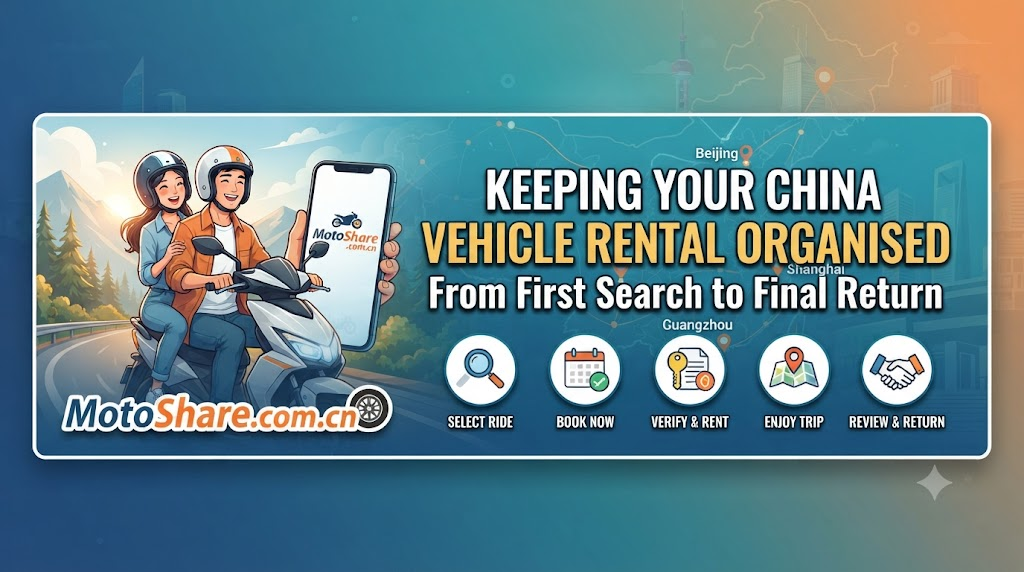
A Simple Five-Step Rental Planning Process
- Write down the basics. Record the place, the dates and the type of vehicle, so that every later choice has a reference point.
- Compare and record totals. Put two or three listings side by side with their full costs, so one headline price does not decide for you.
- Check the rules in writing. Note the licence requirements, identification needs and provider terms before you get attached to an option.
- Review the details and keep proof. Read the insurance, deposit, pickup arrangements and vehicle condition, and save photos and messages.
- Confirm last and keep a copy. Book only when you understand the whole agreement, and keep the final version.
This is general advice and not a description of how any one platform’s booking system works.
Common Rental Errors and How to Avoid Them
- Assuming a foreign licence is accepted. Read the official rules before you travel.
- Ignoring the permit. Start the application early and keep its documents together.
- Looking only at the advertised price. Add every cost to your log before deciding.
- Skipping the insurance and deposit details. Read what is covered and how the deposit is returned.
- Choosing a motorcycle that is too hard to handle. Pick one that fits your real experience.
- Forgetting the pickup and return arrangements. Confirm the place, the time and the required condition.
- Assuming a vehicle is free on your dates. Check the exact dates on the listing.
- Planning a long trip without checking local rules and roads. Research restrictions and road conditions first, and write down what you verify.
A Realistic Hypothetical Example
Nadia and Omar are visiting China with their young child for nine days. They arrive at an airport and want to see two nearby towns. They start a notes page with the basics: the dates, the number of people, the bags and the child’s needs.
They compare a bicycle, a scooter and a small car against those notes. The bicycle and scooter fail at once, because they cannot carry a child and luggage safely and comfortably. The car fits their needs. They read the official guidance and learn that Chinese law does not recognise their home licences on their own, that a temporary permit is needed and that some airports help with applications. They note that Omar will apply, with his licence translated into Chinese, and they write down that the permit may cover only small automatic vehicles.
They then compare two cars for their dates. In the same order for each, they write the total cost, deposit, insurance, mileage limit, fuel rule and pickup place, and they ask whether the provider can supply a child seat. They choose the car with clearer terms, save the agreement, photograph the car at pickup and keep every paper in one folder.
It was not a complicated plan. It was a well-recorded one.
Frequently Asked Questions
What should I keep in a rental notes file?
Keep your trip basics, the listings you compared with their total costs, the rules you verified, the final agreement, your documents and your photos of the vehicle.
Which documents should I carry while driving in mainland China?
Official guidance says to carry the temporary driving permit, your foreign licence with its Chinese translation and the rental contract.
Why does the vehicle type on a permit matter?
The official Chongqing FAQ says the permit it describes covers only small automatic vehicles for rentals, so a permit that works for a car should not be assumed to work for a motorcycle.
What should I ask the provider before paying a deposit?
Ask how much it is, when it is returned, how it is returned and what could reduce it.
How should I record existing damage?
Photograph every scratch and dent, tell the provider and ask for the damage to be written down before you drive away.
What if my plans change after booking?
Check the cancellation terms you saved, and contact the provider early.
How do I keep several listings straight?
Use the same headings for each one and compare totals, not daily rates.
Conclusion
A rental is easier to manage when it leaves a trail. The basics you wrote at the start, the totals you compared, the rules you checked, the agreement you saved and the photos you took at pickup all work together, so that nothing important depends on memory. Visitors should give special care to the permit, because a licence from home does not settle it and a permit may not cover every kind of vehicle. MotoShare can help you find and compare options in one place, while the records stay in your own hands. Keep them tidy, and a rental that could have been confusing becomes an ordinary part of the trip.
