
Introduction
The landscape of software development and IT operations has undergone a massive shift. In the past, developers and operations teams worked in separate silos. This separation often led to delays, miscommunication, and unstable software releases. The Master in DevOps Engineering (MDE) has been established as a framework to remove these barriers. It is designed to foster a culture where collaboration, automation, and continuous improvement are prioritized.
In today’s ecosystem, the importance of DevOps cannot be overstated. Automation is no longer an optional luxury; it is a necessity for survival in a competitive market. Whether a company is a small startup or a global enterprise, the ability to deploy code safely, frequently, and reliably is viewed as a primary goal. The MDE certification program is structured to provide the deep technical knowledge required to manage these complex environments.
Certifications are often debated in the tech world, but their value for engineers and managers is significant. A structured program like MDE provides a verified standard of knowledge. It ensures that a professional has been trained in the latest industry practices and tools. For a manager, it provides a benchmark for hiring and team building. For an engineer, it serves as a roadmap for career progression and skill validation.
2. Certification Overview Table
The following table provides a summary of the Master in DevOps Engineering (MDE) program.
| Track | Level | Who it’s for | Prerequisites | Skills Covered | Recommended Order |
| Master in DevOps | Expert | Engineers & Managers | Basic Linux & Coding | CI/CD, IaC, Cloud, Monitoring | First |
Official Provider: DevOpsSchool
Why choose DevOpsSchool?
The choice of a training provider is a critical decision for any professional. DevOpsSchool is recognized for its commitment to practical, real-world learning. The curriculum is not merely based on theory but is built upon the experiences of industry veterans. Hands-on labs are provided so that tools are learned in environments that mimic actual production systems. Furthermore, a strong emphasis is placed on the cultural shifts required for DevOps success, ensuring that learners are prepared for the human element of technical change.
3. Certification Deep-Dive: Master in DevOps Engineering (MDE)
What is this certification?
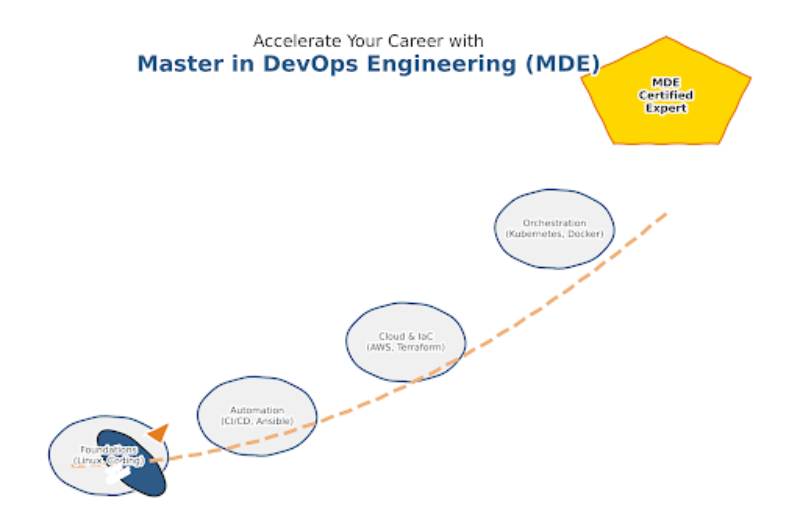
The Master in DevOps Engineering (MDE) is an advanced program that encompasses the entire lifecycle of software delivery. It is intended to transform a traditional IT professional into a high-level DevOps architect capable of designing and maintaining sophisticated automation pipelines.
Who should take this certification?
This certification is designed for software developers who wish to take control of their deployment processes. It is also highly suitable for systems administrators who are looking to transition into automation-heavy roles. Engineering managers and technical leads will find it beneficial for overseeing modern engineering teams effectively.
Skills you will gain
- Advanced Version Control: Proficiency in Git is achieved, allowing for complex branching and merging strategies.
- Continuous Integration/Deployment: The ability to build and manage CI/CD pipelines is developed.
- Infrastructure as Code (IaC): Skills in tools like Terraform and Ansible are gained to manage infrastructure through code.
- Containerization & Orchestration: Deep knowledge of Docker and Kubernetes is acquired for managing microservices.
- Cloud Strategy: Competency in managing multi-cloud environments is built.
- Site Reliability Principles: An understanding of how to maintain system uptime and performance is established.
Real-world projects you should be able to do
- Automated Pipeline Construction: A full CI/CD pipeline is built for a multi-service application, ensuring zero-touch deployment.
- Infrastructure Provisioning: Entire cloud environments are provisioned using automated scripts, reducing manual errors.
- Cluster Management: A production-grade Kubernetes cluster is deployed and managed, including scaling and self-healing.
- Monitoring Dashboards: Comprehensive monitoring and alerting systems are created to track application health in real-time.
Preparation Plan
- 7–14 Days Plan: The focus is placed on the core fundamentals. Linux command-line proficiency is refreshed, and basic networking concepts are reviewed. Git basics are mastered during this initial period.
- 30 Days Plan: Concentration is shifted toward automation tools. Configuration management and basic CI/CD pipelines are explored. Small projects are completed to reinforce the learning of tools like Jenkins or GitLab CI.
- 60 Days Plan: Advanced topics are tackled. Deep dives into Kubernetes, Terraform, and Cloud-native security are conducted. Mock exams are taken, and complex, multi-tool projects are finalized to ensure readiness for the certification.
Common mistakes to avoid
- Over-reliance on Tools: A common error is focusing solely on learning software while ignoring the underlying principles of DevOps culture.
- Lack of Hands-on Practice: Theory is important, but failing to build actual projects in a lab environment is often a reason for struggle.
- Ignoring the Basics: Attempting to learn advanced orchestration without a solid foundation in Linux and networking is avoided by successful learners.
Best next certification
- Same Track: Certified Kubernetes Security Specialist (CKS).
- Cross-Track: Site Reliability Engineering (SRE) Foundation.
- Leadership / Management: DevOps Leader (DOL) certification.
4. Choose Your Learning Path
DevOps Path
This path is chosen by those who want to be the engine of the software delivery process. It is best for individuals who enjoy building bridges between development and operations. The primary focus is on increasing the speed and quality of software releases through automation.
DevSecOps Path
This path is intended for professionals who believe that security is everyone’s responsibility. It is best for those working in sensitive industries where security must be baked into the pipeline from day one. Techniques for automated security scanning and compliance are emphasized.
Site Reliability Engineering (SRE) Path
The SRE path is pursued by those who have an interest in making systems more resilient. It is best for engineers who enjoy troubleshooting complex performance issues and ensuring that high-scale applications remain available under pressure.
AIOps / MLOps Path
This is a modern path designed for the intersection of Artificial Intelligence and Operations. It is best for engineers working with data science teams to automate the deployment and monitoring of machine learning models in production.
DataOps Path
The DataOps path is focused on the management of data pipelines. It is best for data engineers who want to apply DevOps principles—such as versioning and automated testing—to the flow of data across an organization.
FinOps Path
As cloud usage grows, the FinOps path has become essential. It is best for professionals who want to manage cloud costs effectively, ensuring that technical performance does not lead to unnecessary financial waste.
5. Role → Recommended Certifications Mapping
- DevOps Engineer: Master in DevOps Engineering (MDE).
- Site Reliability Engineer (SRE): SRE Practitioner and Advanced Monitoring.
- Platform Engineer: Kubernetes Master and Infrastructure as Code.
- Cloud Engineer: Multi-Cloud Solutions Architect and MDE.
- Security Engineer: Certified DevSecOps Professional.
- Data Engineer: DataOps Certification and Big Data Automation.
- FinOps Practitioner: Cloud Financial Management Specialist.
- Engineering Manager: DevOps Leader and Strategic IT Management.
6. Next Certifications to Take
Continuous growth is encouraged for all practitioners. The following recommendations are based on trends found within the engineering community.
- For the Same-Track Learner: A focus on Advanced Container Security is recommended to deepen existing technical skills.
- For the Cross-Track Learner: Transitioning into an SRE Foundation certification is suggested to broaden the understanding of system reliability.
- For the Leadership-focused Learner: A certification in Technical Project Management or DevOps Leadership is advised to prepare for managerial responsibilities.
7. Training & Certification Support Institutions
DevOpsSchool
A wide range of training programs is offered by this institution, focusing on practical industry needs. It is recognized for its extensive library of technical content and its community-driven learning model.
Cotocus
Professional training and consulting services are provided by Cotocus. They are known for helping organizations and individuals master niche technologies in the DevOps and Cloud space.
ScmGalaxy
This platform serves as a major hub for technical resources and tutorials. A wealth of information on version control and configuration management is hosted here for the global engineering community.
BestDevOps
Specialized training paths for career growth are offered through this portal. It is highly regarded for its structured approach to helping beginners transition into senior DevOps roles.
devsecopsschool.com
This institution is dedicated to the integration of security into the DevOps lifecycle. Deep dives into automated security tools and best practices are provided to its students.
sreschool.com
A focus on reliability and system performance is maintained by this school. It is an essential resource for those looking to master the principles of Site Reliability Engineering.
aiopsschool.com
The application of artificial intelligence to IT operations is taught here. It provides the knowledge needed to manage modern, self-healing infrastructure.
dataopsschool.com
Training is provided on how to manage data workflows with high efficiency. It is designed for engineers who want to bring DevOps rigor to the world of big data.
finopsschool.com
Financial management in the cloud is the core focus of this institution. It helps professionals understand how to balance performance requirements with budget constraints.
8. FAQs Section
General DevOps FAQs
- Is a coding background required?
A basic understanding of scripting is usually expected, as automation relies on code. - How is DevOps different from Agile?
Agile focuses on the software development process, while DevOps extends those principles to delivery and operations. - Can I learn DevOps without a degree?
Yes, industry-recognized certifications and practical experience are often valued more than traditional degrees. - How long is the MDE certification valid?
Most certifications are valid for two to three years, after which recertification is encouraged. - Is Linux knowledge mandatory?
Yes, since most servers and containers run on Linux, it is considered a fundamental skill. - What is the role of a DevOps Engineer in a team?
The role involves building tools and processes that allow developers to release code faster and more safely. - How much time is needed daily for preparation?
At least two hours of consistent study and practice is recommended. - Are remote jobs available for DevOps?
Yes, DevOps is one of the most common roles for remote work in the tech industry. - What is CI/CD?
It stands for Continuous Integration and Continuous Deployment, which are methods for automating code testing and delivery. - Is cloud knowledge necessary?
Yes, understanding platforms like AWS, Azure, or GCP is essential for modern DevOps. - What is Infrastructure as Code?
It is the practice of managing and provisioning servers through machine-readable files rather than manual configuration. - Does DevOps help in career growth?
It is considered one of the most stable and high-paying career paths in technology today.
MDE Focused FAQs
- What makes MDE different from other certifications?
The MDE is a master-level program that covers the entire lifecycle, not just a single tool. - Is there a practical exam for MDE?
Yes, hands-on labs and project work are used to assess the skills of the learner. - Can I take the exam online?
Yes, the certification process is typically managed through an online platform. - Are there any age limits for this certification?
No, it is open to any professional looking to upgrade their skills. - Is MDE suitable for fresh graduates?
While designed for working professionals, motivated graduates can succeed if they have basic coding skills. - Does the MDE cover multi-cloud strategies?
Yes, the curriculum is designed to be applicable across different cloud providers. - What kind of support is provided during the course?
Instructor-led sessions and community forums are typically available for assistance. - How is the MDE certification perceived by recruiters?
It is viewed as a mark of deep technical competence and a commitment to professional growth.
9. Testimonials
Rajesh K.
“A significant improvement in technical skills was noticed after completing the MDE program. The ability to manage complex Kubernetes clusters was gained, which had previously been a major challenge.”
Ananya R.
“The transition from a developer role to an SRE position was made possible. Clear career clarity was provided by the structured learning path of the certification.”
Vikram S.
“Real-world application was the highlight of the training. The projects provided allowed for immediate implementation of automation strategies at my current workplace.”
Sarah M.
“A boost in professional confidence was felt after receiving the MDE certification. The knowledge gained has allowed for better collaboration with the security and data teams.”
Amit P.
“The training provided a deep understanding of cloud cost management. My team was able to reduce infrastructure expenses by thirty percent using the principles learned.”
Conclusion
The journey toward becoming a Master in DevOps Engineering is considered a vital step for any modern tech professional. The MDE certification is not just a title; it represents a deep commitment to excellence in the field of automation and software delivery. Long-term career benefits are secured through the acquisition of these high-demand skills. Strategic learning and careful certification planning are encouraged for everyone who wishes to remain at the forefront of the industry.
