
Introduction
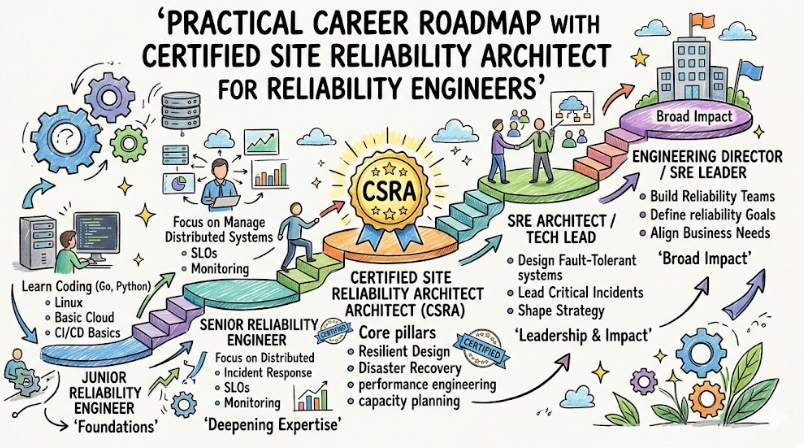
A massive leap in career growth is about to be taken! The thrill of building systems that simply do not break is being experienced by top engineers every day. In this guide, the path to joining these elite ranks is laid out with care and precision. The art of system stability is being mastered by those who are ready to step up, and a clear roadmap for this journey is provided here.
The global digital economy is being powered by applications that must remain online at all costs. Because of this, the role of a Certified Site Reliability Architect is being recognized as one of the most vital positions in the tech industry today. The excitement of keeping the world connected is felt by those who choose this path. Every challenge is seen as an opportunity for better design, and every success is celebrated as a win for the entire team.
Great systems are not built by accident; they are created through deep knowledge and strategic planning. The wisdom gained from managing complex environments is shared throughout this guide. The secrets to creating unbreakable infrastructure are being revealed for anyone who is ready to learn. A high level of energy is brought to this learning process, as the future of engineering is being shaped by those who hold the Certified Site Reliability Architect credential.
Understanding the Certified Site Reliability Architect
A Certified Site Reliability Architect is a professional who is tasked with the high-level design of systems that are built to be resilient. This role is not merely about fixing broken servers; it involves the creation of a blueprint that prevents failures from occurring in the first place. The intersection of software engineering and systems design is where this expert operates, ensuring that every piece of code and every server work in perfect harmony.
The philosophy of Site Reliability Engineering (SRE) is taken to an architectural level in this certification. Strategies for handling massive amounts of traffic are developed, and methods for automated recovery are implemented. A Certified Site Reliability Architect is expected to look at the big picture, balancing the need for speed in development with the non-negotiable requirement for system uptime.
What is Certified Site Reliability Architect?
In the current global economy, including major markets like India, digital services are expected to be available 24/7. When a banking app or an e-commerce site goes down, the impact is felt immediately in terms of lost revenue and customer trust. Therefore, the expertise of a Certified Site Reliability Architect is sought after by organizations that cannot afford even a few minutes of downtime.
Complexity is a natural byproduct of modern software growth. As more features are added, the risk of a system failure increases. The role of a reliability architect is to manage this complexity through smart design and automation. By ensuring that systems are self-healing and scalable, businesses are protected from the unpredictable nature of digital infrastructure.
Why it Matters Today?
A professional certification serves as a global benchmark for technical excellence. It is often used by employers to verify that a candidate possesses the necessary skills to manage mission-critical environments. For a professional, holding a Certified Site Reliability Architect credential is a clear indicator that a standard level of industry knowledge has been mastered.
Furthermore, the process of gaining a certification forces a deep dive into best practices that might be missed during daily work. Theoretical concepts are reinforced by practical exercises, ensuring that the architect is ready for real-world crises. In a competitive job market, these credentials provide a significant advantage, often leading to roles with greater responsibility and higher compensation.
Why Choose SRESchool ?
Quality education in the field of reliability is provided by SRESchool through a very specialized and focused curriculum. The training is not generic; it is specifically designed to address the challenges faced by modern architects. A hands-on approach is maintained throughout the program, ensuring that students do not just learn about tools, but understand the underlying principles of reliability.
The instructors at SRESchool are veterans who have managed some of the largest systems in the world. Their insights are shared with students, providing a perspective that cannot be found in textbooks. Additionally, the support system provided by the institution ensures that learners are guided through every step of their certification journey, from initial study to the final exam.
Certification Deep-Dive
What is this certification?
The Certified Site Reliability Architect is a high-tier professional credential that focuses on the structural design of reliable systems. It validates an individual’s ability to create frameworks that support continuous availability and performance at a massive scale.
Who should take this certification?
This program is designed for Senior DevOps Engineers, SREs, Cloud Architects, and Technical Leads. It is also suitable for Engineering Managers who wish to understand the technical foundations of system reliability to better lead their teams.
Certification Overview Table
| Track | Level | Who it’s for | Prerequisites | Skills Covered | Recommended Order |
| SRE | Architect | Senior Techies | SRE Foundation | System Design, SLOs | Advanced |
| DevOps | Professional | Engineers | CI/CD Basics | Pipeline Automation | Intermediate |
| DevSecOps | Specialist | Security Pros | DevOps Knowledge | Security in SRE | Specialized |
| AIOps | Expert | Data Scientists | Python/ML | AI for Reliability | Advanced |
| DataOps | Practitioner | Data Leads | Database Skills | Data Pipeline SRE | Intermediate |
| FinOps | Associate | Finance/Cloud | Cloud Pricing | Cost Reliability | Foundational |
Skills you will gain
- Complex system architectures are designed with a focus on fault tolerance and high availability.
- Error Budgets and Service Level Objectives (SLOs) are calculated and managed to balance innovation and stability.
- Advanced monitoring systems are established to provide deep visibility into application health.
- Automated incident response workflows are created to reduce the time spent on manual fixes.
- Post-mortem analyses are conducted to identify the root causes of failures and prevent their recurrence.
- Chaos engineering principles are applied to proactively test the resilience of the infrastructure.
- Large-scale migrations to cloud-native environments are planned and executed with minimal disruption.
- Performance tuning is carried out on distributed systems to ensure consistent user experiences.
Real-world projects you should be able to do after this certification
- A global load-balancing strategy is implemented across multiple data centers to handle regional outages.
- A self-healing infrastructure is built that automatically replaces unhealthy containers or virtual machines.
- A centralized logging and alerting system is deployed to track millions of events in real time.
- A complete CI/CD pipeline is designed with integrated reliability tests and automated rollbacks.
- A disaster recovery plan is created and tested for a complex microservices-based application.
- A cost-optimization project is led to reduce cloud spending without impacting system performance.
Preparation plan
7–14 days plan
- The core concepts of SRE and the role of an architect are studied for several hours daily.
- Official documentation and exam blueprints are reviewed to understand the scope of the test.
- Basic networking and cloud storage concepts are refreshed to ensure a solid foundation.
30 days plan
- Hands-on laboratory environments are used to practice setting up monitoring and alerting tools.
- Case studies of major internet outages are analyzed to learn from historical mistakes.
- Weekly practice exams are taken to monitor progress and identify areas that require more focus.
60 days plan
- Advanced topics such as distributed consensus and database reliability are explored in detail.
- A comprehensive personal project is completed, simulating a full system architectural design.
- Group discussions and mentorship sessions are attended to gain insights from other professionals.
Common mistakes to avoid
- Too much focus is placed on learning specific tools while ignoring the underlying architectural principles.
- The cultural aspect of SRE, such as blamelessness and collaboration, is often overlooked.
- Monitoring is implemented without a clear strategy, leading to “alert fatigue” for the engineering team.
- Systems are over-engineered with unnecessary components, which actually increases the risk of failure.
Best next certification after this
- Same track: Advanced SRE Leadership and Management.
- Cross-track: Certified DevSecOps Professional for integrated security.
- Leadership / management: Technical Program Management for Engineering Leads.
Choose Your Learning Path
DevOps Path
The automation of the software delivery process is the focus of this path. It is best for those who want to ensure that code is moved from development to production as quickly and safely as possible. Tools for continuous integration and delivery are the main subjects of study here.
DevSecOps Path
Security is made a core part of the reliability lifecycle in this path. It is ideal for professionals who believe that a system cannot be truly reliable if it is not secure. The automation of security checks within the SRE framework is prioritized.
Site Reliability Engineering (SRE) Path
The application of software engineering practices to operations is the core of this path. It is designed for engineers who want to build and manage large-scale systems through code and automation. Reliability is treated as the most important feature of the software.
AIOps / MLOps Path
Artificial intelligence is used to enhance the reliability of IT operations in this path. It is suited for data-driven professionals who want to use machine learning models to predict and prevent system failures before they occur.
DataOps Path
The reliability of data pipelines is the main concern here. This path is perfect for data engineers who are responsible for ensuring that large volumes of data are processed and delivered accurately and on time.
FinOps Path
The financial management of cloud resources is integrated into the engineering process in this path. It is best for those who need to balance high performance with cost-efficiency in a cloud-based environment.
Role → Recommended Certifications Mapping
| Role | Primary Certification | Secondary Certification |
| DevOps Engineer | Certified DevOps Professional | Certified SRE Architect |
| Site Reliability Engineer | Certified Site Reliability Architect | AIOps Specialist |
| Platform Engineer | Certified SRE Architect | Cloud Platform Expert |
| Cloud Engineer | Cloud Architect | FinOps Associate |
| Security Engineer | Certified DevSecOps Professional | SRE Architect |
| Data Engineer | DataOps Practitioner | SRE Foundation |
| FinOps Practitioner | FinOps Associate | Cloud Cost Management |
| Engineering Manager | Engineering Leadership | Certified SRE Architect |
Next Certifications to Take
One same-track certification
The SRE Masterclass for Leadership is an excellent next step. It focuses on the human and organizational aspects of running a reliability team at scale.
One cross-track certification
The Certified DevSecOps Professional certification is recommended. It allows an architect to add a layer of automated security to their reliability designs.
One leadership-focused certification
The Engineering Management Professional credential is suggested. This helps a technical architect transition into a role where they manage both people and systems.
Training & Certification Support Institutions
DevOpsSchool
A wide variety of technical training programs is provided by DevOpsSchool. The focus is on helping professionals gain practical skills that can be applied in the workplace immediately. A global community of learners is supported through their extensive library of resources and expert-led sessions.
Cotocus
Specialized consulting and training in modern engineering practices are offered by Cotocus. Their programs are designed to meet the needs of both individual learners and large organizations. High-quality instruction and a commitment to student success are the hallmarks of their service.
ScmGalaxy
A comprehensive platform for learning about software configuration and operations is managed by ScmGalaxy. Numerous tutorials, articles, and training programs are available to help engineers stay ahead of the curve. It serves as a valuable knowledge hub for the tech community.
BestDevOps
The core principles of DevOps and SRE are taught through simple and effective methods at BestDevOps. Their curriculum is structured to be accessible to beginners while still providing depth for experienced professionals. Professional growth is encouraged through their well-organized courses.
devsecopsschool.com
Training that focuses on the intersection of security and operations is provided by this institution. Professionals are taught how to integrate security measures into the heart of their SRE practices. A secure-by-design approach is advocated in all their programs.
sreschool.com
A dedicated environment for mastering Site Reliability Engineering is provided at sreschool.com. This institution specializes in certifications like the Site Reliability Architect, ensuring a deep and focused learning experience. Technical mastery is the primary goal of their curriculum.
aiopsschool.com
The use of artificial intelligence in IT operations is the main subject at this school. Students are taught how to build intelligent systems that can monitor themselves and react to issues automatically. It is a leading source for cutting-edge AIOps training.
dataopsschool.com
Programs focused on the reliability and efficiency of data operations are offered here. Data engineers are trained to manage complex data flows with the same rigor that SREs apply to software. Accuracy and speed in data delivery are emphasized.
finopsschool.com
The principles of financial accountability in the cloud are taught at this institution. Engineers are shown how to optimize their infrastructure for cost without losing performance. It is an essential resource for modern cloud financial management.
FAQs Section
1. What is the primary goal of the Certified Site Reliability Architect program?
The primary goal is to train professionals in the design and management of highly stable and scalable digital systems through architectural excellence.
2. How long does it take to get certified?
Most candidates spend between one and two months preparing for the exam, depending on their prior experience and the time dedicated to study.
3. Are there hands-on labs included in the training?
Yes, practical laboratory exercises are a major part of the curriculum to ensure that the concepts are understood and can be applied.
4. Is this certification useful for software developers?
Absolutely, developers gain a better understanding of how their code affects the overall reliability of the system and how to write more resilient software.
5. What are the prerequisites for the architect level?
A foundational knowledge of SRE principles and experience with cloud platforms or server management are highly recommended.
6. Can the exam be taken from home?
Yes, the examination is conducted through an online platform, allowing for flexibility in scheduling and location.
7. How does this certification impact salary?
Certified professionals often see a significant increase in their earning potential due to the specialized nature of the SRE Architect role.
8.Is there a community for certified professionals?
Yes, a global network of SREs and architects is available for knowledge sharing and career support.
9.What kind of companies hire Certified Site Reliability Architects?
Major tech firms, financial institutions, and any company with a large digital presence actively seek out these professionals.
10.Is the curriculum updated frequently?
The course materials are regularly reviewed to ensure they include the latest industry trends and tool updates.
11. Are there group discounts for corporate training?
Yes, many institutions like SRESchool offer specialized training packages for engineering teams.
12. What is the pass rate for the exam?
The pass rate is high for those who complete the recommended training and hands-on labs thoroughly.
Certified Site Reliability Architect Specific FAQs
1. Is the role of an architect different from a lead engineer?
Yes, an architect focuses more on the high-level structural design and long-term strategy, while a lead engineer handles daily technical execution.
2. How are SLOs used by a Site Reliability Architect?
SLOs are used to define the acceptable level of reliability for a service, which then guides all architectural decisions.
3. What role does automation play in this certification?
Automation is central to the program, as it is the primary tool used by architects to ensure reliability at scale.
4. Are specific cloud providers like AWS or Google Cloud required?
While the principles are universal, the training often uses these platforms to demonstrate practical applications.
5. How is chaos engineering integrated into the architect’s role?
Architects design systems that can survive intentional failures, which are introduced through chaos engineering to verify resilience.
6. Does the certification cover cost management?
Yes, building a reliable system also involves doing so in a way that is financially sustainable for the organization.
7. What is the importance of a blameless culture in SRE architecture?
A blameless culture ensures that system failures are treated as learning opportunities, which is essential for improving the architecture over time.
8. Can this certification help in becoming a CTO or Head of Engineering?
Yes, the strategic view of technology and reliability provided by this program is excellent preparation for senior leadership roles.
Testimonials
Vikram
A very deep understanding of system stability was gained through this program. The ability to design for failure has changed the way projects are approached at my company.
Sana
The hands-on labs were the highlight of the training. Real-world scenarios were simulated, which provided the confidence needed to manage a large-scale production environment.
Rohan
Career growth was immediate after obtaining the certification. The knowledge shared by the veteran instructors was invaluable and cannot be found elsewhere.
Priya
A clear path for career advancement was provided. The focus on both technical skills and architectural strategy was exactly what was needed for a senior role.
Ishaan
The curriculum was very well-structured and easy to follow. My skills in automation and monitoring were greatly enhanced, leading to much better system performance.
Conclusion
The importance of the Certified Site Reliability Architect certification is evident in the growing complexity of the digital world. By focusing on high-level design and reliability, professionals are able to build systems that stand the test of time. The long-term career benefits are substantial, offering a path to senior leadership and the opportunity to work on cutting-edge technology.
Strategic learning is encouraged for anyone who wants to remain relevant in the field of software engineering and operations. By planning a clear certification path and gaining specialized knowledge, a bright and stable future is secured. The investment made in professional development today will yield significant rewards throughout a career.
