
Introduction
The silence of a perfectly running system is often the greatest achievement of an engineering team. It is understood that when everything works correctly, the hard work behind the scenes remains invisible. However, this stability is not achieved by chance; it is the result of rigorous discipline and specialized knowledge. A shift from traditional firefighting to proactive engineering is required to maintain this level of calm in complex digital environments.
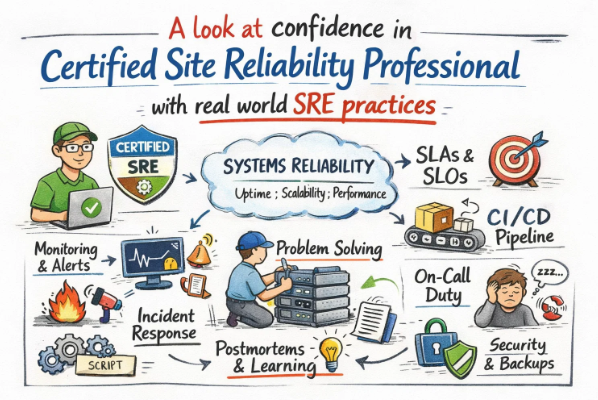
The Certified Site Reliability Professional program has been developed to provide this exact expertise. Within this curriculum, the principles of system health and automated recovery are explored deeply. It is recognized that a structured approach is needed to balance the speed of development with the requirement for uptime.
What is certified site reliability professional
The Certified Site Reliability Professional is a high-level credential that focuses on the intersection of software engineering and systems operation. It is designed to transform how infrastructure is managed by treating operations as a software problem. Within this program, the core pillars of uptime, scalability, and efficiency are explored in great detail.
A deep understanding of how to balance the need for new features with the requirement for system stability is provided. By completing this certification, a professional is validated as someone who can design systems that are inherently resilient. It is not merely about fixing errors but about building environments where errors are minimized through intelligent automation.
Why it matters today?
Digital platforms are now the backbone of the global economy, and any interruption is seen as a major failure. As companies move toward complex cloud-native architectures, the old methods of manual intervention are no longer sufficient. A proactive approach to reliability is demanded by the modern market to ensure customer trust is maintained.
The complexity of modern applications requires a specialized role that can navigate between development and operations. Without the principles of reliability engineering, teams often face burnout and frequent outages. Therefore, the implementation of these practices is seen as a strategic advantage for any organization aiming for global scale and high performance.
Why certified site reliability professional certifications are important
A standard of excellence is established when a professional becomes certified. In a crowded job market, a clear distinction is made between those who have general knowledge and those who have mastered a specific discipline. The certification serves as a testament to an individual’s dedication to the craft of system stability.
Consistency across teams is also ensured through formal certification. When every engineer follows the same reliability framework, incident response becomes faster and more effective. Furthermore, the risk of architectural flaws is reduced when systems are managed by certified experts who understand the long-term impact of every technical decision.
Why choose SRESchool?
SRESchool is preferred because of its singular focus on the discipline of reliability. While other institutions offer broad technology courses, the curriculum here is narrowed down to the most critical aspects of system uptime. The training is conducted by industry veterans who have managed massive distributed systems.
A hands-on approach is prioritized, ensuring that theoretical concepts are backed by practical lab exercises. Students are given access to simulated environments where real-world failures can be analyzed and resolved. This deep level of engagement ensures that the skills learned are ready for immediate deployment in high-pressure production environments.
Certification deep-dive
What is this certification?
This is a technical credential that confirms a professional’s ability to apply SRE principles to real-world IT challenges. It centers on the use of automation to improve system health and reduce manual workloads.
Who should take this certification?
Software developers who want to understand infrastructure, and operations engineers who wish to move into automation, are the ideal candidates. It is also beneficial for leads who manage large-scale digital platforms.
Certification overview table
| Track | Level | Who it’s for | Prerequisites | Skills Covered | Recommended Order |
| DevOps | Associate | Junior Engineers | Scripting Basics | CI/CD Pipelines | 1 |
| DevSecOps | Specialist | Security Analysts | DevOps Knowledge | Security Automation | 2 |
| SRE | Professional | Senior Engineers | System Architecture | Reliability Metrics | 3 |
| AIOps/MLOps | Expert | Data Scientists | Python & Math | Model Observability | 4 |
| DataOps | Specialist | Database Leads | Data Engineering | Pipeline Resilience | 5 |
| FinOps | Practitioner | Finance/Tech Leads | Cloud Costing | Budget Optimization | 6 |
Skills you will gain
- Service Level Indicators (SLIs) are accurately defined to measure user experience.
- Error Budgets are managed to allow for safe innovation and rapid deployments.
- Toil is identified and eliminated through the creation of clever automation scripts.
- Blameless culture is fostered through the effective use of post-mortem reports.
- Resilience is tested using controlled chaos engineering experiments.
- Full-stack observability is implemented to gain deep insights into system behavior.
Real-world projects you should be able to do after this certification
- A self-healing infrastructure can be built that automatically recovers from server failures.
- A global monitoring system can be designed to track latency across different continents.
- An automated deployment gate can be created that stops code if the error budget is exceeded.
- A disaster recovery plan for a multi-cloud environment can be simulated and executed.
- A centralized logging and tracing system can be deployed for microservices architectures.
Preparation plan
7–14 days plan
The fundamental principles of the reliability framework are reviewed. A focus is placed on learning the vocabulary and the basic metrics used to measure system health.
30 days plan
Intermediate concepts like error budget management and incident response cycles are studied. Hands-on practice with monitoring tools and automation scripts is conducted during this period.
60 days plan
Advanced topics including chaos engineering and distributed tracing are mastered. Mock exams are used to ensure that the candidate is ready for the final assessment.
Common mistakes to avoid
- Technical tools are often prioritized over the necessary cultural shifts in a team.
- Simple metrics are ignored in favor of overly complex monitoring dashboards.
- The importance of manual “toil” reduction is frequently underestimated by beginners.
- Learning is often rushed without spending enough time on practical lab exercises.
Best next certification after this
- Same track: Advanced Site Reliability Manager for those aiming for senior leadership.
- Cross-track: MLOps Professional to apply reliability to artificial intelligence.
- Leadership / management: Global Technology Director certification for career advancement.
Choose your learning path
DevOps path
This path is intended for those who wish to master the flow of software from code to production. It is focused on speed, collaboration, and the removal of silos within an organization.
DevSecOps path
Safety and security are the core of this path. It is chosen by professionals who believe that security should be integrated into the development process from the very first day.
Site reliability engineering (SRE) path
This is the ultimate path for engineers who are passionate about stability. It is designed for those who want to build systems that can withstand any amount of traffic or technical failure.
AIOps / MLOps path
The future of operations is explored here. This path is suitable for those who want to use machine learning to predict system issues before they even occur.
DataOps path
The reliability of data flows is the focus of this path. It is ideal for engineers who manage large datasets and want to ensure that data delivery is never interrupted.
FinOps path
The financial health of a cloud environment is managed through this path. It is perfect for professionals who want to ensure that technical performance is balanced with cost-efficiency.
Role → recommended certifications mapping
| Role | Primary Certification | Secondary Certification | Leadership Path |
| DevOps Engineer | DevOps Professional | SRE Foundation | Engineering Manager |
| SRE | SRE Professional | Cloud Security | VP of Infrastructure |
| Platform Engineer | Platform Engineering | FinOps Practitioner | CTO |
| Cloud Engineer | Cloud Architect | SRE Professional | Cloud Director |
| Security Engineer | DevSecOps Lead | SRE Professional | CISO |
| Data Engineer | DataOps Master | MLOps Specialist | Chief Data Officer |
| FinOps Practitioner | FinOps Expert | SRE Professional | Financial Director |
| Engineering Manager | SRE for Leaders | Tech Leadership | Director of Ops |
Next certifications to take
One same-track certification
The Certified Reliability Architect program is the logical next step. It provides the advanced knowledge needed to design global infrastructures that can handle millions of simultaneous users.
One cross-track certification
The AIOps Professional certification is suggested for those looking to diversify. By adding artificial intelligence to reliability practices, a smarter and more autonomous system can be built.
One leadership-focused certification
The Engineering Executive program is designed for the transition into high-level management. It focuses on the strategic skills required to lead large departments and manage multi-million dollar budgets.
Training & certification support institutions
DevOpsSchool
A wide variety of professional training programs is offered by this institution. It is highly regarded for its practical approach to teaching modern engineering practices and automation tools.
Cotocus
Specialized training and consulting for corporate teams are provided here. A strong emphasis is placed on helping organizations adopt cloud-native technologies and streamlined workflows.
ScmGalaxy
Valuable resources and community-driven knowledge are shared through this platform. It serves as a great hub for learning about source code management and continuous integration best practices.
BestDevOps
Quality education and career coaching are the focus of this organization. It is known for its ability to help engineers upgrade their skills and transition into high-paying DevOps roles.
DevSecOpsSchool.com
The integration of security into the modern delivery pipeline is taught here. It provides the expertise needed to ensure that software is both fast to deliver and safe to use.
SRESchool.com
This is the premier institution for dedicated Site Reliability Engineering education. Master-level certifications and deep technical insights are provided to a global community of engineers.
AIOpsSchool.com
The application of artificial intelligence to IT operations is the core curriculum here. It prepares professionals for the future of automated and predictive system management.
DataOpsSchool.com
The agility and reliability of data lifecycles are the main topics of study. It is an essential resource for those who manage complex data pipelines and big data environments.
FinOpsSchool.com
Expertise in managing and optimizing cloud costs is provided by this school. It teaches the balance between technical requirements and financial responsibility in the cloud.
FAQs section
1. Is this certification considered difficult?
The exam is designed to be challenging but fair. A solid understanding of both software engineering and operations is required to pass the assessment successfully.
2. What is the estimated time for completion?
Most professionals complete the preparation and the exam within a period of two to three months, depending on their existing technical background.
3. Are there any mandatory prerequisites?
While no strict certificates are required first, a basic knowledge of Linux and some experience with cloud environments is strongly recommended for all candidates.
4. What is the best order to take these certifications?
A foundation in DevOps is usually recommended before moving into the specialized SRE track. This ensures that the basic principles of automation are already understood.
5. How does this certification improve career growth?
Certified professionals are often viewed as experts in their field. This leads to better job opportunities, higher salaries, and the ability to work on more complex projects.
6. What specific job roles can be applied for?
Positions such as Site Reliability Engineer, Cloud Infrastructure Lead, and Platform Architect are commonly filled by those who hold this certification.
7. Is the certification recognized in international markets?
Yes, the curriculum is designed to meet global industry standards. It is recognized by major technology companies across the world, including those in India.
8. Is hands-on training included in the program?
Practical labs are a major component of the learning experience. Real-world scenarios are simulated to ensure that students can apply their knowledge immediately.
9. How long does the certification stay valid?
The credential is valid for a period of two years. After this, a renewal process or a higher-level certification is suggested to keep the skills current.
10. Can a non-coder become a certified SRE?
While deep coding is not always required, a basic understanding of scripting is essential. SRE is based on the idea of using code to manage systems.
11. What tools will be learned during the course?
A variety of monitoring, logging, and automation tools are introduced. However, the focus is always on the underlying principles rather than just the software.
12. How is this different from a DevOps certification?
DevOps is focused on the delivery of software, while this certification is focused on the long-term health and stability of that software in a live environment.
Additional FAQs for certified site reliability professional
- What is the core philosophy taught in this certification?
The core philosophy is that operations should be treated as a software problem. This means using engineering principles to solve operational challenges and improve reliability.
- How are Service Level Objectives (SLOs) used in the exam?
SLOs are used as a key metric to determine if a system is meeting its goals. The exam tests the ability to set and monitor these objectives effectively.
- Does this certification cover cloud-specific technologies?
The principles taught are applicable to any cloud provider, whether it is AWS, Azure, or Google Cloud. The focus is on the architecture rather than a specific vendor.
- How does the program address incident response?
A structured approach to managing outages is taught. This includes communication strategies, technical troubleshooting, and the creation of blameless post-mortem reports.
- Is there a community for certified professionals?
Yes, a global network of experts is accessible to those who complete the program. This allows for continuous learning and professional networking after the exam.
- What is the format of the certification exam?
The exam is conducted online and consists of both multiple-choice questions and practical scenarios that test real-world problem-solving abilities.
- How does this certification help with team management?
Managers learn how to use data-driven metrics to make decisions about feature releases and system maintenance, reducing conflict between teams.
- Is help provided for exam preparation?
Comprehensive study guides, mock tests, and instructor-led sessions are all provided to ensure that every candidate has the best chance of success.
Testimonials
Arjun
The transition from a traditional sysadmin to an SRE was made possible by this program. The concepts of error budgets have completely changed how I work.
Meera
A much deeper understanding of system stability was gained through the labs. I am now able to automate tasks that used to take my team hours of manual work.
Karan
The career clarity provided by SRESchool was exactly what I needed. I am now more confident in my ability to manage complex cloud architectures.
Priya
Skill improvement was immediate after the training. The focus on blameless culture has helped our team resolve incidents much faster than before.
Rahul
Real-world application is the strongest part of this certification. The scenarios we practiced in the lab were almost identical to the challenges I face at work.
Conclusion
The journey toward becoming a Certified Site Reliability Professional is seen as a strategic move for any serious engineer. It is through this mastery that long-term career security is achieved in an ever-changing technical market. The ability to manage large-scale systems with confidence is a skill that is highly valued by global organizations. By prioritizing reliability as a core feature, a professional is transformed into a vital architect of digital success. Continuous growth and the planning of future certifications are encouraged to maintain this level of expertise. Ultimately, the transition from a traditional role to a reliability-focused one is recognized as the path to leadership and sustained professional excellence.
