
Introduction
In modern enterprise ecosystems, public cloud deployments are widely adopted to achieve rapid software delivery and global scalability. However, cloud infrastructure expenditures are frequently observed to escalate unpredictably when effective financial management frameworks are omitted. To address these structural financial challenges, a strategic methodology known as financial operations is utilized. For organizations seeking to establish rigorous fiscal discipline across engineering teams, advanced educational validation becomes necessary.
Defining the Core of the Certified FinOps Architect
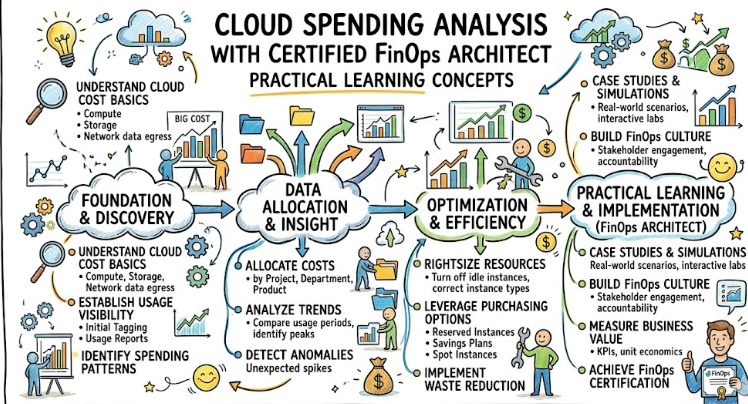
The Certified FinOps Architect designation is recognized as a master-level professional credential designed to validate advanced expertise in cloud financial management, workload optimization, and corporate governance. Cloud systems are analyzed from both technical and financial dimensions through this programmatic framework. Infrastructure design patterns are aligned with corporate budgetary constraints so that maximum business value is derived from every cloud resource unit.
Why it matters today’s ?
In the current landscape of multi-cloud architectures, substantial portions of IT budgets are allocated to raw cloud compute, storage, and networking services. Without unified structural oversight, architectural waste is inadvertently generated by distributed product engineering groups. A centralized blueprint is provided by a certified professional to bridge the historical communication gap between finance departments and technology implementation units. Operational inefficiencies are successfully minimized when strategic financial policies are integrated directly into early architectural phases.
Why Certified FinOps Architect certifications are important
Corporate reliance on multi-cloud environments is accelerated daily, which necessitates formal authorization for cloud optimization initiatives. When architectural teams are led by an accredited cloud financial architect, corporate spending anomalies are mitigated before deployment cycles are finalized. Industry trust is established when engineering leaders hold validated credentials, ensuring that complex cloud topologies are governed with financial precision and architectural stability.
why choose Finopsschool ?
Global education standards are maintained at the highest tier by this training provider. Finopsschool are regularly updated by domain specialists so that contemporary real-world challenges are accurately reflected. Practical laboratory exercises are combined with executive strategy modules, ensuring that both technical implementation details and corporate reporting structures are comprehensively addressed. Professional support networks and comprehensive peer-to-peer discussions are facilitated, positioning this institution as the premier selection for global engineering groups.
Certification Deep-Dive
What is this certification?
The Certified FinOps Architect program is structured as an advanced pedagogical framework through which high-level cloud architecture strategies and complex unit economics are mastered. Corporate financial governance and automated cost-remediation systems are thoroughly evaluated under this master-level curriculum.
Who should take this certification?
This certification is designed for senior technology practitioners, including enterprise cloud architects, principal platform engineers, infrastructure managers, site reliability directors, and engineering executives who are tasked with fiscal accountability across large-scale cloud operations.
Certification Overview Table
| Track | Level | Who it’s for | Prerequisites | Skills Covered | Recommended Order |
| Cloud Financial Analytics | Associate | Data Analysts & Engineers | Basic Cloud Literacy | Cost Allocation, Tagging Strategies, Dashboarding | First |
| Cloud Cost Optimization | Specialist | DevOps & SRE Teams | Analytics Track Core | Lifecycle Policies, Rightsizing, Waste Detection | Second |
| Enterprise Governance | Professional | Compliance & Security Officers | Optimization Core | Policy Automation, Guardrails, Risk Auditing | Third |
| Shared Cost Architecture | Expert | Lead Platform Architects | Governance Core | Amortization Models, Container Unit Economics | Fourth |
| Strategic Leadership | Architect | Engineering Managers & Directors | Complete Technical Core | Business Value Mapping, KPI Design, Culture Shift | Fifth |
Skills you will gain
- Advanced multi-cloud cost allocation methodologies are acquired.
- Complex key performance indicators (KPIs) are formulated for executive reporting.
- Automated governance guardrails are designed and deployed across infrastructure pipelines.
- Cloud unit economics models are developed to measure true product profitability.
- Strategic vendor negotiation strategies for reserved capacities are mastered.
- Containerized workload cost-attribution matrices are established within Kubernetes environments.
Real-world projects you should be able to do after this certification
- A multi-region, multi-cloud automated tagging and resource-compliance engine is constructed.
- An enterprise-wide shared cost allocation model for Kubernetes clusters is implemented.
- A live cloud financial anomaly detection and automated alerting system is configured.
- A comprehensive migration roadmap mapping legacy infrastructure to variable cost frameworks is formulated.
Preparation plan
7–14 Days Plan
- The official domain documentation and core architectural modules are reviewed thoroughly.
- High-level financial management concepts and fundamental cloud pricing matrices are studied daily.
- Initial diagnostic practice evaluations are completed to identify primary knowledge deficiencies.
30 Days Plan
- Weekly laboratory simulations focusing on cost attribution and policy creation are executed.
- Real-world corporate case studies detailing successful infrastructure optimization are analyzed.
- Peer-to-peer study sessions are attended to dissect complex multi-tenant billing models.
60 Days Plan
- Advanced programmatic governance scripts and automated remediation workflows are drafted and tested.
- Full-length comprehensive mock examinations are completed under strict testing limitations.
- Strategic reporting frameworks are presented to mock executive panels for advanced validation.
Common mistakes to avoid
- Technical optimization is overemphasized while corporate cultural alignment is neglected.
- Variable operational billing cycles are evaluated using rigid legacy capital expenditure models.
- Automated remediation policies are deployed across production systems without prior staging validation.
- Long-term capacity planning forecasts are formulated without consulting product development roadmaps.
Best next certification after this
- Same-track: Advanced Cloud Financial Engineering Masterclass.
- Cross-track: Enterprise Cloud Security and Compliance Architect.
- Leadership / management: Global Technology Executive Management Certification.
Specialized Framework Progression Pathways
DevOps Pathway
Infrastructure automation frameworks are aligned with cloud cost visibility objectives in this pathway. Continuous integration and continuous deployment pipelines are configured so that financial guardrails are evaluated during the build phase. Continuous deployment architecture is optimized to prevent runaway resource allocation.
DevSecOps Pathway
Regulatory compliance mandates and financial waste mitigation strategies are fused under this learning trajectory. Automated security scanning tools are synchronized with budget tracking mechanisms so that orphaned or insecure test resources are terminated automatically.
Site Reliability Engineering (SRE) Pathway
System availability metrics are directly correlated with financial efficiency targets in this blueprint. Infrastructure resilience patterns are architected with cost-effective redundancy models, ensuring that high availability objectives do not cause excessive financial overhead.
AIOps / MLOps Pathway
Large-scale artificial intelligence compute workloads and machine learning model training cycles are governed efficiently through this specialty track. High-performance GPU instances are monitored continuously, and dynamic resource scheduling models are applied to minimize inactive idle times.
DataOps Pathway
Large-scale data pipelines, warehouse systems, and analytics storage clusters are managed from a strict fiscal perspective. Data tiering policies and multi-temperature storage strategies are systematically implemented to ensure analytical efficiency is maintained at minimal cost.
FinOps Pathway
The core operational principles of collaboration, accountability, and optimization are embedded across organizational structures. Cross-functional communication channels between corporate finance and core platform engineering teams are established and refined over this period.
Matrix: Professional Positions and Suggested Educational Trajectories
| Current Professional Role | Primary Suggested Program | Secondary Acceleration Program | Core Strategic Focus |
| DevOps Engineer | Cost Optimization Specialist | Shared Cost Architecture | Pipeline Budget Guardrails |
| Site Reliability Engineer (SRE) | Architecture Resilience Master | Cloud Financial Analytics | Performance-Cost Co-optimization |
| Platform Engineer | Internal Developer Portal Governance | Enterprise Governance | Centralized Resource Control |
| Cloud Engineer | Multi-Cloud Architecture Specialist | Cost Optimization Specialist | Workload Placement Strategy |
| Security Engineer | Secure Governance Professional | Risk Auditing Master | Compliance Cost Elimination |
| Data Engineer | Data Lifecycle Optimizer | Analytical Storage Specialist | Data Warehouse Unit Economics |
| FinOps Practitioner | Certified FinOps Architect | Strategic Leadership Track | Enterprise Culture Transformation |
| Engineering Manager | Strategic Leadership Track | Business Value Mapping | KPI Alignment and Budgetary Success |
Next Certifications to Take
Same-Track Progression
Advanced mastery within the financial domain is achieved when deep specialization programs are pursued. Complex organizational financial structures are tackled, and proprietary enterprise cost monitoring systems are designed from the ground up.
Cross-Track Progression
Multi-disciplinary excellence is secured when advanced security or automation curriculums are integrated into the financial portfolio. Holistic architectural frameworks are built, ensuring that system vulnerabilities and financial inefficiencies are addressed simultaneously.
Leadership-Focused Progression
Executive command is solidified when corporate strategy and organizational behavior programs are mastered. High-level corporate budgeting decisions are influenced, and cross-departmental financial literacy initiatives are successfully directed.
Profile Analysis of Educational and Enablement Organizations
DevOpsSchool
Comprehensive training methodologies are delivered by this global educational body to bridge technology and operational requirements. Deep industry alignment is prioritized across all technical certification preparation courses.
Cotocus
Tailored corporate training programs and specialized container infrastructure learning modules are consistently provided by this institution. Advanced architectural concepts are broken down into practical enterprise skills.
ScmGalaxy
A robust knowledge ecosystem centered around configuration management, continuous integration, and infrastructure automation is maintained here. Valuable technical resources and study guides are regularly distributed to global communities.
BestDevOps
Immersive technical bootcamps and hands-on laboratory environments are specialized in by this educational platform. Technical competency is quickly elevated through practical, real-world case simulations.
devsecopsschool.com
Advanced educational programs focusing exclusively on the integration of automated security protocols within modern deployment pipelines are provided by this site.
sreschool.com
Pedagogical frameworks centered entirely on platform reliability, system performance metrics, and cost-effective disaster recovery architectures are delivered through this portal.
aiopsschool.com
Cutting-edge courses detailing the application of machine learning algorithms and artificial intelligence systems to corporate infrastructure monitoring are hosted on this platform.
dataopsschool.com
Educational paths designed to streamline data delivery pipelines, optimize big data storage layers, and enhance data warehouse financial efficiency are provided here.
finopsschool.com
The principal authoritative academy dedicated to cloud financial operations education, where advanced structural frameworks like the Certified FinOps Architect are managed and administered globally.
Comprehensive Frequently Asked Questions
FAQ 1: What is the perceived difficulty level of advanced cloud financial architecture programs?
The curriculum is considered highly rigorous, as deep understanding of both cloud infrastructure engineering and corporate finance methodologies is demanded.
FAQ 2: What total time commitment is required to successfully clear the examination?
A structured preparation timeline spanning forty-five to sixty days is typically required by mid-career professionals to comfortably master the material.
FAQ 3: Are specific technical prerequisites mandated before enrollment can be finalized?
Prior foundational knowledge of public cloud environments and basic corporate budgetary structures is highly recommended for all candidates.
FAQ 4: What is the recommended certification sequence for an absolute beginner in this domain?
The foundational analytics track is completed first, followed sequentially by the cost optimization specialist and the master architect programs.
FAQ 5: What long-term career value is unlocked after authorization is secured?
Substantial corporate leverage is obtained, which frequently leads to senior advisory positions and enterprise infrastructure leadership appointments.
FAQ 6: Which job roles are most frequently granted to accredited professionals?
Positions such as Principal Cloud Architect, Director of Infrastructure Finance, and Global FinOps Lead are successfully secured.
FAQ 7: How is corporate growth impacted when this financial framework is implemented?
Unpredictable cloud waste is systematically removed, allowing corporate capital to be redirected toward core product innovation initiatives.
FAQ 8: Is deep programming capability required to pass the technical evaluations?
Advanced software engineering skills are not mandatory, but capability in reading automation scripts and infrastructure-as-code files is highly beneficial.
FAQ 9: How frequently are the examination patterns and core questions updated?
The evaluation material is revised regularly by industry boards to incorporate newly introduced multi-cloud pricing models and service updates.
FAQ 10: Can global enterprise teams coordinate centralized group training sessions?
Customized group enablement plans are regularly facilitated by accredited training providers to support corporate transformation goals.
FAQ 11: Is re-validation required after a specific duration has passed?
Professional credentials must be maintained periodically through continuous educational activities or updated programmatic evaluations to ensure industry relevance.
FAQ 12: How are modern container architectures handled within the testing matrix?
Advanced modules focusing on Kubernetes microservices and shared cluster cost-allocation mechanisms are comprehensively evaluated during the testing process.
Certified FinOps Architect Focused FAQs
1. What core architectural focus is maintained within the Certified FinOps Architect curriculum?
A holistic view of cloud financial systems is developed, wherein technical decisions are directly balanced with corporate fiscal targets.
2. How are multi-cloud billing complexities addressed by an accredited architect?
Unified governance frameworks are structured so that disparate billing formats from multiple vendors are translated into single consolidated executive dashboards.
3. What strategy is used to drive accountability across autonomous engineering squads?
Granular unit economics metrics are established, whereby individual product teams are enabled to view the direct financial impact of their infrastructure footprints.
4. How are cloud spending anomalies managed under this master framework?
Automated programmatic tracking systems are designed to identify sudden cost spikes and trigger instant isolation workflows before budgets are breached.
5. What role does automation play in the day-to-day operations of a certified professional?
Manual review cycles are completely substituted with infrastructure-as-code policies and programmatic tagging guardrails to ensure continuous compliance.
6. How are long-term capacity reservations evaluated by the architectural leader?
Historical consumption profiles are analyzed using predictive statistical models so that commitment-based discounts are optimized without creating over-provisioning risks.
7. Why is cultural transformation considered a major pillar of this programmatic study?
The siloed operational patterns of engineering and finance units are broken down, and a shared responsibility model for corporate cloud spend is successfully fostered.
8. How is business value quantified after this credential framework is adopted?
Success is measured not merely by total cost reduction, but by the maximization of revenue generated per unit of cloud resource utilized.
Professional Feedback
Cloud infrastructure clarity was completely established within our delivery pipelines. Financial anomalies are now identified before production deployment cycles are reached.
— Rohan
Strategic career transformation was realized immediately. The gap between complex infrastructure engineering and executive financial reporting has been successfully closed.
— Sophia
Organizational confidence was significantly boosted across our entire platform division. Unit economics models are now used to guide every major architecture discussion.
— Aarav
System waste was reduced by half within the first quarter of application. Automated policy guardrails are now used to govern all multi-cloud environments seamlessly.
— Liam
Complete visibility into shared container infrastructure cost metrics was achieved. Leadership reporting has been transformed from reactive firefighting into predictive strategy.
— Priya
Conclusion
In summary, advanced mastery of cloud financial systems is achieved when professional accreditation is systematically pursued. Corporate reliance on scalable cloud platforms remains absolute, which guarantees long-term market demand for skilled orchestration professionals. Career trajectories are significantly accelerated, and organizational resilience is reinforced when technology architecture is executed with financial precision. Comprehensive education pathways should be strategically planned by engineering leaders to ensure continued professional relevance in an evolving global market.
