
Introduction
Managing cloud costs has become one of the biggest operational challenges for modern engineering teams. In the past, infrastructure budgets were managed entirely by procurement departments. Today, engineers can spin up powerful cloud resources with a single command or a few lines of code. While this speed drives rapid innovation, it often leads to unexpected cloud bills and massive financial waste.
A structured framework is required to bridge the gap between engineering, finance, and business operations. This framework is known as FinOps, or Cloud Financial Management. The practice of FinOps ensures that organizations get the maximum business value out of every dollar spent on the cloud.
To lead these initiatives successfully, deep knowledge of cloud economics, resource optimization, and cultural change is necessary. This master guide is designed to detail the path toward achieving the Certified FinOps Professional designation, which serves as a premier standard for validating cloud financial management capabilities.
What is Certified FinOps Professional
The Certified FinOps Professional is an advanced certification designed for individuals who validate cloud financial management strategies across enterprise environments. This program goes beyond basic cloud cost concepts. It focuses deeply on actionable optimization methods, governance frameworks, and cultural alignment.
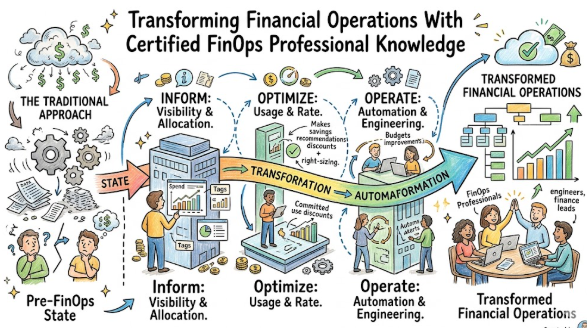
The core mechanics of the FinOps lifecycle—Inform, Optimize, and Operate—are thoroughly evaluated through this credential. Individuals are trained to analyze complex cloud bills, detect anomalies, allocate shared costs, and implement automated budgeting policies.
Why it matters today?
Uncontrolled cloud spend directly impacts the profitability and competitive edge of modern businesses. Many organizations find that their cloud bills are significantly higher than originally budgeted. This issue typically occurs because engineering teams build for speed and scalability without clear visibility into the financial consequences of their architectural choices.
Traditional financial budgeting processes are too slow for the dynamic nature of cloud environments. Decisions must be made in real time based on hourly or daily utilization data. By introducing financial accountability directly into the engineering workflow, waste is eliminated, and cloud investments are perfectly aligned with business growth.
Why Certified FinOps Professional certifications are important
Validating your expertise through an official certification is highly beneficial for several reasons:
- Standardized Knowledge: A unified vocabulary and structured framework are provided to align engineering and finance teams.
- Career Advancement: Certified individuals are positioned for leadership roles like Cloud Financial Analysts, FinOps Architects, and Infrastructure Directors.
- Measurable Business Impact: Certified professionals possess the skills to immediately identify waste, negotiate better cloud contracts, and improve organizational margins.
- Global Recognition: The credential proves to international employers that your skills match verified cloud financial management standards.
Why choose Finopsschool?
Finopsschool stands out as a premier dedicated training and certification platform focused exclusively on cloud financial management. The curriculum is built entirely around practical, real-world scenarios that professionals encounter daily in production environments.
Rather than teaching purely theoretical concepts, comprehensive deep-dives into multi-cloud billing datasets, complex cost allocation matrices, and actual organizational governance structures are provided. The learning paths are designed by seasoned industry experts to ensure that architectural decisions are always backed by solid financial intelligence.
Certification Deep-Dive
What is this certification?
The Certified FinOps Professional credential validates an individual’s ability to architect, implement, and govern comprehensive cloud financial management practices within large-scale organizations. It certifies deep expertise in building collaborative frameworks between engineering, finance, and executive leadership teams.
Who should take this certification?
This certification is highly recommended for Cloud Engineers, DevOps Professionals, Site Reliability Engineers, Engineering Managers, Enterprise Architects, and Cloud Procurement Specialists who are directly responsible for managing or optimizing cloud infrastructure budgets.
Certification Overview Table
| Track | Level | Who it’s for | Prerequisites | Skills Covered | Recommended Order |
| FinOps Foundation | Associate | Beginners, Finance Analysts, Fresh Engineers | Basic Cloud Awareness | Core FinOps Principles, Lifecycle Phases, Basic Terminology | First |
| Certified FinOps Professional | Professional | Cloud Engineers, DevOps Lead, Finance Managers | Cloud Experience, FinOps Basics | Advanced Cost Allocation, Anomaly Detection, Unit Economics | Second |
| FinOps Architecture & Engineering | Advanced | Solutions Architects, Principal SREs | Professional Level Cert | Automated Optimization, Rightsizing at Scale, Serverless Costing | Third |
| FinOps Leadership & Governance | Executive | Engineering Directors, CFOs, Product Owners | Professional Level Cert | Cultural Transformation, KPI Setting, Policy Implementation | Fourth |
Skills you will gain
- Advanced Cost Allocation: The ability to map complex container and shared resource costs accurately back to specific business units.
- Anomaly Detection & Mitigation: Implementation of real-time monitoring strategies to catch and resolve sudden cloud cost spikes immediately.
- Unit Economics Modeling: Calculating the precise cloud cost per business metric, such as cost per customer transaction or cost per active user.
- Commitment Discount Management: Architecting strategy for Reserved Instances (RIs) and Savings Plans across multi-cloud environments.
- Automated Governance: Creating automated guardrails and policies to prevent unnecessary resource provisioning without slowing down development.
Real-world projects you should be able to do after this certification
- Multi-Tenant Cost Attribution: Building a tagging and allocation model to distribute shared Kubernetes cluster costs across distinct engineering teams.
- Automated Rightsizing Pipeline: Developing an automated script or workflow that detects idle or underutilized resources and safely downsizes them during off-peak hours.
- FinOps Dashboard Creation: Designing comprehensive real-time financial dashboards tailored for executive leadership to track monthly cloud efficiency and waste reduction metrics.
Preparation plan
7–14 days plan
Focus entirely on core definitions, the three pillars of the FinOps lifecycle, and foundational cloud billing structures. Review official documentation daily and complete fundamental practice questions.
30 days plan
Dedicate two hours daily to practical exercises. Analyze simulated billing reports, build mock cost-allocation matrices, and study detailed case studies regarding corporate cloud waste elimination.
60 days plan
Conduct deep-dives into advanced governance frameworks and commitment discount strategies. Take full-length practice exams weekly to improve pacing, clarify confusing concepts, and build maximum testing confidence.
Common mistakes to avoid
- Ignoring Engineering Culture: Focusing entirely on cutting costs rather than teaching engineers how to build cost-efficient architectures naturally.
- Over-committing Early: Purchasing long-term savings plans or reserved instances before establishing a stable baseline of cloud usage.
- Poor Tagging Enforcement: Attempting to build allocation models without first standardizing and enforcing automated tagging policies across all environments.
Best next certification after this
- Same track: FinOps Architecture & Engineering
- Cross-track: Certified DataOps Professional
- Leadership / management: FinOps Leadership & Governance
Choose Your Learning Path
DevOps Path
This path is tailored for engineers who automate infrastructure pipelines. It focuses on embedding cloud cost considerations directly into continuous integration and continuous deployment loops. Cost metrics are treated with the exact same importance as performance and security metrics during the deployment process.
DevSecOps Path
Designed for security and compliance professionals. This path merges financial governance with risk management frameworks. It ensures that automated cloud cost guardrails strictly comply with corporate security standards, preventing financial waste while maintaining an airtight perimeter.
Site Reliability Engineering (SRE) Path
Built specifically for professionals managing system availability and performance. The core focus rests on balancing system reliability with optimal cloud spending. This path helps engineers define Service Level Objectives (SLOs) that take infrastructure cost efficiency into consideration.
AIOps / MLOps Path
Tailored for data scientists and machine learning engineers dealing with high-compute AI workloads. This track provides specific strategies to manage massive GPU clusters, optimize training pipeline data paths, and control the heavy financial storage footprints associated with model training.
DataOps Path
Focused on data engineers and database administrators handling large enterprise data warehouses. It details optimization techniques for big data pipelines, analytical queries, and tiered cloud storage configurations to ensure large-scale data processing remains highly cost-effective.
FinOps Path
The direct, specialized track for dedicated cloud financial management practitioners. It covers the entire lifecycle of cloud financial governance from deep analytical billing reviews to establishing global cloud optimization strategies across multiple cross-functional departments.
Role → Recommended Certifications Mapping
| Role | Recommended Certification | Alignment Focus |
| DevOps Engineer | Certified FinOps Professional | Pipeline Cost Integration & Resource Automation |
| Site Reliability Engineer (SRE) | FinOps Architecture & Engineering | Infrastructure Efficiency, Performance, & Reliability Balancing |
| Platform Engineer | Certified FinOps Professional | Shared Service Allocation & Cluster Optimization |
| Cloud Engineer | FinOps Foundation | Resource Provisioning Guardrails & Tagging Hygiene |
| Security Engineer | FinOps Leadership & Governance | Compliance, Financial Risk Control, & Secure Automation |
| Data Engineer | Certified DataOps Professional | Big Data Pipeline Cost Control & Storage Tiering |
| FinOps Practitioner | Certified FinOps Professional | Global Cost Visibility, Reporting, & Lifecycle Management |
| Engineering Manager | FinOps Leadership & Governance | Strategic Budgeting, KPI Tracking, & Team Alignment |
Next Certifications to Take
One same-track certification
The FinOps Architecture & Engineering credential can be pursued to deepen practical execution skills, focusing heavily on building highly scalable, automated cloud optimization systems across multi-cloud enterprise footprints.
One cross-track certification
The Certified DataOps Professional program can be selected to gain comprehensive knowledge regarding data pipeline efficiency, which ensures big data infrastructure spend is managed with extreme precision.
One leadership-focused certification
The FinOps Leadership & Governance certification can be taken to master the organizational change methodologies, cultural alignments, and high-level KPI tracking strategies required to manage global corporate cloud budgets.
Training & Certification Support Institutions
DevOpsSchool
Comprehensive training programs and structured learning support are delivered by this platform to help professionals master modern infrastructure methodologies. Deep practical labs and expert mentorship are consistently provided to prepare candidates thoroughly for top industry credentials.
Cotocus
Specialized technical bootcamps and customized enterprise training paths are successfully offered through this platform. Hands-on learning experiences are emphasized to ensure that engineering teams can rapidly deploy advanced optimization strategies across live production environments.
ScmGalaxy
A rich repository of community resources, technical tutorials, and educational blogs is maintained by this institution. Strong foundational support across multiple cloud disciplines is offered to guide engineers through continuous learning paths.
BestDevOps
Tailored career development paths and industry-aligned training materials are continuously produced by this training portal. Focus is placed on bridging knowledge gaps to help engineers successfully transition into highly sought-after cloud infrastructure and optimization roles.
devsecopsschool.com
Dedicated educational courses focused completely on merging security practices with automated development workflows are provided here. Practical security engineering principles are taught alongside modern infrastructure management techniques.
sreschool.com
Comprehensive learning materials focused directly on system reliability, uptime management, and cloud infrastructure stability are offered by this site. Engineers are trained to build resilient, highly scalable enterprise architectures.
aiopsschool.com
Advanced training programs specializing in automated operations and artificial intelligence infrastructure management are provided through this educational platform. Workflows for modern, data-driven system scaling are emphasized.
dataopsschool.com
Structured learning paths covering data pipeline orchestration, big data architecture governance, and data lifecycle management are delivered here. Data teams are equipped to build robust data solutions efficiently.
finopsschool.com
The premier educational institution focused entirely on cloud financial management, cloud architecture economics, and FinOps cultural frameworks. Deep practical knowledge is provided to help organizations maximize the business value of every cloud dollar spent.
FAQs Section
What is the difficulty level of the Certified FinOps Professional exam?
The exam is considered moderately difficult as it requires a balanced understanding of both technical cloud infrastructure concepts and financial budgeting models.
How much time is required to prepare for this certification?
A period of thirty to sixty days is typically required for thorough preparation, depending on your prior experience with cloud billing systems.
Are there any absolute prerequisites for taking the exam?
No strict prerequisites are mandatory, but holding a foundational cloud certification or having direct experience with cloud infrastructure is highly recommended.
What is the recommended certification sequence to follow?
The FinOps Foundation course should be completed first, followed by the Certified FinOps Professional exam, and concluding with advanced architecture or leadership paths.
What is the long-term career value of this credential?
High career value is provided as organizations are actively seeking certified leaders to manage escalating cloud expenses and build efficient infrastructure practices.
Which job roles are unlocked after achieving this certification?
Roles such as FinOps Analyst, Cloud Optimization Engineer, FinOps Architect, Platform Manager, and Cloud Financial Director are opened to certified professionals.
Does this program cover multi-cloud environments?
Yes, the core principles taught throughout the framework are entirely platform-agnostic and apply cleanly to Amazon Web Services, Microsoft Azure, and Google Cloud Platform.
How does this certification benefit an engineering manager?
Strategic insight is gained to help balance product delivery velocity with strict corporate budget constraints, allowing for better high-level planning.
Is the exam conducted online or in person?
The certification exam is conveniently administered online through a secure, proctored testing platform accessible from global locations.
How long does the certification remain valid?
The certification is officially maintained for a period of three years, after which a recertification process is required to update credentials.
Are practice questions provided during the course?
Yes, comprehensive practice exams and real-world mock scenarios are included within the training tracks to build testing confidence.
Can financial professionals with minimal coding experience take this course?
Yes, the material is structured to teach non-technical professionals how to interpret cloud architectures and cooperate effectively with engineering teams.
Certified FinOps Professional FAQs
- What specific topics are evaluated in the Certified FinOps Professional exam?
Deep testing is conducted across cloud cost allocation methodologies, anomaly detection, forecasting accuracy, unit economics, and commitment discount optimization strategies.
- How does the Certified FinOps Professional program differ from the baseline Foundation course?
The Foundation course covers basic terminology and concepts, whereas the Professional level focuses heavily on practical execution, advanced strategy, and governance implementation.
- Can a DevOps engineer pass this exam without a strong background in corporate finance?
Yes, the required financial management concepts, corporate budgeting structures, and cloud economic models are thoroughly taught within the preparation program.
- What types of questions are encountered on the official exam?
The examination consists primarily of complex situational scenarios, case-study analysis questions, and multiple-choice options requiring strategic decision-making skills.
- How is cost allocation taught within this certification?
Advanced tagging methodologies, container cost-distribution strategies, and models for split-cost allocation across shared cloud resources are covered extensively.
- Does the curriculum address automated cloud cost governance?
Yes, the creation of automated infrastructure guardrails, policy enforcement scripts, and real-time budgeting alerts are major focuses of the training.
- How does this credential assist in vendor contract negotiations?
Detailed knowledge regarding enterprise discount programs, volume usage metrics, and savings plan structures is gained to help negotiate favorable cloud contracts.
- What strategy is recommended for mastering the practical scenarios?
Deep participation in real-world billing dataset analysis labs and building simulated optimization dashboards during the study period is highly recommended.
Testimonials
A profound impact was made on my daily deployment workflows. The cloud cost allocation methods learned through the course allowed our team to eliminate thousands of dollars in monthly staging environment waste.
— Rajesh
Complete career clarity was achieved after completing this program. The delicate balance between infrastructure reliability and cloud spend is now managed with total precision across our production systems.
— Aarav
Maximum confidence was gained to present cloud optimization strategies directly to executive leadership. The unit economics models taught in the curriculum are utilized daily to track product profitability.
— Priya
The architectural decisions made across our multi-cloud environment are now fully informed by solid financial metrics. Financial risk is managed seamlessly without causing any drops in deployment speed.
— Vikram
Strategic budgeting has been transformed completely across our department. Engineers and financial analysts now cooperate using a standardized vocabulary, which has vastly improved our operational velocity.
— Ananya
Conclusion
The Certified FinOps Professional certification serves as an invaluable asset for navigating the complexities of modern cloud economics. By bridging the gap between engineering execution and corporate financial strategy, certified individuals are uniquely equipped to eliminate operational waste and maximize infrastructure efficiency.
Long-term career benefits are unlocked through this credential, positioning professionals as critical strategic assets within global enterprises. Commencing a clear learning path and prioritizing purposeful certification planning will ensure sustained professional growth and leadership positioning within the cloud sector.
